The evidence grade for red and near-infrared light in traumatic brain injury (TBI) is Limited: the human data in this index's sources are a single 11-person open-protocol LED study with no placebo group (PMID 24568233), backed by a narrative review (PMID 29327206) and a paper on how much light reaches the brain (PMID 26346298). That is enough to justify better trials, and not enough to say a home panel does anything for a head injury.
Choosing a panel? Our ranking of the best red light therapy panels is computed from published, method-labeled specs across 188 devices. For brain questions, the spec that matters is verified irradiance, because the penetration research shows only a small share of surface light reaches 3 cm of tissue.
Why the grade is Limited
This site grades evidence as Strong, Moderate, Limited or Insufficient, and the evidence grades explained page describes what each level asks for. TBI lands at Limited and not Insufficient because there is a human study with a defined protocol, a stated dose and measured outcomes. It does not reach Moderate because that study had 11 participants, no placebo arm and no replication in these sources. The brain and mood evidence page grades the related mood question as Insufficient, and the two should not be blended.
What the studies found
The open-protocol LED study (2014)
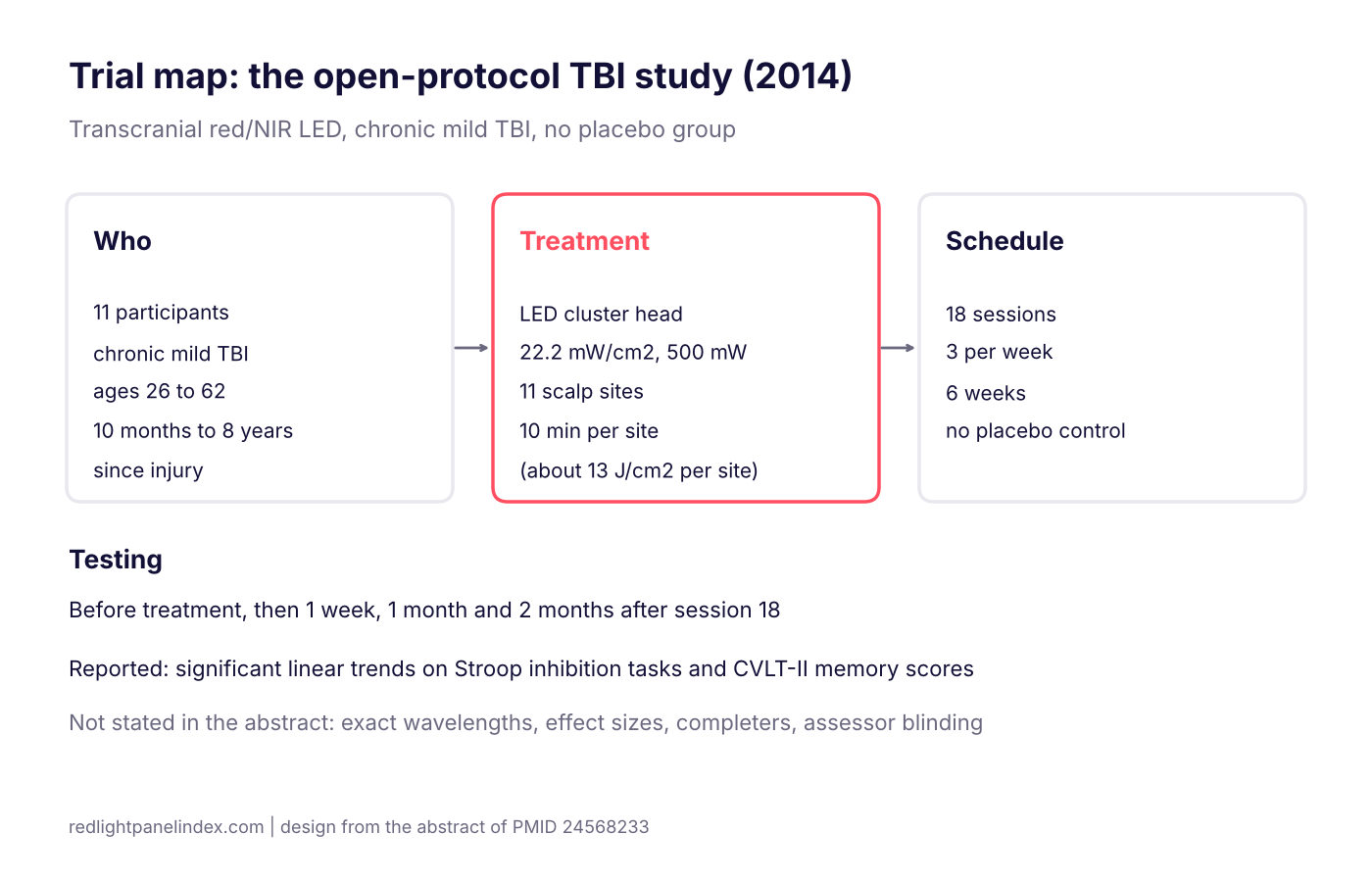
Naeser and colleagues, in the Journal of Neurotrauma, ran a pilot, open-protocol study in 11 people with chronic, nonpenetrating mild TBI and persistent cognitive problems (PMID 24568233). Ages ranged from 26 to 62, and six participants were male. Time since injury ranged from 10 months to 8 years. Causes were motor vehicle accidents or sports injuries, plus one blast injury, and four participants had a history of multiple concussions.
The device was a scalp-applied red and near-infrared LED cluster head, 5.35 cm in diameter, with 500 mW output and an irradiance of 22.2 mW/cm2. Each of 11 scalp sites was treated for 10 minutes, which the abstract gives as about 13 J/cm2 per site. Sites ran along the midline from the front to the back hairline, plus both sides over the frontal, parietal and temporal areas. Participants had 18 sessions, three per week, over six weeks. The abstract says "red and near-infrared" and does not give wavelengths in nanometers.
Participants were tested before treatment and again 1 week, 1 month and 2 months after the 18th session. The abstract reports significant linear trends over time on four measures: Stroop Trial 3 (p = 0.004), Stroop Trial 4 (p = 0.003), CVLT-II Total Trials 1-5 (p = 0.003) and CVLT-II Long Delay Free Recall (p = 0.006). Participants also reported better sleep and, where present, fewer PTSD symptoms, and participants and families described better social and occupational functioning. The abstract does not quantify those self-reports.
The authors say the data suggest placebo-controlled studies are warranted. That wording matters. With no control group, a trend over time can reflect practice effects on repeat testing, natural recovery, the attention that comes with an 18-session program, or the light. The abstract cannot separate them, and it gives no effect sizes, completer counts or statement about blinded assessors. A section-by-section look at this one study is in the study review of the 2014 transcranial LED trial.
The narrative review (2018)
Salehpour and colleagues reviewed preclinical and clinical brain photobiomodulation in Molecular Neurobiology (PMID 29327206). It is a narrative review, not a systematic one, and its abstract reports no numbers: no sample sizes, no count of studies, no doses. It describes red to near-infrared light acting on cytochrome c oxidase and raising ATP production, and lists reported effects on neuronal metabolism, inflammation, neurogenesis and synaptogenesis across conditions that include brain trauma, dementia, Parkinson's disease, stroke and depression. It also states a practical problem: transcranial light is attenuated exponentially in tissue, so delivering an adequate dose is hard, and it names intracranial and intranasal delivery as alternatives. A narrative review is useful for orientation and weak as proof of benefit. For the mechanism in plain terms, see the photobiomodulation explainer.
Can light reach the brain? (2015)
Henderson and Morries, in Neuropsychiatric Disease and Treatment, reviewed TBI pathophysiology and tested how much near-infrared light passes through tissue (PMID 26346298). Their abstract reports that low-level NIR did not penetrate 2 mm of skin or 3 cm of skull and brain. At 10 to 15 W, 0.45% to 2.90% of 810 nm light penetrated 3 cm of tissue, and a 15 W, 810 nm device in continuous mode delivered 2.9% of its surface power density. Pulsing at 10 Hz cut the surface light dose by 50%, yet 2.4% of the surface energy still reached 3 cm. About 1.22% of the energy from 980 nm light at 10 to 15 W reached 3 cm. The authors conclude that 10 to 15 W at 810 and 980 nm may deliver fluence in the range shown to be biologically beneficial at that depth.
Two cautions apply. The abstract does not say what tissue was used or whether the measurements were ex vivo or in vivo, and it does not define the fluence range it calls beneficial. And the power levels in the conclusion, 10 to 15 W, are far above the 500 mW head used in the 2014 study. The penetration depth page and the optical window page cover why the answer depends so heavily on wavelength and power.
What was not studied
- Placebo-controlled human trials in these sources. The only human study here had no control group.
- Acute and recent TBI. The 2014 participants were 10 months to 8 years past injury. Nothing here addresses treatment soon after a head injury.
- Moderate or severe TBI. The study population had chronic mild TBI.
- Home panels aimed at the head. The studied device was a scalp-applied cluster head used site by site, not a panel at a distance.
- Long-term outcomes. Follow-up ended two months after the last session.
- Harms. The abstracts do not report an adverse event analysis.
For the separate, better-documented question of near-infrared light and mood, see the transcranial depression page, and for a laser study in healthy adults see the 1064 nm transcranial cognition review. Neither tests head injury.
What this means in practice
If you have a head injury, symptoms such as persistent headache, confusion, memory problems or changes in mood need a clinician, and light is not a replacement for that care. Memory loss and dementia are a separate question, covered on the dementia and cognition evidence page. Headache on its own is covered on the migraine evidence page, which grades the one small laser trial Insufficient. The studies here do not support using a panel on the head as a recovery tool.
If you and your clinician still want to understand what a given device would deliver, work from numbers. The 2014 protocol is a useful reference point: roughly 22.2 mW/cm2 for 10 minutes per site, about 13 J/cm2. Use the dose calculator with a verified irradiance figure at your working distance to see how a panel compares, and the irradiance guide to check how that figure was measured. The wavelength guide explains why the red and near-infrared bands differ in reach. A panel's output spread over a large area is not the same as 22.2 mW/cm2 concentrated on one scalp site, so matching the trial's dose is not a given.
Cautions
- Seek medical evaluation for any head injury and for new or worsening symptoms. Light therapy is not a substitute.
- Protect your eyes. Facing a bright panel with the eyes open is a different exposure from a treatment head applied to the scalp, and the eye protection guide covers the basics.
- Review photosensitizing medications and the general safety and side effects evidence before starting.
- Be wary of any claim that a panel treats, heals or reverses brain injury. The sources reviewed here describe an open-protocol pilot and a penetration study, and they do not show that.
This page summarizes published abstracts and is general information, not medical advice.