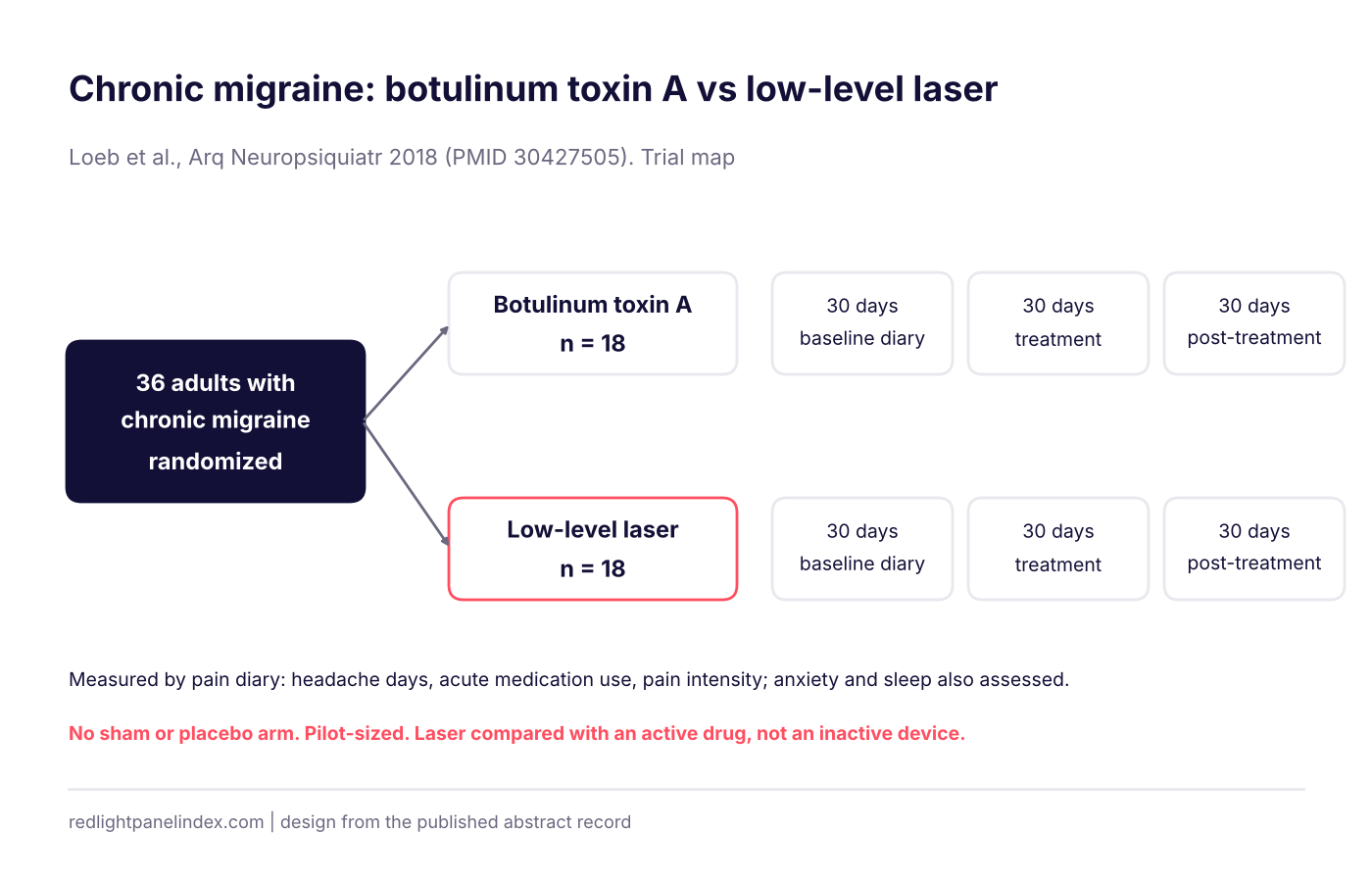
The evidence grade for red light therapy and migraine is Insufficient: the only study in our sources is one small randomized comparison of a low-level laser against botulinum toxin A, with no placebo or sham arm, and no study tested a home LED panel. An Insufficient grade is not a claim that an effect is impossible. It means no controlled trial tests the question at a dose a consumer device can deliver.
Choosing a panel? Our ranking of the best red light therapy panels is computed from published, method-labeled specs across 188 devices. For migraine, the spec to check is whether the brand cites any trial for headache at all, because the research here used a laser, not a panel.
Why the grade is Insufficient
This site grades evidence as Strong, Moderate, Limited or Insufficient, and the evidence grades explained page describes what each level asks for. Insufficient means no credible controlled human trial tests the claim at doses a consumer device can deliver. Migraine fits that definition for three reasons:
- The one study found compared a laser with an active drug treatment, so it cannot separate a light effect from the passage of time or from expectation.
- It was small, with 18 people in each group.
- The device was a low-level laser, which is a different instrument from the LED panels sold for home use. The LED vs laser page explains how the two differ.
The one study: botulinum toxin A versus low-level laser
What it asked
Loeb and colleagues (PMID 30427505), publishing in Arquivos de Neuro-Psiquiatria in 2018, asked whether low-level laser therapy could be used for chronic migraine in place of botulinum toxin A, a treatment already used for this condition. It compared the two directly.
Who was studied
The study randomized 36 adults with chronic migraine into two groups of 18: one received botulinum toxin A and the other received low-level laser therapy. The record indexes it as a pilot project.
Device and parameters
We could not read the full methods text, because the journal pages were not available to us. The wavelength, power, dose per point, treatment sites and number of sessions are therefore not stated here, and we are not giving figures we have not read. If you want those numbers, read the paper itself before drawing any conclusion about a dose.
What was measured and found
Patients kept pain diaries for three 30-day periods: a baseline period, a treatment period and a post-treatment period. Both treatments were reported to reduce headache days, acute medication use and pain intensity. Anxiety improved more in the botulinum toxin A group, and sleep disturbance improved more in the laser group. The authors concluded that both treatments can be used for chronic migraine, with no notable difference between them.
Limitations
- No sham arm. Without an inactive laser group, the improvements in the laser group cannot be separated from natural variation in migraine, from expectation or from the attention of a treatment visit. Our page on sham-controlled trials explains why that matters for light studies.
- Small groups. Thirty-six people in total is a pilot, not a basis for a dose recommendation.
- A short window. Three 30-day diary periods say little about how long any change lasts.
- Not a panel. The study tested a laser, so it does not tell you what a wall-mounted LED panel would do.
What was not studied
- A sham-controlled trial of red or near-infrared light for migraine.
- Any trial of a home LED panel for headache or migraine.
- Episodic migraine, as opposed to the chronic form studied here.
- Whether light changes how often attacks begin, or only how people rate them afterward.
- Long-term follow-up and safety over months of repeated sessions.
- What a safe, effective wavelength and dose would be, if any.
How this fits the wider brain evidence
Light delivered through the head is an active research area, and our other pages on it carry grades of their own. The brain and mood evidence page is graded Insufficient and explains why a wall panel is not designed or dosed as a transcranial device. The transcranial depression page and the traumatic brain injury page cover the studies that used head-mounted devices. None of those pages mentions migraine, and none supports a headache claim.
What this means for a home panel
Nothing in the migraine literature we found gives a dose, distance or session length for a panel. Using the dose calculator will turn an irradiance figure into a dose at a chosen distance, but it cannot tell you what dose, if any, is relevant to migraine, because no trial supplies one. The wavelengths that reach deeper tissue are covered on the 810 nm and 850 nm pages, and the penetration depth page shows why only a small share of surface light reaches tissue beneath the scalp and skull. A panel pointed at a forehead is a different exposure from the laser in the trial.
If you are curious about light for headaches, the honest summary is that it is an open question, not a tested home protocol. Be wary of any product page that presents a migraine claim without naming a trial, a wavelength and a dose.
How to read a migraine claim on a product page
Three questions sort most claims quickly. First, does the page name a trial, with an author and year, that studied migraine or headache specifically, and not a different condition? Second, does that trial have an inactive comparison group, or only another treatment? Third, did the trial use a device like the one for sale, with a stated wavelength, dose and distance? A claim that fails the first question has no evidence behind it, and one that fails the second or third is borrowing credibility from a study that does not apply. The one trial we found would fail the second and third.
Cautions
- Migraine is a medical condition. Chronic migraine is diagnosed and managed by a clinician. Red light is not a replacement for medical care, and it is not a reason to stop or change a prescribed treatment.
- New or changing headaches need a clinician. A sudden severe headache, a headache after a head injury, or one with weakness, confusion or vision loss needs urgent medical attention, not a light session.
- Protect your eyes. Bright light near the face can be uncomfortable, and light sensitivity is common during a migraine. See the eye health page and the safety and side effects page before pointing any panel near your head.
- Photosensitizing medicines. Some medications make skin more sensitive to light. Our photosensitizing medications guide lists what to check with a pharmacist.
- Claims to avoid. No page on this site says a panel treats migraine, and nothing here should be read that way.
What would change the grade
A move to Limited would need at least a single controlled trial that includes a sham arm and states its wavelength, dose and schedule. A move to Moderate would need several such trials, of reasonable size, pointing the same way. Until then, the migraine question belongs in a clinician's office, with light as at most a topic to raise there.