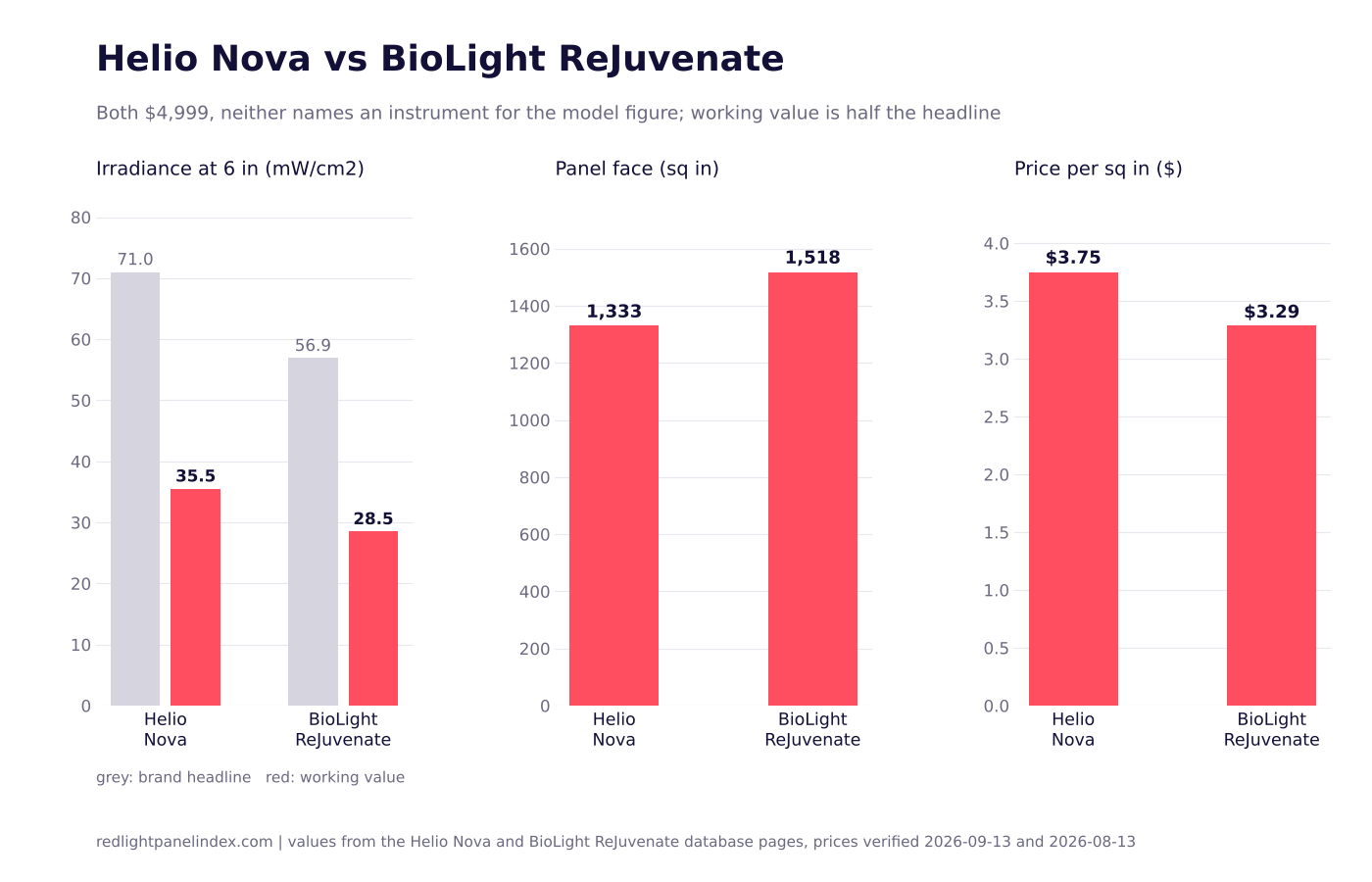
The Helio Cure Helio Nova and the BioLight ReJuvenate both list at $4,999 (verified 2026-09-13 and 2026-08-13), and neither names the instrument behind its irradiance figure, so the headline numbers are closer than they look. The Nova spreads six bands, including a 1064nm share, across a narrower face and ships with an electric stand; the ReJuvenate is a two-band 660nm and 850nm panel with a larger face, more control over output and a stand that costs extra.
Choosing a panel? Our ranking of the best red light therapy panels is computed from published, method-labeled specs across 188 devices. For two full-body panels at the same price, the spec that matters is a method-labeled irradiance figure, and neither of these panels publishes one for the model itself.
The two panels, side by side
Every figure below comes from the two live database pages, last reviewed November 2026. Prices change, so confirm on the brand site before buying.
| Spec | Helio Cure Helio Nova | BioLight ReJuvenate |
|---|---|---|
| Price | $4,999 (verified 2026-09-13) | $4,999 (verified 2026-08-13) |
| Brand irradiance at 6 in | 71 mW/cm2, method not stated | 56.9 mW/cm2, method not stated |
| Measurement note | LightLab spectrometer cited, but only the Glow was physically tested; other models extrapolated | Brand publishes third-party test documents; instrument not named |
| Wavelengths | 630, 660, 810, 830, 850, 1064nm | 660, 850nm |
| Allocation | 19.4, 19.4, 19.4, 13.9, 8.3, 19.4 percent | Not published |
| LEDs | 864, 3535 single-chip | 1,008, type not published |
| Beam angle | 19 degrees | 30 degrees |
| Panel size | 65 x 20.5 x 2.4 in | 66 x 23 x 3 in |
| Face area | About 1,333 sq in | About 1,518 sq in |
| Controls | Five presets, full-spectrum and custom modes, touchscreen | Red, near-infrared or combined; brightness 1 to 100 percent; pulsing 0 to 10,000 Hz; programmable timer |
| EMF | Not reported | 0.3 mG, published |
| Stand | Electric rotating, height-adjustable stand included | Mobile stand is a paid option (+$600) |
| Warranty | 3 years | 3 years |
| Trial | 60 days, no restocking fee stated | 60 days, restocking fee not published |
| FDA status | Registered (assumed) | Not cleared; brand says panels do not require clearance |
Irradiance: two unlabeled numbers
At face value the Nova's 71 mW/cm2 is about 25 percent higher than the ReJuvenate's 56.9. Neither figure carries a named instrument for the model itself, so neither can be compared directly with a spectrometer reading or with each other.
Helio Nova. The Helio Cure brand page records that the brand cites a LightLab spectrometer test, but only the Helio Glow was physically measured. The same 71 mW/cm2 is listed for all four Helio Cure models, from the $499 Spark to the Nova, so for the Nova it is an extrapolation, not a reading of this panel. The narrow-beam panel ranking lists the Glow's LightLab report at 71.7 mW/cm2 average at 6 inches and leaves the Nova unranked for that reason. The model table labels it "method not stated" for that reason.
BioLight ReJuvenate. The BioLight brand page notes that the brand publishes third-party test documents and that its figures of 56 to 63 mW/cm2 at 6 inches sit on the low side of the database. The instrument is not named, so the ReJuvenate's 56.9 is also labeled "method not stated." A modest number is not proof of a conservative method, but it does rule out the inflated headlines common elsewhere.
On a common footing. Both model pages give the same rule for an unlabeled figure: treat roughly half of it as the working value. That puts the Nova at about 35 mW/cm2 and the ReJuvenate at about 28 mW/cm2 at 6 inches. These are planning assumptions, not measurements. The site's claimed versus measured analysis found headline figures averaging 2.11 times the spectrometer reading across 44 panels, with a range of 1.36 to 2.60, so the true figure for either panel could sit above or below the halved value. Neither panel appears in that analysis. The irradiance page explains why the instrument and distance change the number.
Session length at 6 inches
Dose in J/cm2 is irradiance in W/cm2 multiplied by seconds. Taking 20 J/cm2 as an example inside the 10 to 60 J/cm2 range the model pages point to, the dose calculator gives:
- Helio Nova at a 35.5 mW/cm2 working value: about 563 seconds, or a little over 9 minutes.
- BioLight ReJuvenate at a 28.5 mW/cm2 working value: about 703 seconds, or a little under 12 minutes.
Both are full-body panels, so a session covers a large area at once, but either one asks for longer sessions than a panel with a higher spectrometer figure would. If you own one, a home irradiance check at 6 inches will tell you more than either headline.
Wavelengths: six bands against two
The ReJuvenate uses the classic pairing that the 660nm vs 850nm page describes as red for the skin and near-infrared for deeper tissue. BioLight does not publish how its 1,008 LEDs divide between the two, so the balance is unknown.
The Nova publishes its allocation: about 39 percent red (630 and 660nm), about 42 percent near-infrared (810, 830 and 850nm) and 19.4 percent at 1064nm. These are shares of LEDs, not measured shares of power. Only 8.3 percent sit at 850nm, the band most two-band panels lean on.
What do the extra bands add? The 630nm vs 660nm page treats the two reds as close neighbors, and the 810nm vs 850nm page finds the practical difference between those two small. The 1064nm page notes that the research on that deep band used lasers, not LED panels, so the Nova's 1064nm share is unusual but not a tested home dose. The deep-tissue 1064nm panel ranking compares the panels that carry it.
One caution sits on the Helio Cure brand page: an independent test found the brand's labeled wavelengths peaking about 10 to 20nm high. The wavelength tolerance page explains why a label and a measured peak can differ, and how much it matters.
Area, LEDs and beam angle
The ReJuvenate is the larger panel: 66 by 23 inches, about 1,518 square inches of face, against the Nova's 65 by 20.5 inches, about 1,333. That is about 14 percent more face for the same list price, or about $3.29 per square inch against $3.75. Add the ReJuvenate's $600 stand and it rises to about $3.69, close to the Nova with its stand included. The largest panels ranking and the treatment area guide explain what face area does and does not tell you.
LED density is almost identical, about 0.65 LEDs per square inch on both. The Nova's LEDs are 3535 single-chip, which the LED chip page explains puts each diode's full power into one wavelength; BioLight does not publish a chip type.
The Nova states a 19-degree beam, the narrowest single angle any panel in the database publishes, a lens the Helio line shares; the ReJuvenate states 30 degrees. The beam angle page explains that a narrow beam keeps output concentrated in front of each LED and may hold up better as you step back, while a wider one blends more evenly at close range. Neither brand publishes a model-specific figure beyond 6 inches to show it.
Controls, stand and the regulatory label
The ReJuvenate offers the most control: red only, near-infrared only or both, brightness from 1 to 100 percent, and pulsing from 0 to 10,000 Hz. The pulsed versus continuous page found no general advantage for pulsing, which lowers average output, so continuous mode is the reference for dose arithmetic. BioLight also publishes an EMF figure of 0.3 mG; the EMF explainer puts that in context. The Nova offers five presets, a full-spectrum mode and a custom mode on a touchscreen, and its database page reports no EMF figure.
The Nova's model table lists an electric rotating, height-adjustable stand as included, though the largest panels ranking notes the brand's wording on this is inconsistent, so confirm before ordering; the ReJuvenate's mobile stand is a $600 option. The Helio Cure brand page also notes owner reports of loud fans and floor-stand-only setups.
Helio Cure's FDA registration is listed as assumed rather than verified. BioLight states plainly that its panels do not require clearance, and the database lists the ReJuvenate as not cleared. The FDA clearance page explains the difference; no rectangular red light panel is FDA cleared.
Terms
Both carry a 3-year warranty and a 60-day trial. Helio Cure describes a risk-free trial with full refund eligibility and no restocking fee stated. BioLight does not publish a restocking fee, so ask before buying. On panels this size, return freight is the real cost; get a quote first. The free trial and no restocking fee ranking compares return terms across the database.
Verdict by use case
If you want the most face for the money: the ReJuvenate, with about 14 percent more area at the same list price, as long as you already have a way to mount it or budget for the stand.
If you want a stand in the box: the Nova, whose electric stand is included.
If you want a deep 1064nm band or a broad wavelength mix: the Nova is the only one of the two that carries 630, 810, 830 and 1064nm, with a published allocation.
If you want control over output: the ReJuvenate, with separate red and near-infrared modes, adjustable brightness and a published EMF figure.
If you want a number you can dose from: neither yet. Plan from about 35 mW/cm2 for the Nova and about 28 mW/cm2 for the ReJuvenate until a model-specific spectrometer reading exists.
If return terms decide it: the Nova, whose no-restocking-fee terms are stated; BioLight's are not published.
For other panels above $2,000 on the same criteria, see the premium panel ranking.