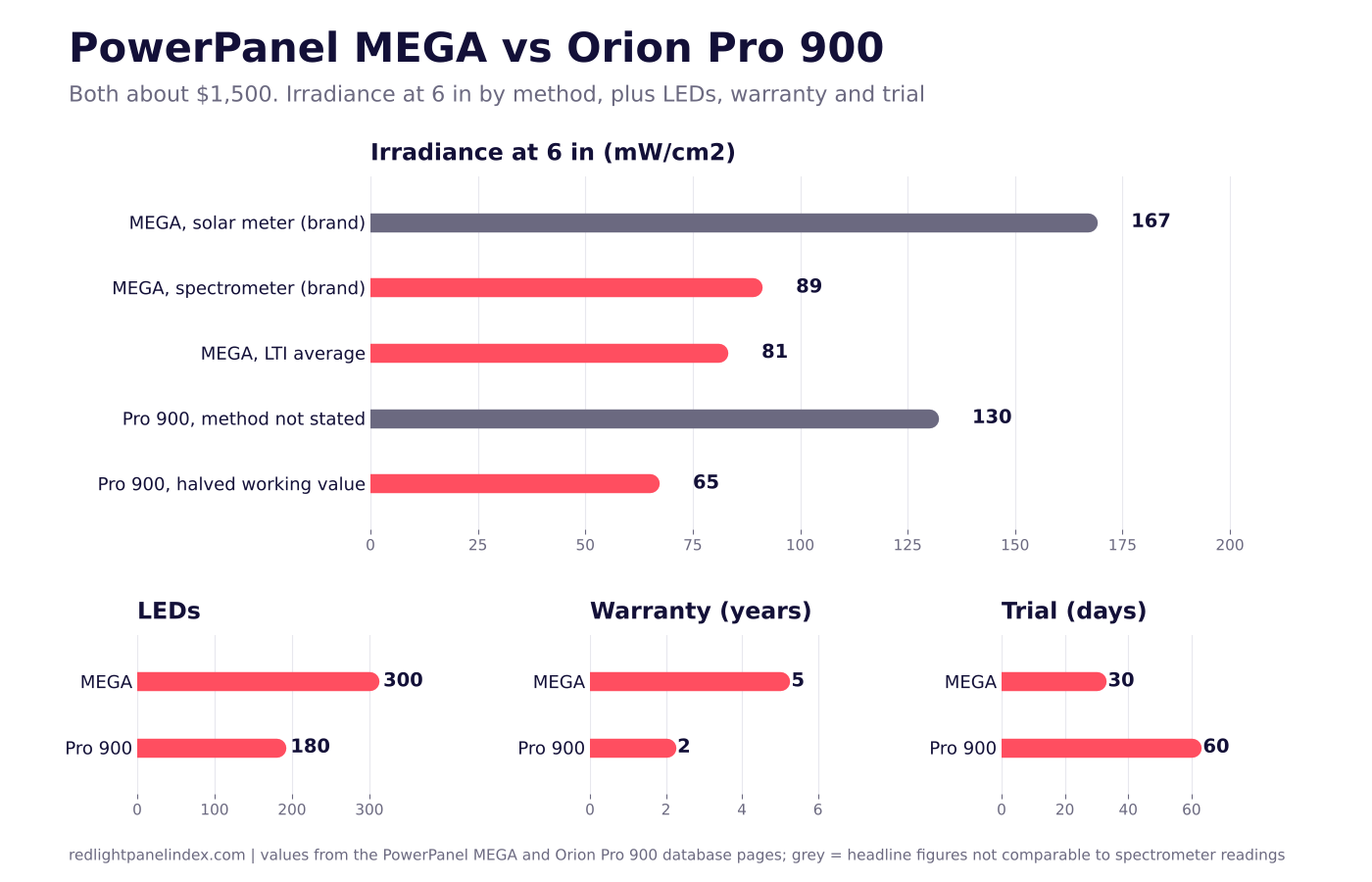
The BlockBlueLight PowerPanel MEGA at $1,500 (verified 2026-09-12) and the Orion Pro 900 at $1,499 (verified 2026-08-13) cost the same and are close to the same length, but they are not equally documented. BlockBlueLight publishes its MEGA irradiance two ways, by solar meter and by spectrometer, and a third-party test exists; Orion states a single figure without naming the instrument. On the numbers that can actually be compared, the MEGA has more checkable output, more LEDs, more bands and a longer warranty, while the Pro 900 has the narrower beam, the longer trial and a simpler two-band spectrum.
Choosing a panel? Our ranking of the best red light therapy panels is computed from published, method-labeled specs across 188 devices. For two panels at the same price, the spec that matters is whether the irradiance figure names the instrument that produced it.
The two panels, side by side
Every figure below comes from the two live database pages, last reviewed November 2026.
| Spec | BlockBlueLight PowerPanel MEGA | Orion Pro 900 |
|---|---|---|
| Price | $1,500 (verified 2026-09-12) | $1,499 (verified 2026-08-13) |
| Irradiance at 6in | 167 mW/cm2 by solar meter; 89 mW/cm2 by spectrometer (both brand-published) | 130 mW/cm2, method not stated (brand range 120 to 160) |
| Third-party test | Light Therapy Insiders (LTI Gen5): peak 105, average 81 mW/cm2 | None listed |
| Wavelengths | 630, 660, 810, 830, 850nm | 660, 850nm |
| Allocation | Brand: 660 40%, 850 40%, 630 10%, 830 5%, 810 5%; LTI measured roughly 25/25/17/17/17 | Not published |
| LEDs | 300, dual-chip, 5W | 180, type and wattage not published |
| Beam angle | 60 degrees | 30 degrees |
| Panel size | 920 x 300 x 65mm (36.2 x 11.8in) | 36.5 x 9 x 3in |
| EMF at 6in | 0.1 uT | 0.0 uT |
| Stand | Not included | Paid option (floor stand +$150) |
| Warranty | 5 years | 2 years |
| Trial | 30 days; customer pays return shipping; orders with a code over 15% off are exchange or store credit only | 60 days; customer pays returns; full refund within the trial with some exceptions |
Both brand pages, BlockBlueLight and Orion, list the full lineups if you want a smaller or larger size from either.
Irradiance: which numbers can be compared
The headline figures, 167 against 130 mW/cm2, are not a fair contest because they come from different kinds of measurement. The MEGA's 167 is a solar meter reading, and BlockBlueLight puts its own spectrometer reading of 89 mW/cm2 at the same 6 inches next to it. That pair works out to a ratio of 1.88, the lowest of the seven BlockBlueLight panels in the claimed-versus-measured analysis, where headline figures across 44 checkable panels average 2.11 times the spectrometer reading. An independent LTI test came in slightly below the brand's spectrometer figure, at an 81 mW/cm2 average and a 105 peak.
Orion's 130 mW/cm2 has no instrument attached, and the database page notes that reviewers call the brand's 120 to 160 range unverified. Because a solar meter reads roughly double what a spectrometer records on the same LED panel, the Pro 900's database page and the dose calculator both advise treating a method-unstated irradiance figure as a working value of about half: around 65 mW/cm2 for the Pro 900. That is an assumption, not a measurement. The real number could be higher or lower, and a spectrometer test of the Pro 900 would settle it.
Session length at 6 inches
Run each panel's best-documented number through the dose calculator. Dose in J/cm2 is irradiance in W/cm2 multiplied by seconds, so a 20 J/cm2 target, inside the 10 to 60 J/cm2 band where most studied protocols sit, works out as follows at 6 inches:
- MEGA at its 89 mW/cm2 spectrometer figure: about 225 seconds, or under 4 minutes.
- MEGA at the LTI 81 mW/cm2 average: about 247 seconds.
- Pro 900 at the halved working value of 65 mW/cm2: about 308 seconds, or just over 5 minutes.
The gap is a minute or so per area, not a different class of panel. It also shrinks or grows with distance, which is where beam angle comes in.
Wavelengths: what the extra bands add
The Pro 900 runs the two most common bands in the database, 660nm and 850nm. The MEGA adds 630nm, 810nm and 830nm. The site's 630nm vs 660nm page finds no different mechanism between the two red bands, since both fall in the range cytochrome c oxidase absorbs, and no trial in the register compares them at matched dose; 630nm matters mainly if you follow a protocol built around 633nm. The 810nm vs 850nm page reaches a similar verdict for the near-infrared side: the practical difference for a home user is small, and nothing in the tracked evidence shows 810nm producing a different kind of response than 850nm.
So the extra bands are a feature, not a requirement. What the MEGA does offer is a published allocation and an independent check of it. The brand allocates 40 percent each to 660nm and 850nm, while the LTI measurement put the real spread closer to 25/25/17/17/17, so the panel's output is more even than its own percentages suggest. Orion publishes no allocation for the Pro 900, so there is nothing to check either way.
LEDs, beam angle and coverage
The MEGA uses 300 dual-chip 5W LEDs. As the LED chip page explains, a dual-chip diode splits its power between two wavelengths, which gives a more even surface blend but less power per band. Orion lists 180 LEDs with no chip type or wattage, the most common gap in the database (89 of 188 panels do not publish chip architecture). By price per diode, the MEGA works out to $5.00 per LED and the Pro 900 to about $8.33, though LED count says nothing on its own about light delivered to skin.
Beam angle pulls the other way. The Pro 900's 30-degree beam concentrates its output straight ahead, which the beam angle page says gives a narrow-beam panel its biggest advantage close to the panel, and suits spot work on a joint or muscle at short range. The MEGA's 60-degree beam spreads light over a wider area and suits larger-area sessions at longer distances. The MEGA's face is also wider, 11.8 inches against 9, for roughly 427 against 329 square inches of panel, so it covers more of the torso in one position.
EMF is low on both: 0.1 uT for the MEGA and 0.0 uT for the Pro 900 at 6 inches.
Warranty, trial and the regulatory label
The terms split cleanly. BlockBlueLight gives the longer warranty, 5 years against 2, but the shorter trial, 30 days against 60, and any MEGA bought with a discount code over 15 percent off is exchange or store credit only, which matters if you buy during a major sale. Orion's 60-day trial is the more forgiving return window, with the customer paying return shipping and some exceptions to the full refund. Neither brand includes a stand for these models.
Neither panel is FDA cleared. The MEGA page lists BlockBlueLight as FDA-registered and describes that accurately; the Pro 900 page notes that Orion markets "medical-grade" and Health Canada language but has no 510(k). Registration is a listing, not a clearance, and no home red light panel is FDA approved.
Verdict by use case
If you want numbers you can verify: the PowerPanel MEGA. It publishes a spectrometer figure alongside its solar meter figure, has an independent test that lands close to it, and discloses a wavelength allocation that has also been checked. At the same price, the Pro 900 gives you a single unlabeled figure.
If you want the longest protection after purchase: the MEGA's 5-year warranty is two and a half times the Pro 900's 2 years.
If you want a longer window to try the panel at home: the Pro 900's 60-day trial is twice the MEGA's 30 days, without the discount-code condition.
If you mainly treat one area at close range: the Pro 900's 30-degree beam concentrates output in front of the panel, and its narrower face is easier to aim at a knee or shoulder. Just budget sessions from a halved working figure until a spectrometer reading exists.
If you want a two-band panel and nothing extra: the Pro 900's 660nm and 850nm cover the bands most trials used; the MEGA's three additional bands are optional extras rather than a proven advantage.
For the MEGA against another panel that publishes an independent lab figure, see Total Spectrum MAX vs PowerPanel MEGA. For the largest BlockBlueLight against a same-price two-band panel, see the ULTIMATE XXL vs Kala Quad Panel head-to-head.