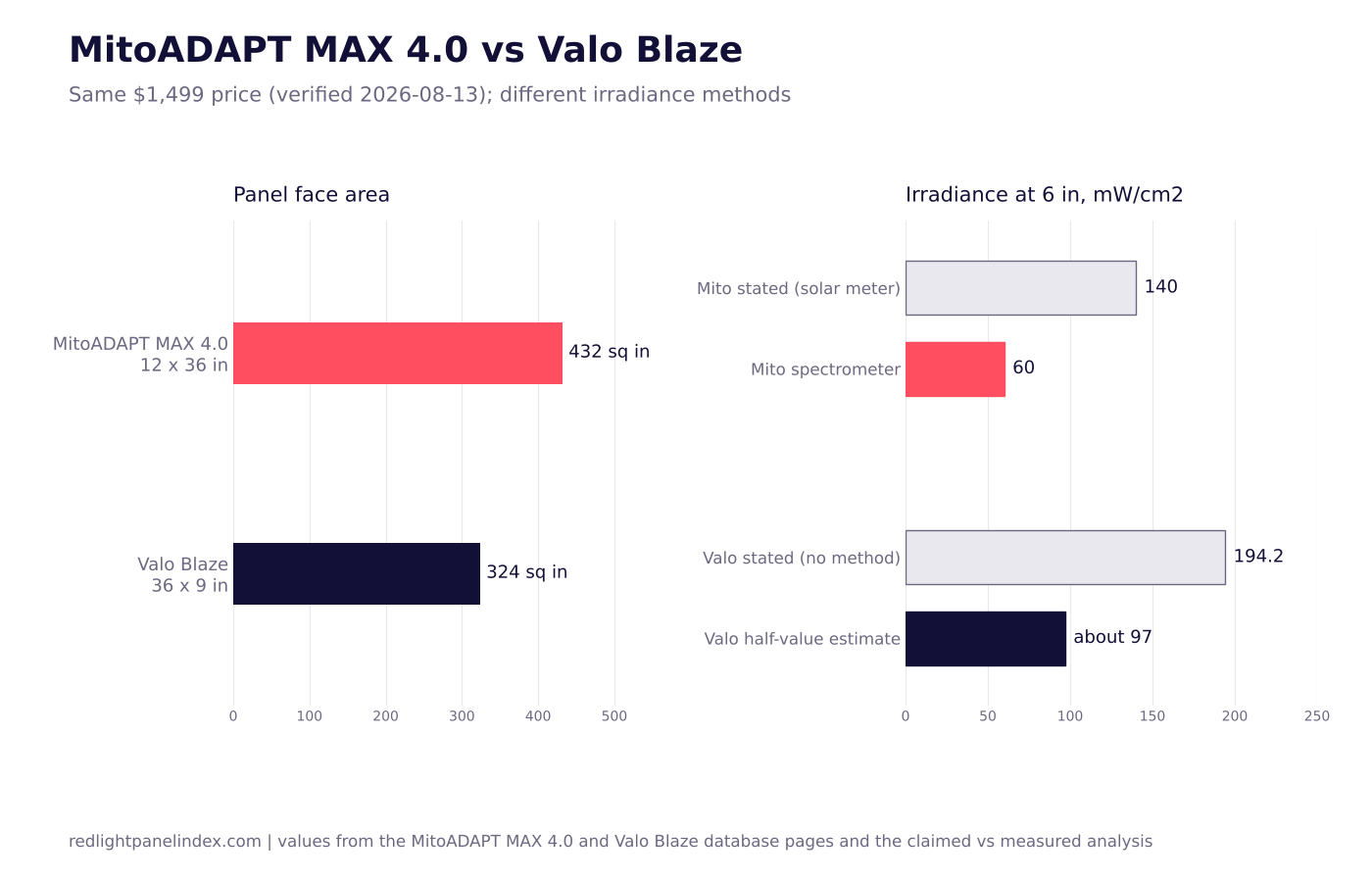
The Mito Red Light MitoADAPT MAX 4.0 and the Valo Blaze cost the same, $1,499 each (both verified 2026-08-13), and both run a 60-day trial with a 3-year warranty. They differ in almost everything else: Mito publishes a spectrometer figure next to its headline, spreads eight wavelengths over a larger face and offers 11 modes, while Valo gives a higher headline number with no stated method, four wavelengths and no modes at all. The deciding questions are which irradiance figure you trust, whether you want the extra bands, and controls versus simplicity.
Choosing a panel? Our ranking of the best red light therapy panels is computed from published, method-labeled specs across 188 devices. For two panels at the same price, the spec that matters is irradiance with a named instrument, because the headline numbers here were not measured the same way.
The two panels at a glance
| Spec | MitoADAPT MAX 4.0 | Valo Blaze |
|---|---|---|
| Price (verified) | $1,499 (2026-08-13) | $1,499 (2026-08-13) |
| Brand irradiance | 140 mW/cm2 at 6 in | 194.2 mW/cm2 at 6 in |
| Method | Dual-disclosed: solar meter and spectrometer | Not stated; brand range 167 to 200 at 6 in under "standard testing conditions" |
| Spectrometer figure on record | 60 at 6 in (brand disclosure); page also lists LTI peak 74, average 58 | None |
| Wavelengths | 590, 630, 660, 670, 810, 830, 850, 940nm | 630, 660, 810, 850nm |
| Allocation | Even 8-wave split | Not published |
| LEDs | 288 lenses, 576 chips, dual-chip | 200, multi-spectrum 5W, each emits all four bands |
| Panel size | 12 x 36 in | 36 x 9 x 2.5 in |
| Beam angle | 60 degrees | 30 or 60 degrees (brand statements conflict) |
| Modes | 11 wavelength-combination modes | None; timer only |
| Stand | Sold separately, about $139 single | Door hook or wall mount; floor stand $199 |
| Warranty | 3 years | 3 years |
| Trial | 60 days, no restocking fee | 60 days, no restocking fee |
All figures are from the two live database pages and the Mito and Valo brand pages. Prices move, so confirm on the brand site before buying.
Irradiance: compare the methods before the numbers
On the headlines, the Valo looks about 39 percent stronger, 194.2 against 140 mW/cm2. Those two numbers are not the same kind of measurement, so they cannot be compared directly. The irradiance guide explains why a figure without an instrument and a distance is a claim rather than a spec.
MitoADAPT MAX 4.0. Mito publishes two readings. The 140 headline is a solar power meter reading, and the brand also discloses a spectrometer reading. The site's claimed versus measured analysis lists the MAX 4.0 at 140 claimed and 60 by spectrometer at 6 inches, a ratio of 2.33. The model page also records an independent reading, labeled LTI, at peak 74 and average 58. The two spectrometer-range figures agree closely. The brand page does flag Mito's dual labeling as internally inconsistent across its range.
Valo Blaze. The spec table shows 194.2 mW/cm2 at 6 inches with the method not stated, and a second note gives a brand range of 167 to 200 under "standard testing conditions," not independently verified. No instrument is named. The page treats it as not comparable to spectrometer numbers.
Working values. Across 44 checkable panels, headline figures run a median 2.18 times the spectrometer reading. Both model pages suggest working from roughly half of a method-unstated or solar-meter figure. For the Blaze, half of 194.2 is about 97 mW/cm2. That is an estimate from a rule of thumb, not a measurement. For the Mito you do not have to estimate: 58 to 60 is on record. So the Blaze may well be the more intense panel at 6 inches, but only the Mito has given you a number you can check.
Session length at 6 inches
Session time is dose divided by irradiance. Taking 20 J/cm2 as an example:
- MitoADAPT MAX 4.0 at the spectrometer figure of 60 mW/cm2: about 5.6 minutes.
- Valo Blaze at the half-value estimate of about 97 mW/cm2: about 3.4 minutes.
The Valo estimate is the softer of the two and could be off in either direction. Enter your real distance and the figure you trust in the dose calculator.
Wavelengths and allocation
Both panels share 630, 660, 810 and 850nm, the core red and near-infrared bands covered on the 630nm vs 660nm and 810nm vs 850nm pages. The Mito adds 590, 670, 830 and 940nm.
What the extras add is modest on the site's own evidence. The 830nm page ties that band mainly to a split-face skin trial where it was paired with red light, and calls it "not a demonstrated benefit on its own." The 940nm page finds no trial comparing 940nm with 850nm and says a panel adding 940nm "is not automatically stronger." The site has no dedicated page for 590 or 670nm and makes no claim for them. More bands also means each band gets a smaller share: Mito describes an even split across eight, and its dual-chip LEDs split each diode's power between two wavelengths. Valo publishes no allocation, and each of its LEDs emits all four bands, with the chip count not stated. The LED chips page explains how chip layout affects per-band output.
Size, coverage and beam angle
The Mito face is 12 x 36 inches, about 432 square inches. The Blaze is 36 x 9 inches, about 324 square inches, so the Mito lights about a third more area at once. The treatment area and coverage page explains why face size matters.
The Mito uses a 60 degree beam. The Blaze is listed at 30 degrees in one place and 60 in another, and the brand's statements conflict. A narrower beam holds irradiance better as you step back, as the beam angle page explains, but until Valo settles the figure, assume nothing.
Controls, mounting and terms
The Mito's 11 modes let you run chosen band combinations, for example red only for skin. The Blaze has no modes: all four bands run together on a timer.
The Blaze mounts on a door hook or wall, with a $199 floor stand as an upsell, and the brand page notes NIR-blocking goggles are included. The Mito needs a stand, about $139 for a single-panel stand. Both have a 60-day trial with no restocking fee. Mito return shipping is at the customer's cost unless a paid add-on was bought at checkout; the Valo brand page lists free FedEx shipping. The Blaze page lists EMF of 0.0 uT at 6 inches; the Mito page does not publish EMF. See EMF explained for what that figure means.
FDA wording
Neither panel is FDA cleared. The Mito page lists the panels as FDA-registered Class II and not cleared, and flags Mito's "medical-grade" marketing, a term no home panel can claim as a performance class. The Valo page labels the brand's "FDA Cleared Class II" claim misleading because no 510(k) number is given. The FDA clearance explainer sets out the difference between registration and clearance.
Verdict by use case
- You want a number you can verify: the MitoADAPT MAX 4.0. Its spectrometer figure is on record and matches an independent reading.
- You want the shortest likely session at 6 inches: probably the Valo Blaze, if its headline holds up at the usual ratio, which no one has measured.
- You want control over bands, or red light alone: the Mito, with 11 modes.
- You want one switch and no settings: the Blaze.
- You want more body covered per session: the Mito's larger face.
- You want to wall-mount without buying a stand: the Blaze.
If you are weighing other options at this price, the Mito alternatives guide and the smaller Valo Beam are the closest starting points.