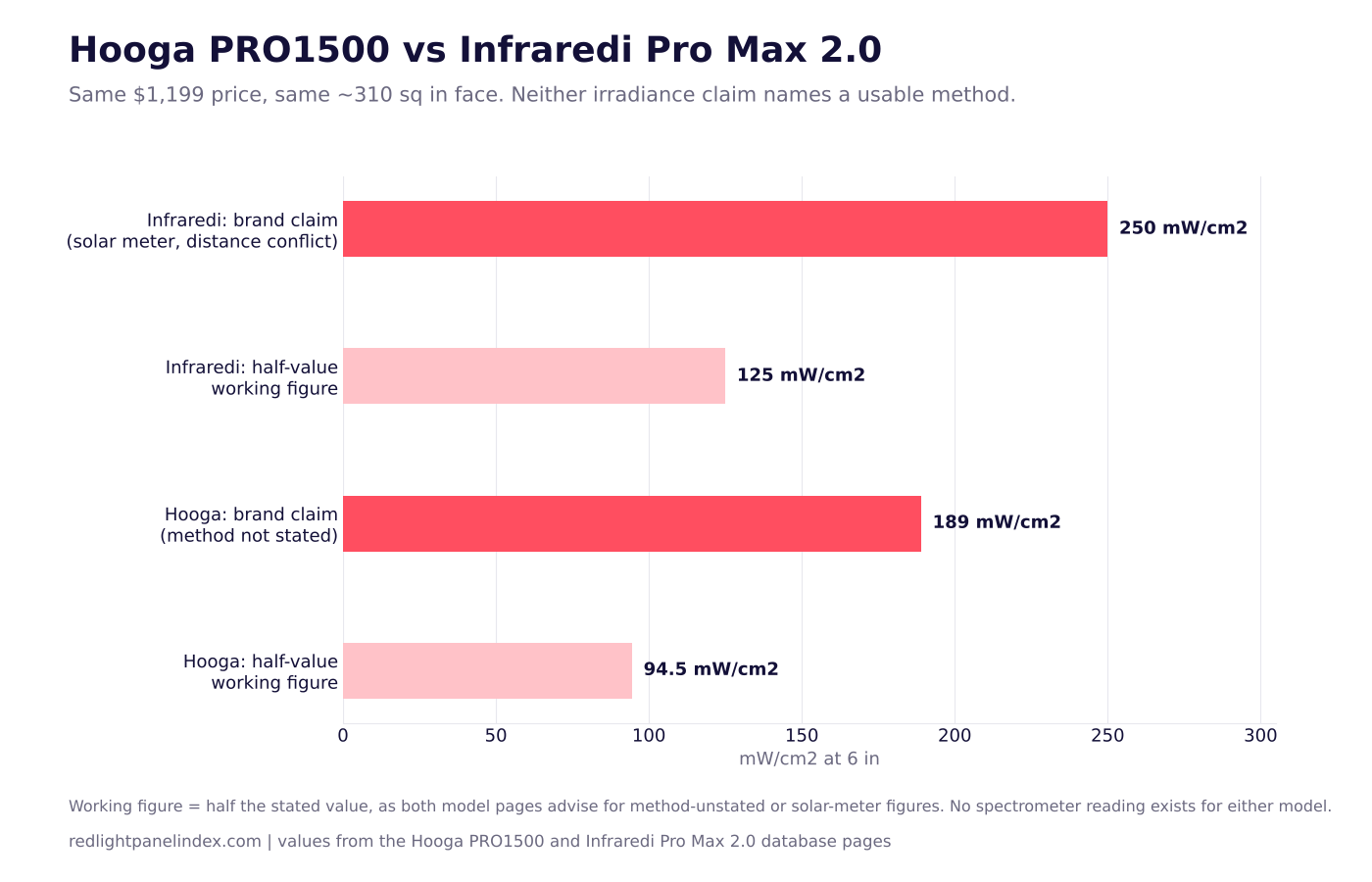
The Hooga PRO1500 and the Infraredi Pro Max 2.0 cost the same $1,199 (Hooga verified 2026-09-12, Infraredi 2026-08-13) and have almost the same panel face, about 310 square inches, yet Infraredi claims 250 mW/cm2 against Hooga's 189. Neither figure comes with a usable measurement method, so the 61-point gap tells you very little: the real differences are wavelength mix (two bands against five), beam angle disclosure, LED count, and small differences in return terms.
Choosing a panel? Our ranking of the best red light therapy panels is computed from published, method-labeled specs across 188 devices. For a matchup like this one, the spec that matters is the measurement method behind each irradiance claim, because two unlabeled numbers cannot be ranked against each other.
The two panels at a glance
| Spec | Hooga PRO1500 | Infraredi Pro Max 2.0 |
|---|---|---|
| Price (verified) | $1,199 (2026-09-12) | $1,199 (2026-08-13) |
| Brand irradiance | 189 mW/cm2 at 6 in | 250 mW/cm2 at 6 in |
| Method note on the page | Method not stated; brand line appears solar-meter based | Brand labels its table "Solar Meter"; no distance stated in the note |
| Third-party reading of this model | None | None |
| Wavelengths | 660, 850nm | 630, 660, 810, 830, 850nm |
| Allocation | 1:1 per dual-chip | Not published |
| LEDs | 300, dual-chip | 210, dual-chip (2 x 3W chips per 6W LED) |
| Panel size | 36 x 8.6 x 3.1 in | 90.8 x 22 cm (about 35.7 x 8.7 in) |
| Beam angle | 60 degrees | Not published |
| Warranty | 3 years | 3 years |
| Trial | 60 days | 60 days |
All figures are from the two live database pages. Prices move, so confirm on the brand site before buying.
Irradiance: two claims, neither with a usable method
This is the comparison the pair exists for. On paper the Infraredi is 32% stronger, and a buyer reading only the headline would pick it. The irradiance guide explains why that is the wrong move: a figure means something only when it comes with the instrument and the distance.
Infraredi Pro Max 2.0. The spec table shows 250 mW/cm2 at 6 inches with the method not stated. The measurement note underneath is more specific: the brand explicitly labels its table as a solar meter reading, and that note says no distance is stated. So the page gives one firm fact (the instrument is a solar meter) and one conflict (6 inches in the table, no distance in the note). A solar power meter reads a much wider band of light than a red and near-infrared LED panel emits, and the database treats such readings as inflated against a spectrometer.
Hooga PRO1500. The spec table shows 189 mW/cm2 at 6 inches, method not stated. A brand-line note on the same page says Hooga's figures are brand-stated at 6 inches and appear solar-meter based. That note also records the only independent reading in the Hooga line: Light Therapy Insiders measured the Hooga ULTRA360 with a spectrometer at roughly 74 mW/cm2 against a 132 claim. That is a different model with quad-chip LEDs, so it cannot be applied to the PRO1500 as a number. What it does show is how far one Hooga claim fell when someone checked it.
What the gap is worth. Across 44 panels where a headline can be checked against a spectrometer, the site's claimed versus measured analysis finds the headline averages 2.11 times the spectrometer figure. Both model pages give the same advice: when a figure is method-unstated or solar-meter based, work from roughly half of it. Applied evenly, that gives working figures of about 94.5 mW/cm2 for the Hooga and 125 for the Infraredi. Those are planning numbers, not measurements, and the true ratio for either panel could be higher or lower than two. Until someone puts a spectrometer in front of both, the honest reading is that the Infraredi claims more and neither claim has been checked.
Neither panel qualifies for the site's method-labeled high-irradiance ranking, which excludes solar-meter and unlabeled figures for exactly this reason.
What the working figures mean for session length
Session time follows from dose divided by irradiance. Taking 20 J/cm2 as an example dose inside the commonly studied range, and using the half-value working figures:
- Hooga PRO1500 at about 94.5 mW/cm2: roughly 3.5 minutes at 6 inches.
- Infraredi Pro Max 2.0 at about 125 mW/cm2: roughly 2.7 minutes at 6 inches.
The difference is under a minute per session, and it rests entirely on two unverified claims. If you sit farther back, irradiance falls quickly, so put your real distance into the dose calculator rather than reusing the 6-inch figure. The measurement distance conventions page explains why a figure without a distance cannot be entered with confidence at all, which is the Infraredi's problem in its measurement note.
Wavelengths and how the LEDs are split
The Hooga is a two-band panel: 660nm red and 850nm near-infrared, with each dual-chip LED carrying one of each, so the split is 1:1. That is the simplest allocation in the database to reason about, and it covers the two bands most often used in trials.
The Infraredi lists five bands: 630, 660, 810, 830 and 850nm. It publishes no allocation, and its LEDs are dual-chip, so each 6W LED carries two 3W chips. With five bands spread across two-chip LEDs, some bands must sit on fewer LEDs than others, but the page gives no way to know which. The wavelength guide covers what each band is used for, and the 630nm vs 660nm and 810nm vs 850nm pages cover the neighboring pairs the Infraredi adds. Neither panel reaches the 1060 to 1064nm band.
Both use dual-chip LEDs, which split each diode's power between two wavelengths. The site's dual-chip panel ranking explains what that means for per-band output.
Panel area, LED count and coverage
The faces are close to identical. The Hooga is 36 by 8.6 inches, about 310 square inches. The Infraredi is 90.8 by 22 cm, which converts to about 35.7 by 8.7 inches, also about 310 square inches. At the same price, both work out to roughly $3.87 per square inch of panel face.
Where they differ is LED count. The Hooga packs 300 LEDs into that face, about one per square inch; the Infraredi uses 210, about 0.68 per square inch, though each Infraredi LED is rated at 6W and the Hooga page publishes no per-LED wattage. LED count and wattage describe input, not delivered light, so neither number settles which panel is brighter.
A 36 by 9 inch panel lights a long, narrow strip. Held vertically it covers roughly the torso or the length of a thigh in one position; for the full back, both legs, or the whole front of the body, either one needs several positions per session. The treatment area and coverage page explains why the usable area is smaller than the printed face, because every panel is brightest near the middle and fades toward the edges.
Beam angle
The Hooga publishes a 60 degree beam angle. The Infraredi does not publish one. A 60 degree lens spreads light over a wider patch and loses irradiance faster with distance than a 30 degree lens, which suits close sessions at 6 inches or less. The beam angle explainer covers the trade-off. With no figure for the Infraredi, a buyer cannot predict how quickly its output falls as they step back, which matters more for a panel that already lacks a stated distance.
Features, mounting and terms
Controls. The PRO line is described as flicker-free and stand-compatible, with a built-in timer and no condition preset modes. The Infraredi offers preset programs including a Wind Down mode, adjustable pulsing, dimming from 1 to 100% and Bluetooth app control. If pulsing or dimming matter to you, only the Infraredi has them; the flicker page explains why a flicker-free label is worth checking.
Mounting. The Hooga page lists a tabletop stand for PRO and ULTRA panels, with a full-body floor stand sold separately. The Infraredi base variant uses a door hook, and stands are extra: $99 for the mini stand, $149 to $199 for the base stand, $399 vertical and $949 horizontal.
Returns. Both offer a 60-day trial and a 3-year warranty, and neither lists a restocking fee. Hooga offers a prepaid label for US returns but deducts its cost from the refund, and open-box items are non-refundable. Infraredi deducts return shipping from the refund.
Regulatory language. The Hooga page records the PRO1500 as not FDA-cleared, made in an FDA-registered facility and marketed as general wellness. The Infraredi page records no device-specific FDA claim and notes the Australian device is TGA-listed. Registration and listing are not clearance, and no home red light panel is FDA approved.
For the brand-level picture, the Hooga vs Infraredi comparison sets the two brands' flagships side by side, and the Hooga line comparison explains where the PRO sits between the HG and ULTRA ranges.
Verdict by use case
There is no single winner here, because the spec that would decide it, a measured irradiance for either model, does not exist.
- You want the simplest, most predictable wavelength mix: the Hooga PRO1500. Two bands at a published 1:1 split, a stated 60 degree beam angle and more LEDs per square inch make its spec sheet the easier one to reason about.
- You want more bands and control features: the Infraredi Pro Max 2.0. It adds 630, 810 and 830nm, plus dimming, pulsing and app control, at the same price. Accept that the split is unpublished and the beam angle unknown.
- You are choosing on the irradiance headline: do not. A 250 solar-meter figure and a 189 unlabeled figure are not comparable, and halving both still leaves you comparing estimates. If a verified number matters, look at panels with a named instrument in the Hooga alternatives and Infraredi alternatives guides instead.
- You want a door or wall setup without buying a stand: the Infraredi, whose base variant ships with a door hook.
- You want a tabletop setup: the Hooga, whose page lists a tabletop stand for the PRO line.
Whichever you choose, plan sessions from roughly half the stated figure, measure your real distance, and recheck the price on the brand site, since both were last verified months ago.