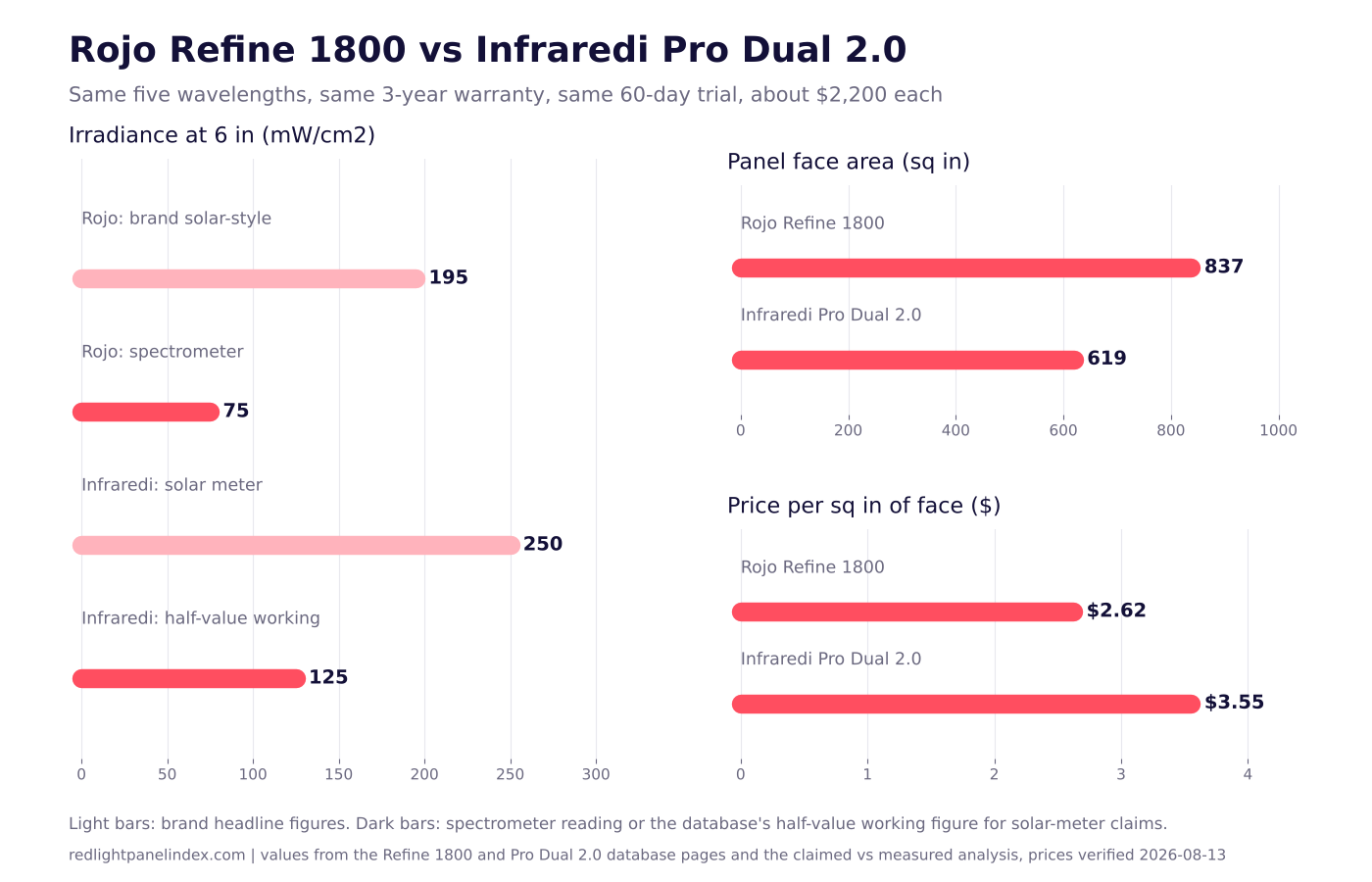
The Rojo Refine 1800 at $2,195 and the Infraredi Pro Dual 2.0 at $2,199 (both verified 2026-08-13) are full-length panels with the same five wavelengths, the same 3-year warranty and the same 60-day trial. What separates them is the irradiance figure each brand prints: Rojo publishes a spectrometer reading of 75 mW/cm2 at 6 inches, while Infraredi publishes 250 mW/cm2 from a solar meter. Once both are put on the same footing, the gap shrinks, and the real differences become panel area, LED count, beam angle disclosure and controls.
Choosing a panel? Our ranking of the best red light therapy panels is computed from published, method-labeled specs across 188 devices. For two full-length panels at the same price, the spec that matters is the instrument behind each irradiance figure, because a spectrometer reading and a solar meter reading are not the same scale.
The two panels, side by side
Every figure below comes from the two live database pages, last reviewed November 2026. Prices change, so confirm on the brand site before buying.
| Spec | Rojo Refine 1800 | Infraredi Pro Dual 2.0 |
|---|---|---|
| Price | $2,195 (verified 2026-08-13) | $2,199 (verified 2026-08-13) |
| Brand irradiance at 6 in | 75 mW/cm2, spectrometer (OHSP350IR); brand also prints a 195 "solar-style comparison" figure | 250 mW/cm2, solar meter |
| Third-party test | None for this model; one for the Refine 900 | None listed |
| Wavelengths | 630, 660, 810, 830, 850nm | 630, 660, 810, 830, 850nm |
| Allocation | Not published | Not published |
| LEDs | 600, dual-chip | 420, dual-chip (2 x 3W chips per 6W LED) |
| Beam angle | 60 degrees | Not published |
| Panel size | 70.9 x 11.8 x 2.6 in | 181.6 x 22 cm (about 71.5 x 8.7 in) |
| Face area | About 837 sq in | About 619 sq in |
| Controls | Per-wavelength control, about 10 preset modes | Preset programs, pulsing, 1 to 100% dimming, Bluetooth app |
| Mounting | Desk stand listed as included; floor and mobile mounts extra | Door hook; stands $99 to $949 extra |
| Warranty | 3 years | 3 years |
| Trial | 60 days; no restocking fee on panels; customer pays return shipping | 60 days; no restocking fee stated; return shipping deducted from the refund |
The brand pages for Rojo and Infraredi list the other sizes in each lineup, and the brand-level Infraredi vs Rojo comparison covers shipping, eye protection and policy details.
Irradiance: two instruments, two scales
At face value the Pro Dual 2.0's 250 mW/cm2 is more than three times the Refine 1800's 75. Both brands name an instrument, but they name different ones.
Rojo Refine 1800. Rojo discloses two figures at 6 inches: 75 mW/cm2 from a spectrometer and 195 from what it calls a solar-style comparison. The site's claimed versus measured analysis lists that pair as a ratio of 2.60, at the top of the 1.36 to 2.60 range across 44 checkable panels, where headline figures average 2.11 times the spectrometer reading. Plan with the spectrometer figure. The independent test in the database (73 average, 85 peak at 6 inches) was run on the smaller Refine 900, so the 1800's own number is brand-published only.
Infraredi Pro Dual 2.0. Infraredi labels its irradiance table as a solar power meter reading. A solar meter is calibrated against sunlight's broad spectrum and reads roughly double what a lab spectrometer records on the same LED panel. The database page also flags two inconsistencies: its measurement note says the brand's table gives no distance, while the spec row shows 6 inches, and its summary line calls the figure spectrometer-measured, which contradicts the brand's own solar meter label. The Infraredi alternatives guide notes that no independent spectrometer reading for any Infraredi panel is in the database.
Putting them on one footing. Both model pages advise working from roughly half of a solar-meter or method-unstated figure. That gives the Pro Dual 2.0 a working value of about 125 mW/cm2 against the Refine 1800's 75 by spectrometer. The 125 is a planning assumption, not a measurement, and the true figure could sit above or below it. The irradiance page explains why instrument and distance change the number.
Rojo lists 75 mW/cm2 for every Refine model and Infraredi lists 250 for seven of its eight Pro 2.0 panels. A figure that stays the same as the panel grows describes one spot in front of it, not total output, as the irradiance vs total power page explains. Larger panels buy coverage, not intensity.
Session length at 6 inches
Dose in J/cm2 is irradiance in W/cm2 multiplied by seconds. Taking 20 J/cm2 as an example inside the 10 to 60 J/cm2 range both model pages point to, the dose calculator gives:
- Refine 1800 at its 75 mW/cm2 spectrometer figure: about 267 seconds, or roughly 4.5 minutes.
- Pro Dual 2.0 at the 125 mW/cm2 working value: about 160 seconds, or under 3 minutes.
Dosing the Infraredi from its 250 headline would stop you after about 80 seconds, likely short of the target. Both panels need longer sessions at full-body distance.
Area, LEDs and beam angle
This is where the two panels differ most on paper. The Refine 1800 is about 70.9 by 11.8 inches, roughly 837 square inches of face. The Pro Dual 2.0 is listed as 181.6 by 22 cm, about 71.5 by 8.7 inches, roughly 619 square inches. They are almost the same height, but the Rojo is about 3 inches wider, so it covers more of the body's width in one position. On price per square inch of face, that works out to about $2.62 for the Rojo and $3.55 for the Infraredi. The coverage per dollar ranking applies the same arithmetic across the database, and the treatment area guide explains what face area tells you.
The Rojo carries 600 LEDs against the Infraredi's 420, so LED density is close: about 0.72 per square inch against 0.68. Both use dual-chip LEDs, which, as the LED chip page explains, split each diode's power between two wavelengths. Infraredi states its chips as 2 x 3W per 6W LED; the Refine 1800 page gives no per-chip wattage.
Rojo states a 60-degree beam angle; Infraredi publishes none for this panel. The beam angle page explains that a wider beam spreads output at distance and a narrow one concentrates it in front, so the Pro Dual 2.0's behavior as you step back is unknown.
Controls and mounting
Rojo offers control of each wavelength plus about 10 preset modes, so you can run only red for a facial session or only near-infrared for a deeper target. Infraredi offers preset programs, 1 to 100% dimming, a Bluetooth app and pulsing. The pulsed versus continuous page found no general advantage for pulsing, which lowers average output, so continuous mode is the reference for dose arithmetic.
Infraredi ships a door hook, with stands from $99 to $949. Rojo's page lists a desk stand as included but its buying checklist says a stand costs extra; floor and mobile mounts are sold separately. Confirm what ships before ordering.
Terms and the regulatory label
Both carry a 3-year warranty and a 60-day trial. Rojo charges no restocking fee on panels and the buyer pays return shipping; Infraredi states no restocking fee and deducts return shipping from the refund. On a panel this size, ask for a return shipping quote early.
Neither panel is FDA cleared, and no rectangular red light panel is. Rojo describes its products as low-risk general wellness devices and does not claim medical grade. Infraredi makes no device-specific FDA claim; its Australian device is TGA-listed, which is a listing, not a clearance.
Verdict by use case
If you want a number you can dose from: the Refine 1800. Its 75 mW/cm2 is a named spectrometer reading at a stated distance, and the brand prints its solar-style figure beside it so you can see which is which.
If you want the most coverage per dollar: the Refine 1800 again, with about a third more face area for the same price.
If you want shorter sessions at close range: the Pro Dual 2.0 is likely the more intense panel even after halving its solar meter figure, but plan from the 125 working value until a spectrometer reading exists.
If you want to isolate single bands: the Refine 1800's per-wavelength control does this; the Pro Dual 2.0 runs preset programs.
If you want dimming and app control: the Pro Dual 2.0.
If warranty or trial terms decide it: neither wins. Both are 3 years and 60 days, with return shipping on the buyer.
For the smaller Rojo against a same-price panel that names no instrument, see Rojo Refine 900 vs iRestore Apex Pro 1500. For another Infraredi against a much higher headline claim, see Recover Red Core vs Infraredi Pro Max Plus 2.0. The Pro Dual 2.0 is ranked seventh in the premium panel ranking, and the Refine 1800 sixth in the coverage per dollar list.