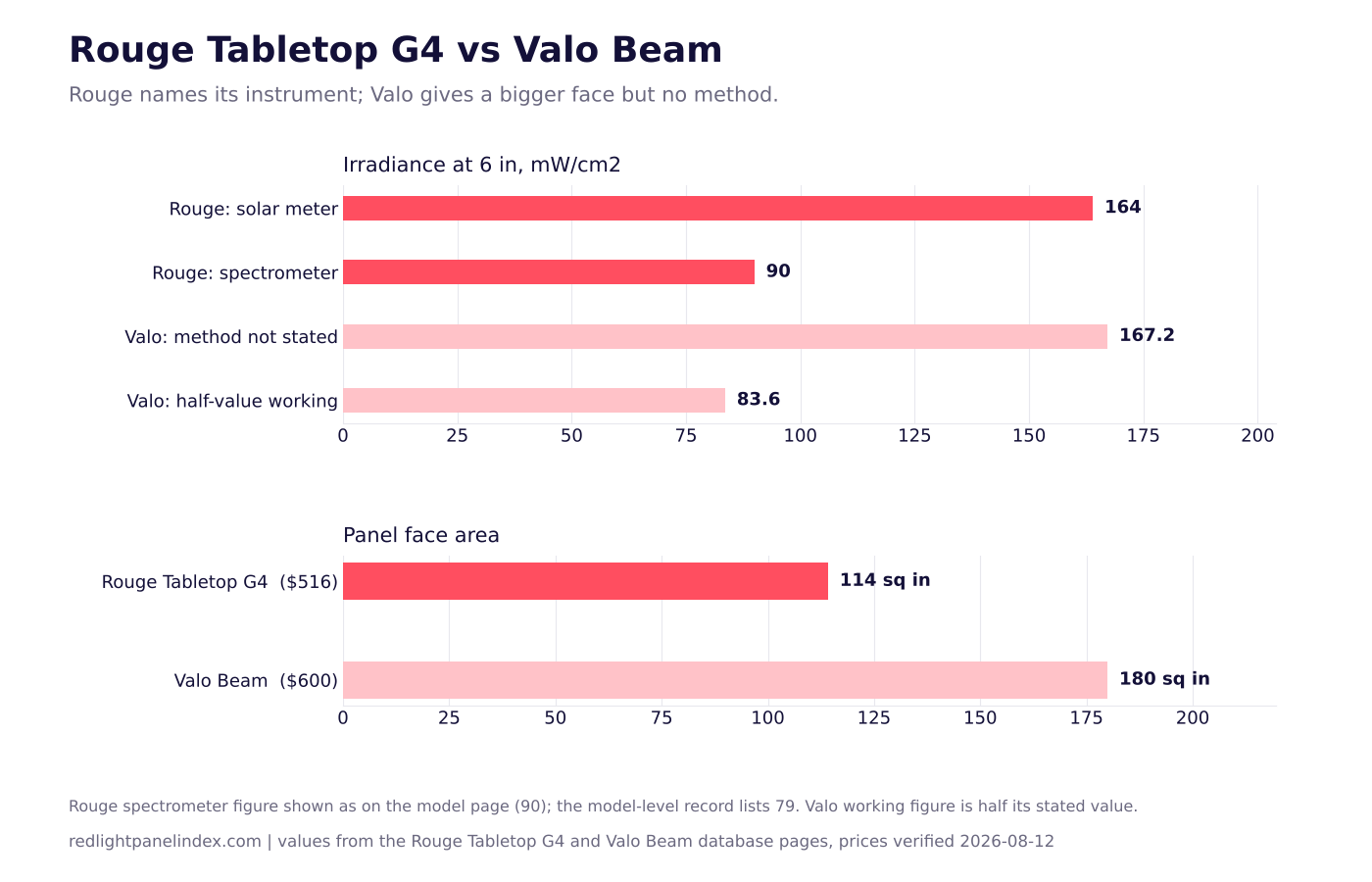
The Rouge Tabletop G4 at $516 and the Valo Beam at $600 (both verified 2026-08-12) are the kind of desk-sized panel most people buy first, and they split cleanly: Rouge publishes a spectrometer figure next to its solar meter figure and spreads eight bands over a small face, while Valo gives a larger face and a simpler four-band mix but no measurement method at all. Neither model has an independent third-party reading on record, so the deciding questions are how much you trust each irradiance figure, how much body you want to light at once, and which wavelengths you actually want.
Choosing a panel? Our ranking of the best red light therapy panels is computed from published, method-labeled specs across 188 devices. For a first tabletop panel, the spec that matters is irradiance with a named instrument, because it decides how long each session has to be.
The two panels at a glance
| Spec | Rouge Tabletop G4 | Valo Beam |
|---|---|---|
| Price (verified) | $516 (2026-08-12) | $600 (2026-08-12) |
| Brand irradiance | 164 mW/cm2 at 6 in | 167.2 mW/cm2 at 6 in |
| Method | Dual-disclosed: solar meter and spectrometer, plus an integrating-sphere lab report | Not stated; "standard testing conditions" range of 167 to 200 at 6 in |
| Third-party reading of this model | None | None |
| Wavelengths | 630, 650, 660, 670, 810, 830, 850, 1060nm | 630, 660, 810, 850nm |
| Allocation | Not published | Not published |
| LEDs | 72, dual-chip (5W) | 100, multi-spectrum (5W), each LED emits all four bands |
| Panel size | 12.6 x 9.06 x 2.56 in | 20 x 9 x 2.5 in |
| Beam angle | 30 degrees | 30 degrees |
| Warranty | 3 years | 3 years |
| Trial | 60 days | 60 days |
All figures are from the two live database pages. Prices move, so confirm on the brand site before buying.
Irradiance: one brand names its instrument, the other does not
The headline numbers are almost the same, 164 against 167.2 mW/cm2 at 6 inches, and that is exactly why the method matters more than the number here. The irradiance guide explains why a figure without an instrument and a distance is a claim rather than a spec.
Rouge Tabletop G4. Rouge is one of the few brands that publishes two readings side by side. The 164 figure is a solar power meter reading, and the brand also discloses a spectrometer reading and an integrating-sphere lab report. The Tabletop G4 page shows the brand's disclosure as 164 solar meter and 90 spectrometer at 6 inches, the same note that appears across the G4 range. The site's narrow-beam ranking, built from the model-level record, lists the Tabletop G4's own spectrometer figure as 79. Either way, the spectrometer number is roughly half the headline, which is what the solar meter label predicts. Rouge's larger Pro G4 also has an affiliated lab reading on record, but that is a different panel and cannot be applied to the Tabletop.
Valo Beam. The spec table shows 167.2 mW/cm2 at 6 inches with the method not stated. A second note gives a brand range of 167 to 200 at 6 inches under "standard testing conditions" and says it is not independently verified. No instrument is named anywhere. The page advises treating the figure as not comparable to spectrometer numbers.
What that does to the comparison. Across 44 panels where a headline can be checked against a spectrometer, the site's claimed versus measured analysis finds the headline averages 2.11 times the spectrometer figure. Both model pages advise working from roughly half of a method-unstated or solar-meter figure. For the Valo, half of 167.2 is about 83.6 mW/cm2. For the Rouge you do not have to estimate: the brand's own spectrometer disclosure, 79 to 90 depending on which record you read, is the better working value. So the two panels probably land in a similar range, but only one of them has given you a reason to believe its number.
Session length at 6 inches
Session time is dose divided by irradiance. Taking 20 J/cm2 as an example inside the commonly studied range:
- Rouge Tabletop G4 at the spectrometer figure of 90 mW/cm2: about 3.7 minutes. At 79: about 4.2 minutes.
- Valo Beam at the half-value working figure of about 83.6 mW/cm2: about 4 minutes.
The difference is small and the Valo estimate is the softer of the two. Both panels use a 30 degree lens, which holds irradiance better as you step back than a 60 degree lens, but irradiance still drops with distance, so enter your real distance in the dose calculator rather than assuming 6 inches.
Panel area and what each one covers
This is where the Valo has a clear, measurable edge. The Rouge face is 12.6 by 9.06 inches, about 114 square inches. The Valo face is 20 by 9 inches, 180 square inches, about 58% more. Per dollar, the Valo gives roughly 0.30 square inches per dollar against about 0.22 for the Rouge.
In practice, a 12.6 by 9 inch face lights one small area per position: the face, a knee, a shoulder or a hand. The 20 inch Valo is long enough to cover a forearm, a shin or more of the upper back in one position. Neither is a full-body panel, and either will need several positions to cover a larger area. The treatment area and coverage page explains why the usable patch is always smaller than the printed face, since every panel is brightest near the middle and fades toward the edges. If you mainly want to carry a panel or keep it on a desk, the portable panel ranking sets both sizes against the smaller devices in the database.
LED density is close: 72 LEDs on 114 square inches is about 0.63 per square inch, and 100 LEDs on 180 square inches is about 0.56. Both are rated at 5W per LED. LED count and wattage are inputs, not delivered light, so they do not settle which panel is brighter.
Wavelengths and how the LEDs carry them
The Rouge lists eight bands: four reds (630, 650, 660 and 670nm) and four near-infrared bands (810, 830, 850 and 1060nm). The 1060nm band, part of the 1064nm class, is unusual at this price; the 1064nm page covers what it is and is not known to do. The catch is that Rouge does not publish how its 72 dual-chip LEDs are divided among eight bands. Each dual-chip LED carries only two wavelengths, so with eight bands some must sit on relatively few LEDs, and the page gives no way to know how much output any one band gets.
The Valo lists four bands: 630, 660, 810 and 850nm. It also publishes no split, but its LEDs are described as multi-spectrum, with each LED emitting all four wavelengths. That spreads the bands evenly across the face in space, though each LED's 5W is shared four ways. The wavelength guide covers what each band is used for.
If you specifically want the deep near-infrared band, only the Rouge has it. If you want a predictable, evenly distributed mix of the four most common bands, the Valo's design is easier to reason about.
Controls, mounting and safety notes
Controls. The Rouge lets its red and near-infrared groups run together or separately. The Valo has no selectable modes by design; all four bands run together and the only control is a timer. The Valo page records 0.0 microtesla EMF at 6 inches; the Rouge page lists no EMF figure.
Mounting. The Rouge Tabletop G4 has no stand listed. The Valo base unit mounts on a door hook or a wall, and a floor stand is a $199 add-on.
Returns and warranty. Both carry a 3-year warranty and a 60-day trial. Rouge charges no restocking fee on panels, but the panel must come back like-new in its original packaging and the buyer pays return shipping; stands and racks carry a 20% restocking fee. Rouge also warrants free replacements for the first 6 months. The Valo page lists a 60-day trial with no restocking fee.
Regulatory language. Rouge describes its devices as low-risk general wellness products under FDA guidance and does not claim "medical grade." The Valo brand claims "FDA Cleared Class II," which the database marks as misleading because no 510(k) K-number is provided, and the Valo page also notes internal spec inconsistencies. The site's FDA clearance explainer covers how to check a clearance claim; no rectangular red light panel is FDA-cleared.
Verdict by use case
There is no single winner; the two panels are better at different things.
- You want a number you can plan around: the Rouge Tabletop G4. It is the only one of the two that names its instrument and discloses a spectrometer figure, which is the best a buyer can get when no independent reading exists for either model.
- You want more area per session: the Valo Beam. Its 180 square inch face is about 58% larger, and it costs only $84 more, so it covers more skin per dollar.
- You want the 1060nm band: the Rouge, the only one here that reaches it, with the caveat that its eight-band split is not published.
- You want a simple, set-and-forget panel on a door or wall: the Valo, with all four bands always on and a door or wall mounting option.
- Return terms matter most: both are close; read Rouge's packaging and stand conditions before ordering.
If neither fits, the Rouge alternatives guide lists price-matched panels with named measurement methods, and the best panels under $1,000 ranks the wider field, where the Valo Beam appears among the method-unstated entries. If you are considering the Beam's larger sibling, the MitoADAPT MAX 4.0 vs Valo Blaze comparison sets the Blaze's method-unstated figure against a same-price panel that publishes a spectrometer reading.