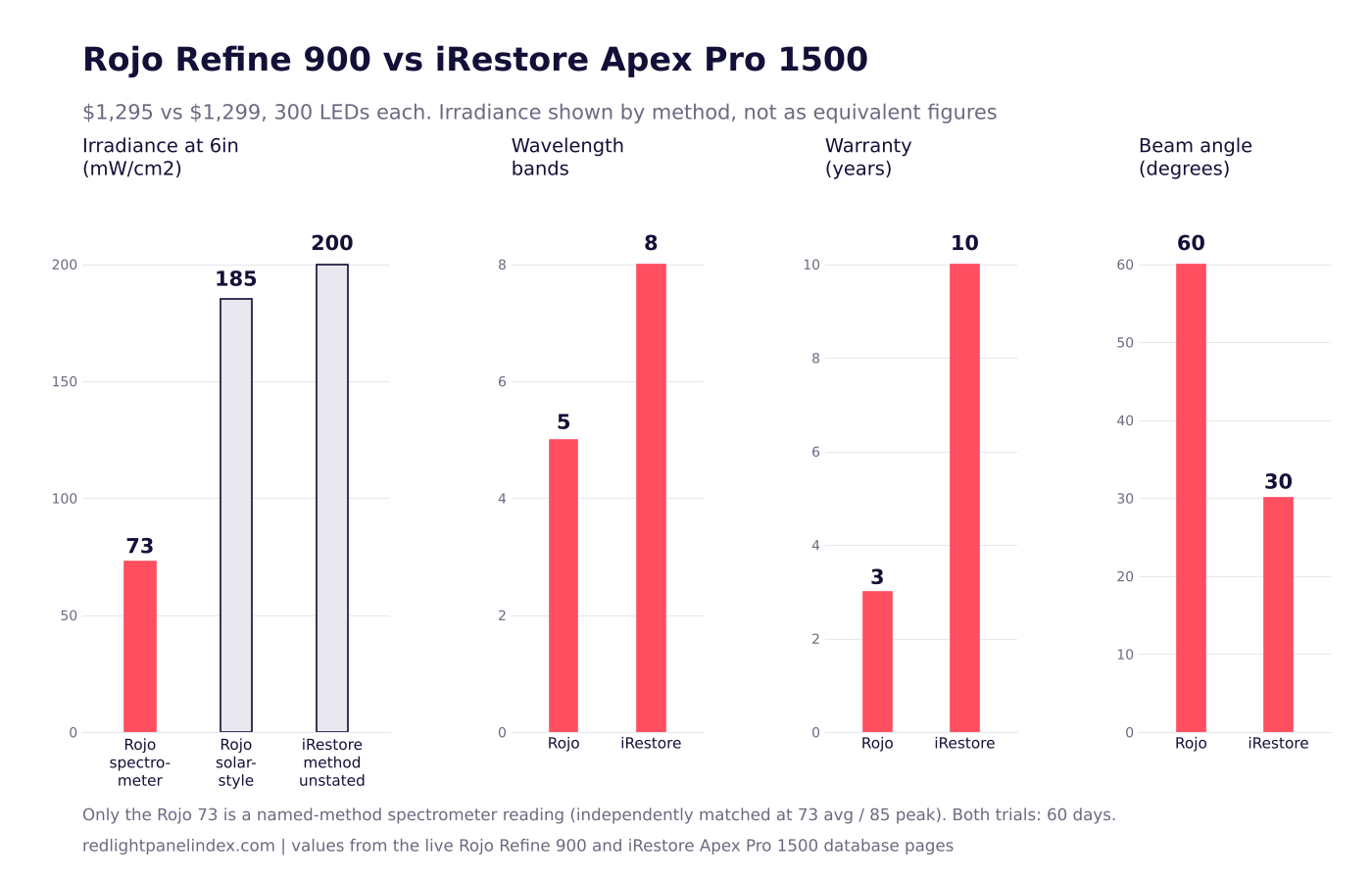
The Rojo Refine 900 at $1,295 (verified 2026-08-13) and the iRestore Apex Pro 1500 at $1,299 (verified 2026-08-12) cost the same, carry 300 LEDs each and are almost the same size, yet their headline irradiance figures cannot be compared at face value. Rojo publishes a spectrometer reading of 73 mW/cm2 at 6 inches that an independent test matches; iRestore states over 200 mW/cm2 at about 6 inches without naming the instrument. The Rojo has the better-documented output and per-band control; the iRestore has more bands, a narrower beam, pulsing and a much longer warranty.
Choosing a panel? Our ranking of the best red light therapy panels is computed from published, method-labeled specs across 188 devices. For two panels at the same price and size, the spec that matters is whether the irradiance figure names the instrument that produced it.
The two panels, side by side
Every figure below comes from the two live database pages, last reviewed November 2026.
| Spec | Rojo Refine 900 | iRestore Apex Pro 1500 |
|---|---|---|
| Price | $1,295 (verified 2026-08-13) | $1,299 (verified 2026-08-12) |
| Irradiance at 6in | 73 mW/cm2 by spectrometer (brand-published); brand also lists a 185 "solar-style comparison" figure | Over 200 mW/cm2 at about 6in, instrument not named |
| Third-party test | Light Therapy Insiders spectrometer: 73 average, 85 peak at 6in | None listed |
| Wavelengths | 630, 660, 810, 830, 850nm | 590, 630, 660, 810, 830, 850, 940, 1060nm |
| Allocation | Not published | Not published |
| LEDs | 300, dual-chip | 300, type not published, listed as 5W |
| Beam angle | 60 degrees | 30 degrees |
| Panel size | 35.8 x 11.8 x 2.6in | 36 x 12 x 3in |
| Controls | Individual per-wavelength control, about 10 preset modes | Group wavelength control, 6 modes, pulsing 0 to 40 Hz, dimmable |
| Mounting | Desk stand included; floor and mobile mounts sold separately | Door mount included; stands $119 to $899 extra |
| Warranty | 3 years | 10 years |
| Trial | 60 days; no restocking fee on panels; customer pays return shipping | 60 days; no restocking fee on Apex panels; 20% fee only on refused or undeliverable shipments |
The brand pages for Rojo and iRestore list the other sizes in each lineup.
Irradiance: compare the methods first
On paper the Apex Pro 1500's 200 mW/cm2 looks like nearly three times the Refine 900's 73. It is not that kind of comparison. Rojo's 73 is a spectrometer reading, and an independent Light Therapy Insiders spectrometer test came in at the same 73 average with an 85 peak. Rojo also prints a larger 185 mW/cm2 figure that it labels a solar-style comparison; set against its own spectrometer reading, that is a ratio of 2.53, one of the highest in the claimed-versus-measured analysis, where headline figures across 44 checkable panels average 2.11 times the spectrometer reading. The useful point is that Rojo shows both numbers, so a buyer can see which is which.
iRestore's figure has no instrument attached. The Apex Pro 1500 database page notes that it is therefore not comparable with spectrometer-based numbers, and the page and the dose calculator both advise working from roughly half of a method-unstated irradiance figure: about 100 mW/cm2 here. That is an assumption, not a measurement: the real figure could be higher or lower. Until a named-method reading exists, the two headline figures should not be treated as equivalent.
Session length at 6 inches
Run each panel's best-documented number through the dose calculator. Dose in J/cm2 is irradiance in W/cm2 multiplied by seconds, so a 20 J/cm2 target, inside the 10 to 60 J/cm2 range the calculator works to, comes out as follows at 6 inches:
- Refine 900 at its 73 mW/cm2 spectrometer figure: about 274 seconds, or roughly 4.5 minutes.
- Apex Pro 1500 at the halved working value of 100 mW/cm2: about 200 seconds, or just over 3 minutes.
The Apex figure carries more uncertainty in either direction.
Wavelengths: what the extra bands add
Both panels share 630, 660, 810, 830 and 850nm. The Apex Pro 1500 adds 590nm amber, 940nm and 1060nm. Neither brand publishes how its LEDs are split across the bands, so the extra bands could be a large share of the output or a token one. What the site's wavelength pages support:
- 590nm: the periocular wrinkle trial reviewed in our study review of 660nm and 590nm light around the eyes found 590nm amber performed close to 660nm red at the same dose, so amber is a studied skin band, but not one shown to beat red.
- 940nm: the 940nm page describes it as a real option in the research literature but not one of the bands most trials were built around, and notes that few brands publish their share of it.
- 1060nm: the 1064nm page explains that the research tied to that band used lasers rather than LED panels. The Apex database page also flags an inconsistency, listing 1060nm in the spec and 1064nm in its wavelength chart.
So the extra bands are a broader spectrum, not a proven advantage.
LEDs, beam angle and controls
The Refine 900 uses dual-chip LEDs. As the LED chip page explains, a dual-chip diode splits its power between two wavelengths, which blends the bands more evenly across the face of the panel but leaves less power per band. iRestore lists its 300 LEDs as 5W without stating the chip type.
Beam angle splits them more clearly. The Apex Pro 1500's 30-degree beam concentrates light straight ahead, which the beam angle page says gives a narrow-beam panel its biggest advantage close in, for spot work on a joint or muscle. The Refine 900's 60-degree beam spreads output over more area, which suits sessions at a longer distance. Face areas are nearly identical, about 422 and 432 square inches.
Controls differ too. Rojo offers individual control of each wavelength, which matters if you want to run only the red bands for a facial session or only near-infrared for a deeper target. The Apex Pro 1500 switches wavelengths in groups (individual control is on the larger Apex Elite 2160) but adds pulsing from 0 to 40 Hz. The pulsed versus continuous page found no general advantage for pulsing in the evidence, and pulsing lowers average output, so continuous mode is the reference setting for dose arithmetic.
Warranty, trial and the regulatory label
Both offer a 60-day trial with no restocking fee on panels. Rojo's buyer pays return shipping; iRestore applies a 20% fee only to refused or undeliverable shipments. The warranty gap is large: 10 years from iRestore against 3 from Rojo.
On mounting, the Refine 900 page notes a conflict between "sold separately" and a statement that a compatible mount ships with every order, so confirm before buying.
Neither panel is FDA cleared. Rojo describes its products as low-risk general wellness devices; the Apex panels are 510(k)-exempt and registered, and the "FDA-Cleared" claim on iRestore's homepage refers to its hair-growth lasers. Registration is a listing, not a clearance.
Verdict by use case
If you want output you can verify: the Refine 900. Its spectrometer figure is published, labeled and independently matched, so session lengths rest on a measurement rather than a working assumption.
If you want the longest protection after purchase: the Apex Pro 1500's 10-year warranty is more than three times the Refine 900's 3 years.
If you want to run single bands: the Refine 900's per-wavelength control lets you isolate red or near-infrared; the Apex Pro 1500 switches them in groups.
If you mainly treat one area at close range: the Apex Pro 1500's 30-degree beam concentrates output in front of the panel. Budget sessions from the halved working figure until a named-method reading exists.
If you want the widest spectrum: the Apex Pro 1500 lists eight bands to the Refine 900's five, including 590nm, 940nm and 1060nm, with the caveat that neither brand publishes how output is split.
For another pair where one panel publishes a spectrometer figure and the other does not, see PowerPanel MEGA vs Orion Pro 900.