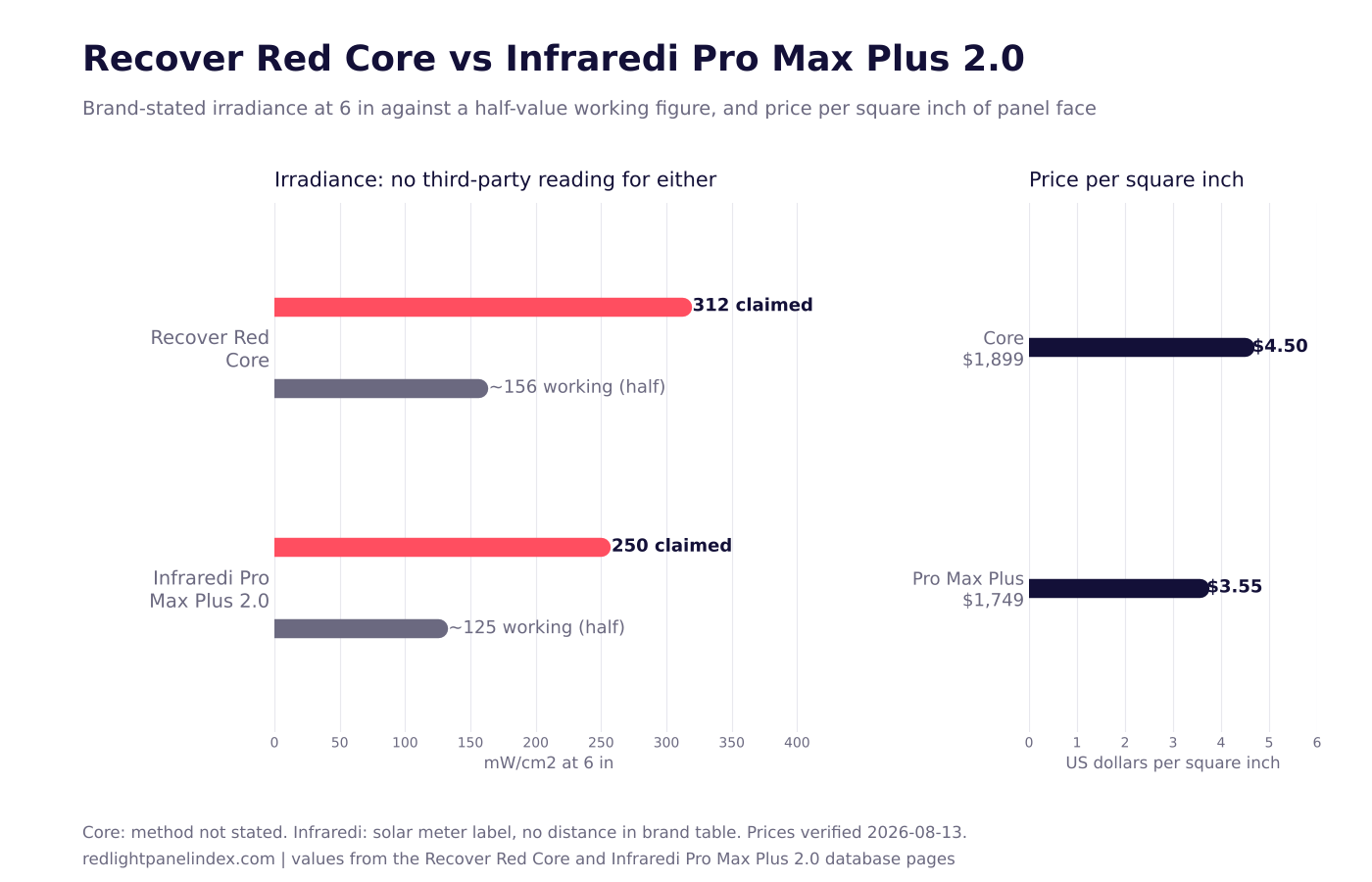
The Recover Red Core claims 312 mW/cm2 at 6 inches, one of the highest irradiance figures in the database, while the Infraredi Pro Max Plus 2.0 claims 250 and costs $150 less ($1,899 against $1,749, both verified 2026-08-13). Neither claim comes with a usable method, and the Core's has none at all, so the headline gap decides nothing: the real differences are panel area, wavelength mix, beam angle disclosure, warranty length and two conflicting lines in the buyer terms.
Choosing a panel? Our ranking of the best red light therapy panels is computed from published, method-labeled specs across 188 devices. For two panels with very high headline figures, the spec that matters is the measurement method behind each claim, because a big number without an instrument and a distance cannot be ranked.
The two panels at a glance
| Spec | Recover Red Core | Infraredi Pro Max Plus 2.0 |
|---|---|---|
| Price (verified) | $1,899 (2026-08-13) | $1,749 (2026-08-13) |
| Brand irradiance | 312 mW/cm2 at 6 in | 250 mW/cm2 at 6 in |
| Method note on the page | Method not stated; claim called implausibly high | Brand labels its table "Solar Meter"; no distance in the brand table |
| Third-party reading | None | None |
| Wavelengths | 660, 850nm | 630, 660, 810, 830, 850nm |
| Allocation | Not published | Not published |
| LEDs | 432, 5W, chip configuration not published | 300, dual-chip (2 x 3W chips per 6W LED) |
| Panel size | 35.8 x 11.8 x 2.6 in | 90.8 x 35 cm (about 35.7 x 13.8 in) |
| Beam angle | 30 degrees | Not published |
| Warranty | 10 years, limited | 3 years |
| Trial | 60 days (see the conflict below) | 60 days |
| Stand | Included | Door hook; stands extra |
All figures are from the two live database pages. Prices move, so confirm on the brand site before buying.
Irradiance: a very high claim against a solar-meter claim
Both brands sit near the top of the database on headline irradiance, and both repeat one figure across their ranges. Recover Red claims 312 to 315 mW/cm2 at 6 inches for its panels, including the Recover Red Beam, which has twice the Core's LED count yet carries the same 312 claim. Seven of Infraredi's eight Pro 2.0 models list 250 mW/cm2. A figure that stays the same as a panel doubles in size describes a point close to the face, not total output, which is the distinction the irradiance vs total power page explains.
Recover Red Core. The spec table shows 312 mW/cm2 at 6 inches with no method. The measurement note is blunt: it calls the 312 to 315 claims implausibly high, with no published method and no third-party test, and says to treat the figure as not comparable to spectrometer readings. The page records no instrument of any kind, so there is nothing to correct for: the claim could come from a solar power meter, from a measurement at the lens, or from a calculation.
Infraredi Pro Max Plus 2.0. The table shows 250 mW/cm2 at 6 inches, and the brand labels its table as a solar meter reading, though the measurement note says no distance is stated in the brand's own table. So the instrument is known and the distance is in doubt. The page's "What stands out" list describes the irradiance as spectrometer-measured, which contradicts the solar-meter label on the same page; the label is the more specific record, and the page itself flags the conflict. The Infraredi alternatives guide notes that no independent spectrometer reading for any Infraredi panel is in the database.
What the claims are worth. Across 44 panels where a headline can be checked against a spectrometer, the site's claimed versus measured analysis finds the headline averages 2.11 times the spectrometer figure, with a range of 1.36 to 2.60. Both model pages advise working from roughly half a method-unstated or solar-meter figure. Applied evenly, that gives working figures of 156 mW/cm2 for the Core and 125 for the Infraredi. Those are planning numbers, not measurements. The Infraredi's half-value rests on a known instrument; the Core's rests on nothing, and its page treats the claim as implausibly high in the first place, so the true ratio could be further from two in either direction.
Neither panel is in the site's method-labeled high-irradiance ranking, and neither reaches the $2,000 line for the premium panel ranking, whose top pick publishes a spectrometer figure of 119.28 mW/cm2 at 6 inches. Both claims here are more than twice that, and neither has been checked.
What the working figures mean for session length
Session time follows from dose divided by irradiance. Taking 20 J/cm2 as an example dose inside the 10 to 60 J/cm2 range the Core's page suggests, and using the half-value working figures:
- Recover Red Core at about 156 mW/cm2: roughly 2.1 minutes at 6 inches.
- Infraredi Pro Max Plus 2.0 at about 125 mW/cm2: roughly 2.7 minutes at 6 inches.
The difference is about 30 seconds and rests on two unverified claims. Irradiance falls quickly with distance, so enter your real distance in the dose calculator rather than reusing a 6-inch figure. The measurement distance conventions page explains why the Infraredi's missing distance in its own table makes even the instrument label less useful.
Wavelengths and how the LEDs are split
The Core is a two-band panel: 660nm red and 850nm near-infrared. Recover Red does not publish the split or the chip configuration of its 5W LEDs.
The Infraredi lists five bands: 630, 660, 810, 830 and 850nm, on dual-chip LEDs with two 3W chips per 6W LED, and no published allocation. With five bands across two-chip LEDs, some bands must sit on fewer LEDs than others, and the page gives no way to know which. The wavelength guide covers what each band is used for, and the 630nm vs 660nm and 810nm vs 850nm pages cover the neighboring pairs the Infraredi adds. Neither panel reaches the 1060 to 1064nm band. The dual-chip panel ranking explains how splitting each diode between two wavelengths affects per-band output.
Panel area, LED count and coverage
Here the cheaper panel is also the larger one. The Core is 35.8 by 11.8 inches, about 422 square inches. The Infraredi is 90.8 by 35 cm, about 35.7 by 13.8 inches or 493 square inches. That puts the Core at about $4.50 per square inch of panel face and the Infraredi at about $3.55.
The Core packs its 432 LEDs at about one per square inch; the Infraredi's 300 work out to about 0.61 per square inch. LED count and wattage describe input, not delivered light, and the optical vs electrical power page explains why neither number settles which panel is brighter.
Both are about 36 inches tall, short of the roughly 64 inches the full-body ranking uses as the benchmark for a lie-down full-body panel, so either one lights about half the body per position. The extra 2 inches of width on the Infraredi helps with a broad back or both thighs at once. The treatment area and coverage page explains why the usable area is smaller than the printed face. Buyers who want full-body height from Recover Red in one panel would look at the Beam, at 71.5 by 11.8 inches and $2,599 with a mobile stand.
Beam angle
The Core publishes a 30 degree beam angle; the Infraredi publishes none. A narrow lens concentrates light into a smaller patch and holds irradiance better as you step back, at the cost of a less even field close up. The beam angle explainer covers the trade-off. With no figure for the Infraredi, and no distance in its brand table, a buyer cannot predict how its output changes with distance.
Features, mounting and regulatory claims
Controls. The Core has intensity adjustment by handheld remote and no published preset programs. The Infraredi offers preset programs including a Wind Down mode, adjustable pulsing, dimming from 1 to 100% and Bluetooth app control. The flicker page covers what to check if pulsing or dimming matters to you; neither page lists a flicker rating.
EMF. Recover Red markets the Core as "Zero EMF", which the page describes as negligible at 6 inches. The Infraredi page lists no EMF figure. The EMF explainer covers what a reading means at working distance.
Mounting. A stand is included with the Core. The Infraredi base variant uses a door hook; stands cost $99 (mini), $149 to $199 (base), $399 (vertical) or $949 (horizontal).
Regulatory language. Recover Red claims "FDA-Cleared Class II." The Core's page calls this misleading: openFDA 510(k) and registration searches returned nothing and there is no K-number. The page also notes that no rectangular red light panel is FDA-cleared, as the FDA clearance explainer sets out. The Infraredi page records no device-specific FDA claim and notes the Australian version is TGA-listed. A listing is not a clearance.
Warranty and returns
Warranty. Recover Red offers a 10-year limited warranty on the Beam, Core and MAX, the longest panel term the site has recorded, matched only by iRestore, and it ranks first on the longest warranty ranking through the Beam. The company pays claim shipping for the first 120 days only. Infraredi offers 3 years.
Returns. Infraredi gives 60 days, no restocking fee, with return shipping deducted from the refund. Recover Red lists a 60-day window from receipt for the Core (the MAX is non-returnable), and the free trial ranking counts the Beam and Core among the 60-day, no-fee policies. But the Core's own page carries a caution that the brand also states it accepts no returns at all. Get the return terms in writing before you order.
Verdict by use case
There is no single winner, because the figure both panels compete on has never been measured independently for either one.
- You want the longest warranty and a stand in the box: the Recover Red Core. Ten years against three is the biggest concrete difference between these panels, though you pay claim shipping after 120 days.
- You want more panel area for less money: the Infraredi Pro Max Plus 2.0. It is about 70 square inches larger and $150 cheaper, roughly $3.55 per square inch against $4.50.
- You want more bands and control features: the Infraredi, which adds 630, 810 and 830nm plus dimming, pulsing and app control, with an unpublished split.
- You want a predictable beam and the simplest spectrum: the Core, with a published 30 degree beam and two bands.
- You are choosing on the irradiance headline: do not. A 312 figure with no method and a 250 solar-meter figure are not comparable, and halving both still leaves you comparing estimates. If a verified number matters, the premium panel ranking and the Infraredi alternatives guide list panels with a named instrument.
Whichever you choose, plan sessions from roughly half the stated figure, measure your real distance, and recheck the price and return terms on the brand site, since both prices were last verified in August.