Continuous wave is the default setting on almost every red light panel, and the closest thing to a settled answer from the evidence: a 2010 review of low-level light therapy found some studies where pulsed light outperformed continuous wave for specific conditions, others where continuous won or the two tied, and no general advantage for pulsing across the board, with continuous wave still described as the field's gold standard (PMID 20662021).
Choosing a panel? Our ranking of the best red light therapy panels is computed from published, method-labeled specs across 188 devices. For a panel with a pulse setting, the spec that matters is the average irradiance at that setting, not the peak irradiance printed on the box.
What pulsing actually changes
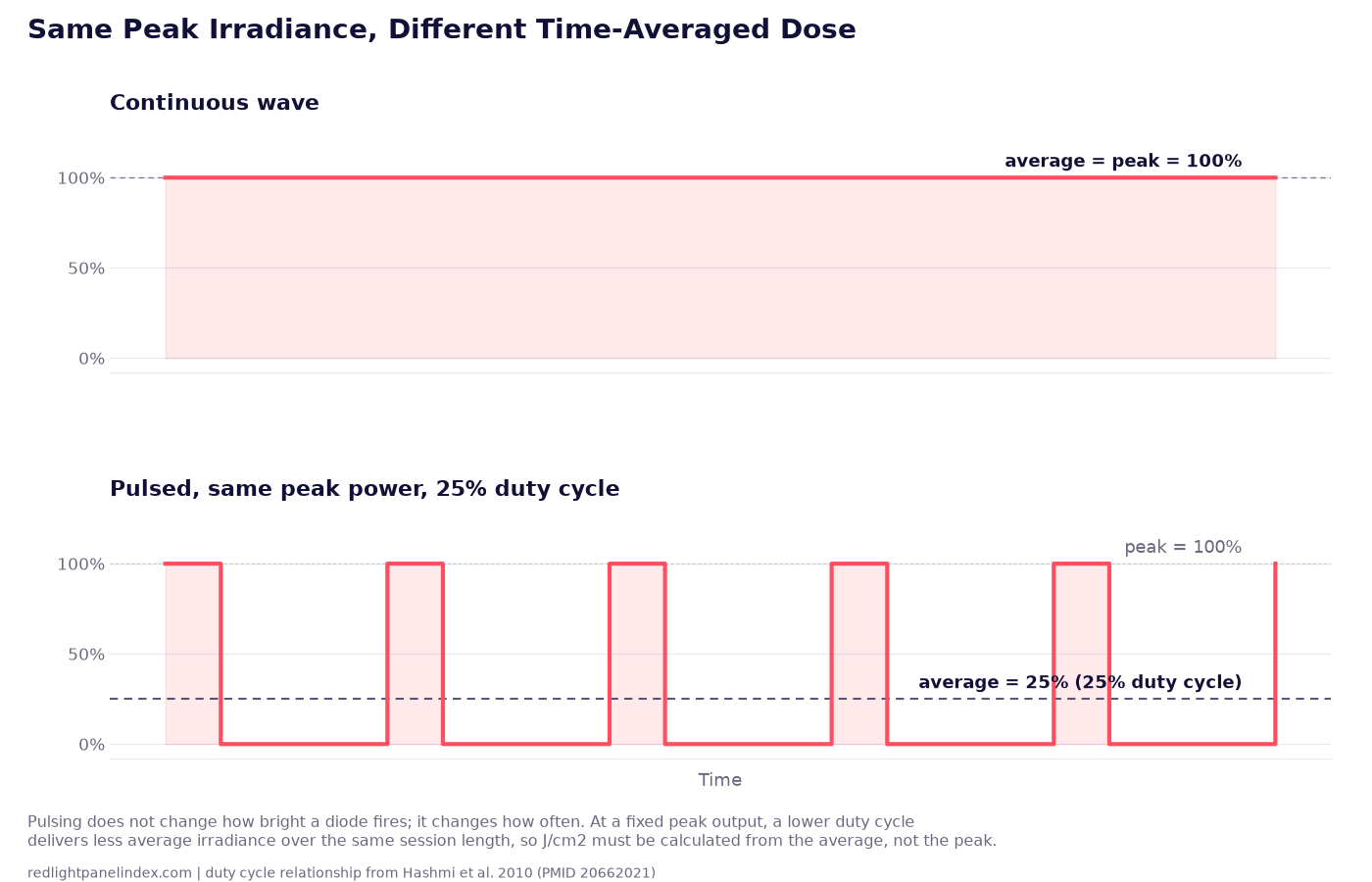
A continuous-wave diode stays on at a fixed output for the whole session. A pulsed diode switches on and off rapidly, at a set frequency, and spends only a fraction of each cycle actually emitting light, a fraction called the duty cycle. That deliberate, brand-controlled cycling is a different thing from the unwanted brightness ripple this site's flicker explainer covers, which comes from a poorly filtered driver rather than a chosen pulse setting and shows up even on a panel running in plain continuous-wave mode. The 2010 review states the relationship plainly: average power equals peak power multiplied by frequency and pulse duration, or duty cycle. Turn that around and peak power equals average power divided by duty cycle. A diode pulsing at a 25 percent duty cycle can fire at four times its continuous peak brightness for each brief burst and still deliver the same average output as a continuous diode running at one-quarter that peak, or it can run at the same peak as the continuous diode and end up delivering only a quarter of the average light over the same session length. The diagram above shows that second case: identical peak output, very different time-averaged dose, because the pulsed panel spends most of each cycle emitting nothing at all.
That distinction is not academic for dosing. This site's J/cm2 explainer and its irradiance page both work from average irradiance over the full session, and a pulsed panel's spec sheet peak number is not that figure; a panel that pulses at a low duty cycle needs either a much longer session or a much higher peak to match the same J/cm2 a continuous panel delivers at its published average.
Why pulsing might matter at all
The review lays out several proposed mechanisms for why pulsing could behave differently from continuous wave, without settling on which, if any, actually explains the mixed results above. One is thermal: pulsed light "has been shown to cause no measurable change in the temperature of the irradiated area" at an equivalent energy density to continuous wave, because the off-time between pulses, the quench period, lets tissue cool between bursts. That, the authors reason, could let a device fire at a much higher peak power than a continuous source without heating tissue, since the average output stays the same even as the peak climbs. A second proposed mechanism involves nitric oxide bound to cytochrome c oxidase, the same enzyme this site's photobiomodulation page covers as the accepted starting point for red and near-infrared light's cellular effects: the authors hypothesize that pulsing could allow multiple rounds of nitric oxide release from that enzyme, where continuous light might let the nitric oxide rebind before another release can happen. A third and more speculative hypothesis ties common LLLT pulse frequencies to the frequency ranges of human brainwaves, on the idea that a matching frequency might have some resonance effect in transcranial applications specifically. The review calls these hypotheses, not established findings, and none of them is tested directly against the wound, pain, stroke, bone and nerve studies summarized below; they are the authors' proposed reasons pulsing could plausibly differ from continuous wave, offered alongside a mixed and inconclusive evidence record rather than in place of one.
It is also worth separating the pulsing technology in most of the underlying research from what a consumer panel's pulse button does. Several of the studies behind that research used superpulsed lasers, a laser technology that fires extremely brief, nanosecond-scale pulses at kilohertz frequencies to reach very high peak powers with a low average output, built for a completely different reason than a panel's on-off switching at a selectable frequency. Across the sources the review surveys, LLLT pulse frequencies ranged from about 2.5 Hz up to 10,000 Hz, overlapping the frequency ranges used in other pulsed physical therapy modalities such as TENS and pulsed electromagnetic field therapy, but the review does not identify a frequency range that works best across conditions, and a superpulsed laser's nanosecond pulses are not the same waveform as an LED panel's pulse setting even when both are described with the same word.
What the studies found
The review looked at published comparisons between continuous and pulsed light going back to 1970 and grouped them loosely by outcome, without landing on one winner. Several studies favored pulsed light in specific settings: an episiotomy wound-healing study found pulsed 670nm light in the 10 to 50 Hz range outperformed continuous wave; a mouse pain study reported pulsed light, particularly at 10 Hz and 8,000 Hz, more effective than continuous; an ischemic stroke study in an animal model found pulsed 808nm light at 100 and 1,000 Hz reduced neurological deficits more than continuous wave; an in vitro bone study found pulsed 830nm light at 2 Hz stimulated bone formation more than continuous; and a study on light penetration through a melanin filter found pulsed 670nm light in the 100 to 600 Hz range penetrated better than continuous (PMID 20662021).
Other comparisons ran the other way or found no real difference. One wound-healing comparison found continuous 635nm light more effective than pulsed variants, though the review describes the gap as small. A nerve-regeneration study found continuous 808nm light produced faster nerve and muscle recovery than a pulsed 905nm laser, though combining continuous and pulsed together outperformed either alone in that same study. A tensile-strength wound-healing comparison found continuous and pulsed light performed about the same. And in a separate set of nerve-conduction studies the review covers, pulsed light showed no significant benefit at all, with one study reporting that a specific pulsed protocol actually decreased nerve regeneration rather than helping it.
The authors' own conclusion sits in the middle of that mixed record: pulsed light may be somewhat better than continuous wave for wound healing and post-stroke recovery specifically, based on the studies above, but continuous wave remains the field's default and has been used across essentially every low-level light therapy application, and the review closes by saying more research is needed before pulsing's role becomes clear, across different conditions and different pulse structures. Nothing in the review suggests a frequency or duty cycle that works best across conditions; the studies above used frequencies ranging from 2 Hz to 8,000 Hz, and what helped in a mouse pain model or a bone-formation dish is not shown to transfer to a wound, a nerve, or a face.
What the review does not cover
The 2010 review is built almost entirely from laser studies, animal models and a handful of small human trials run between 1970 and 2010, not from consumer LED panels, and it mentions LEDs only once, noting in passing that pulse-generator technology can drive LED arrays the same way it drives lasers. No study in the review, and no study this site has found since, compares a home LED panel's continuous mode against that same panel's own pulsed mode on a matched outcome. The specific pulse frequencies and duty cycles built into today's app-controlled panels are not the frequencies tested in the studies above, so even where pulsing showed a benefit in an animal wound model, that finding does not establish anything about a specific panel's pulse setting for skin, joint or recovery use.
What this means for choosing a mode
Continuous wave is the setting every trial this site cites for skin, joint and whole-body outcomes actually used, and it is the mode a method-labeled irradiance figure on a database page describes. Switching a panel to a pulsed setting changes the actual dose delivered per minute, sometimes sharply depending on the duty cycle, which means a session length calculated from the panel's continuous-mode irradiance no longer applies once pulsing is turned on; run the dose calculator again using the pulsed mode's own average irradiance, if the brand publishes one, rather than reusing a continuous-mode session length. For general use aimed at reproducing a published trial's dose, continuous wave is the safer default, since it is what the trials were run on and what a panel's chip design and irradiance figures are usually measured against. A pulsed setting is worth trying only as a deliberate choice following a specific published protocol and frequency, not as a general upgrade over continuous, since the evidence for pulsing is real but narrow, condition-specific, and not yet demonstrated on the kind of device sold as a home panel.