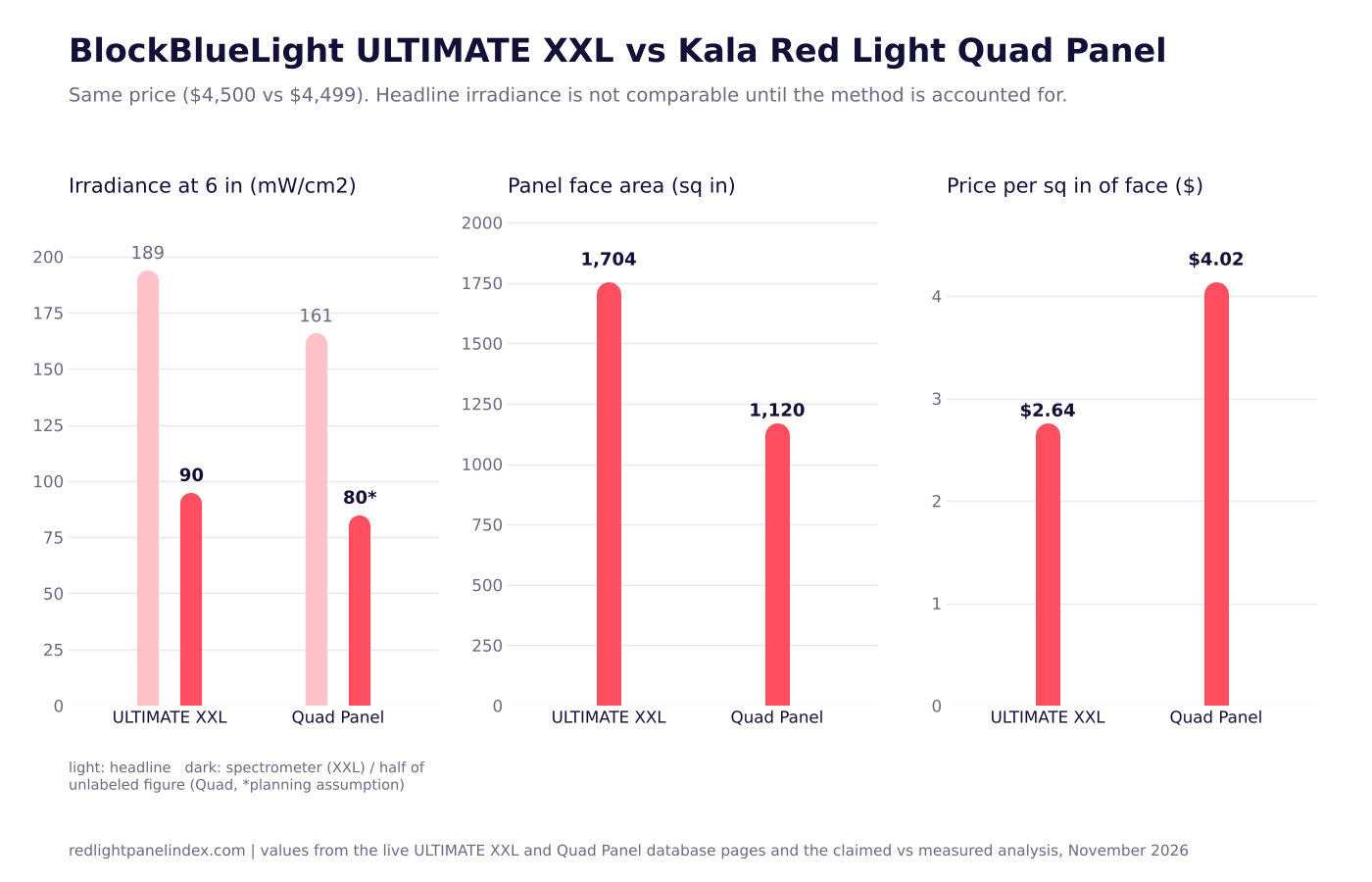
The BlockBlueLight ULTIMATE XXL at $4,500 (verified 2026-09-13) and the Kala Red Light Quad Panel at $4,499 (verified 2026-08-13) cost the same, but only one of them tells you how its irradiance was measured. BlockBlueLight publishes a solar meter figure and a spectrometer figure for the XXL; Kala prints 161 mW/cm2 at 6 inches without naming an instrument. Once both are put on a common footing, the XXL has the larger face, the wider wavelength mix and the longer warranty, while the Quad has a simpler two-band spectrum, a mixed-angle beam and a stand in the box.
Choosing a panel? Our ranking of the best red light therapy panels is computed from published, method-labeled specs across 188 devices. For two full-body panels at the same price, the spec that matters is the instrument behind each irradiance figure, since a spectrometer reading and an unlabeled number are not on the same scale.
The two panels, side by side
Every figure below comes from the two live database pages, last reviewed November 2026. Prices change, so confirm on the brand site before buying.
| Spec | BlockBlueLight ULTIMATE XXL | Kala Red Light Quad Panel |
|---|---|---|
| Price | $4,500 (verified 2026-09-13) | $4,499 (verified 2026-08-13) |
| Brand irradiance at 6 in | 189 mW/cm2, dual-disclosed: solar meter and spectrometer | 161 mW/cm2, method not stated (brand range 135 to 161, instrument not named) |
| Spectrometer figure | 90 mW/cm2 (brand disclosure) | None published |
| Wavelengths | 590, 630, 660, 810, 830, 850, 1060nm | 660, 850nm |
| Allocation | 16, 17, 17, 14, 14, 13, 9 percent | 50/50 |
| LEDs | 1,200, 5W dual-chip | 924, type not published |
| Beam angle | 60 degrees | 30 and 60 degrees (mixed lens angles) |
| Panel size | 71 x 24 x 2.6 in | 70 x 16 x 2.5 in |
| Face area | About 1,704 sq in | About 1,120 sq in |
| Controls | Touchscreen, user-savable presets, Ambient low-intensity mode | Continuous or pulsed, plus timers |
| EMF | 0.1 microtesla at 6 in | 0.00 at 4 in |
| Stand | Not included | Ships with the Kala Mobile Stand |
| Warranty | 5 years | 2 years |
| Trial | 30 days | 30 days |
| Returns | No restocking fee on panels; customer pays return shipping | $15 restocking fee on all returns; Kala does not pay return shipping |
The brand pages for BlockBlueLight and Kala list the smaller panels in each lineup.
Irradiance: one labeled pair, one bare number
At face value the XXL's 189 mW/cm2 is about 17 percent higher than the Quad's 161. Neither number should be compared with the other as printed.
BlockBlueLight ULTIMATE XXL. BlockBlueLight discloses both instruments across its lineup. The site's claimed versus measured analysis lists the XXL at 189 mW/cm2 claimed and 90 by spectrometer, a ratio of 2.10, the same pair it lists for the ELITE XL. Across the 44 panels where a headline can be checked, the analysis finds headline figures average 2.11 times the spectrometer reading, so the XXL sits right on that average. Plan with the 90.
Kala Red Light Quad Panel. Kala states 135 to 161 mW/cm2 at 6 inches across its lineup and names no instrument. The model page says to treat the figure as not comparable to spectrometer numbers and to work from roughly half of it. That gives a working value of about 80 mW/cm2. This is a planning assumption, not a measurement, and the real figure could be higher or lower. No independent reading for any Kala panel is in the database.
On a common footing. That puts the two panels close: about 90 against about 80 mW/cm2 at 6 inches, with the XXL's number checkable and the Quad's not. The irradiance page explains why the instrument and the distance change the number, and the solar power meter page explains why a sunlight-calibrated sensor reads LED panels high.
Session length at 6 inches
Dose in J/cm2 is irradiance in W/cm2 multiplied by seconds. Taking 20 J/cm2 as an example inside the 10 to 60 J/cm2 range the model pages point to, the dose calculator gives:
- ULTIMATE XXL at its 90 mW/cm2 spectrometer figure: about 222 seconds, or a little under 4 minutes.
- Quad Panel at the 80 mW/cm2 working value: about 250 seconds, or a little over 4 minutes.
Dosing either panel from its headline would cut the session roughly in half and likely fall short of the target.
Wavelengths: seven bands against two
The Quad splits its LEDs evenly between 660nm and 850nm, the classic pairing the 660nm vs 850nm page describes as red for the skin and near-infrared for deeper tissue. The XXL spreads its LEDs across seven bands, and only 30 percent of them sit at 660nm and 850nm. Add the neighboring bands and the XXL is about half visible (590, 630 and 660nm) and about two-fifths near-infrared (810, 830 and 850nm), plus 9 percent at 1060nm. These are shares of LEDs, not measured shares of power.
What do the extra bands add? The 810nm vs 850nm page finds the practical difference between those neighbors small, though 810nm is the band most transcranial trials were built around. The 1064nm page notes that the research on that deep band used lasers, not LED panels, so a 9 percent share is a small part of the XXL's output and not a tested home dose. The 590nm amber band appears in one split-face trial that found it close to 660nm red for periocular wrinkles, covered in the periocular wrinkle trial review.
Area, LEDs and beam angle
This is the clearest physical difference. The XXL is 71 by 24 inches, about 1,704 square inches of face; the Quad is 70 by 16 inches, about 1,120. They are the same height, but the XXL is 8 inches wider, enough to cover more of the body's width without turning. Per square inch of face, that is about $2.64 for the XXL against $4.02 for the Quad. The largest panels ranking and the treatment area guide explain what face area does and does not tell you.
The Quad packs its LEDs a little tighter, about 0.83 per square inch against 0.70. The XXL's LEDs are 5W dual-chip, which, as the LED chip page explains, means each diode splits its power between two wavelengths; Kala does not publish a chip type.
The XXL states a 60-degree beam. The Quad mixes 30-degree and 60-degree lenses. The beam angle page explains that a narrow beam keeps more output concentrated in front of each LED and a wider one spreads it, so the Quad's mixed lenses may hold up a little better as you step back, but Kala publishes no figure beyond 6 inches to show it.
Controls, stand and the regulatory label
The XXL has a touchscreen, savable presets and a low-intensity Ambient mode. The Quad offers continuous or pulsed output plus timers. The pulsed versus continuous page found no general advantage for pulsing, which lowers average output, so continuous mode is the reference for dose arithmetic.
The Quad ships with the Kala Mobile Stand. The XXL does not include a stand, so add one to the price.
BlockBlueLight describes its panels as FDA-registered, and the database lists that as accurate; registration is a listing, not a clearance. Kala displays an "FDA Cleared" badge, but the database found no 510(k) number for it and lists the panel as not cleared. The FDA clearance page explains the difference. No rectangular red light panel is FDA cleared.
Terms
The XXL carries a 5-year warranty against the Quad's 2 years. Both have a 30-day trial. BlockBlueLight charges no restocking fee on panels, but the buyer pays return shipping, and items bought with a discount code over 15 percent, which includes major sales, are exchange or store credit only. Kala charges a $15 restocking fee on every return and does not pay return shipping. On panels this large, return freight is the real cost, so ask for a quote before buying. Kala's store is priced in Canadian dollars, so confirm the currency at checkout; BlockBlueLight charges about $10 for shipping to most regions.
Verdict by use case
If you want a number you can dose from: the ULTIMATE XXL. Its 90 mW/cm2 is a brand spectrometer figure printed beside the solar meter headline.
If you want the most coverage for the money: the XXL, with about half again as much face area at the same price.
If you want 810nm or a deep infrared band: the XXL is the only one of the two that carries them, though the 1060nm share is small.
If you want a simple red and near-infrared panel with a stand included: the Quad. Plan from about 80 mW/cm2 until a spectrometer reading exists.
If you want pulsing: the Quad lists a pulsed mode; the XXL's database page lists presets and an Ambient mode but no pulse setting.
If warranty or return terms decide it: the XXL, with 5 years against 2 and no restocking fee, though its discount-code rule matters if you buy on sale.
For a smaller BlockBlueLight against another two-band panel, see the PowerPanel MEGA vs Orion Pro 900 head-to-head. For other panels above $2,000 on the same criteria, see the premium panel ranking.