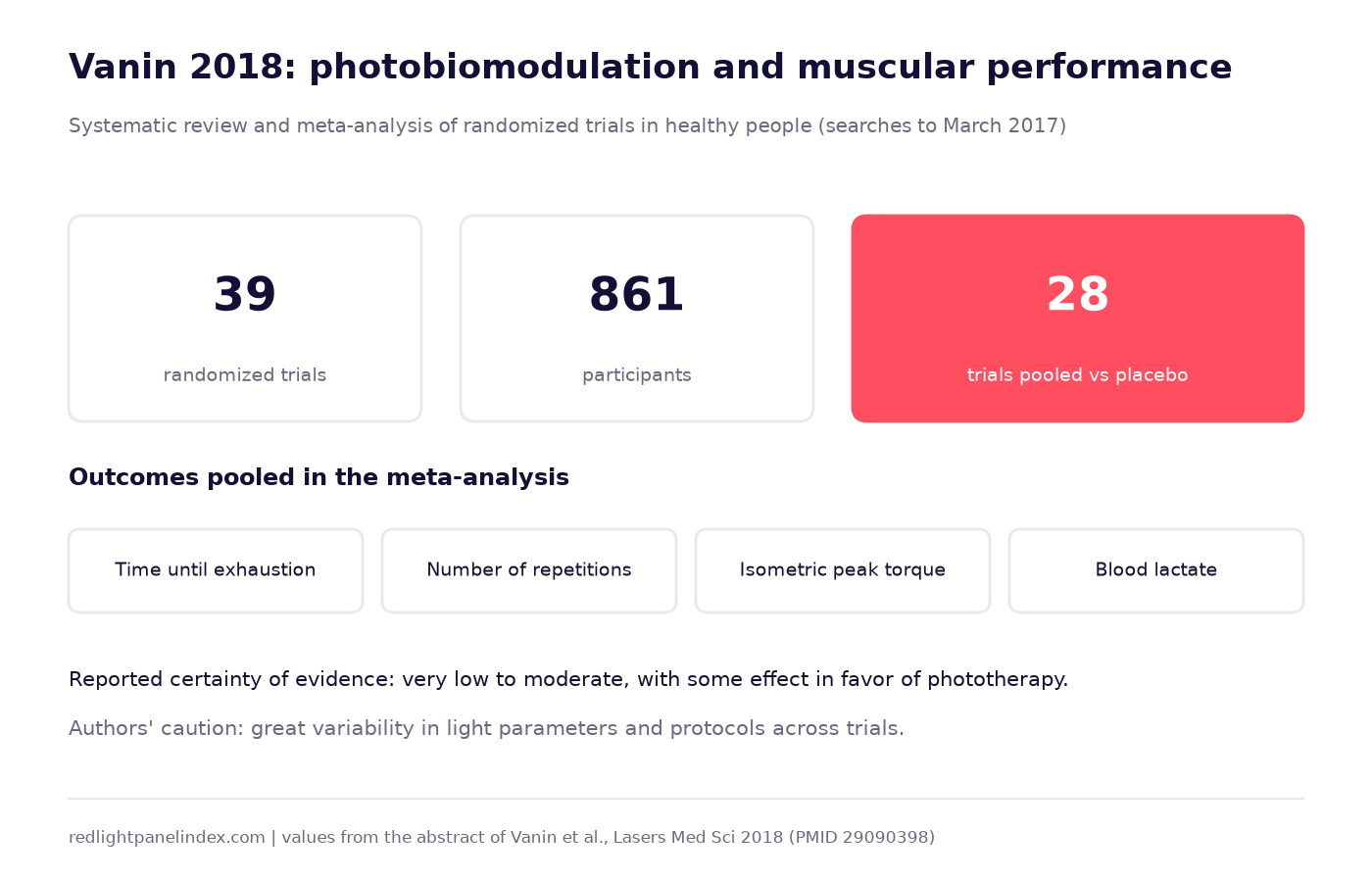
A 2018 systematic review and meta-analysis by Vanin and colleagues pooled randomized trials of phototherapy in healthy people and reported some effect in favor of light on time to exhaustion, repetitions, isometric peak torque and blood lactate, with the certainty of that evidence rated very low to moderate (PMID 29090398). The authors also flagged great variability in light parameters and protocols across the trials, which is the most useful thing to carry away from it.
Choosing a panel? Our ranking of the best red light therapy panels is computed from published, method-labeled specs across 188 devices. For muscle performance, the spec that matters is total optical power delivered to the muscle, not the irradiance density printed on the box.
What the study asked
The review set out to answer three questions about phototherapy (low-level laser and LED light) in healthy people: whether it improves muscular performance and reduces muscular fatigue, when within an exercise protocol it should be applied, and which light parameters are optimally effective. It is a companion to the 2015 Leal-Junior meta-analysis, which asked a narrower question about trials timed around exercise, and it is one of the reviews behind this site's sports performance evidence page.
Who was studied
The authors searched PubMed, PEDro, the Cochrane Library, EMBASE and Web of Science for randomized clinical trials through March 2017. They included 39 trials with 861 participants, all healthy people rather than patients. Data from all 39 trials were reported descriptively in tables, and 28 of them were included in the meta-analysis against placebo. The abstract does not break the participants down by sport, sex or age, so this page does not either. The authors also assessed risk of bias and the quality of the evidence for each pooled outcome.
Device and parameters as stated
Because this is a review of many trials, there is no single device. The pooled trials used both low-level laser and LED devices, and the review's finding on parameters is a range rather than a recipe. As summarized on this site's sports performance page, the review reported positive results across roughly 655 to 950nm, with the most favorable outcomes at energy doses of 20 to 60 joules for smaller muscle groups and 60 to 300 joules for larger ones, delivered before exercise, at up to 200mW per diode. Those are joules per treated site, not joules per square centimeter; the difference is explained here. The wavelength range spans visible 660nm red into 850nm near-infrared, and the device class ranges from single-diode probes to LED clusters, a split covered in LED versus laser.
What was measured and what was found
The meta-analysis covered four variables: time until exhaustion, number of repetitions, isometric peak torque and blood lactate. Across them the authors report some effect in favor of phototherapy, with the quality of evidence ranging from very low to moderate depending on the outcome. The abstract as read for this page does not give a single pooled effect size we can quote, so no percentage or mean difference is stated here. The direction is consistent with the Leal-Junior review, which did report pooled seconds and repetitions for a smaller set of trials, but the two should not be added together, since they overlap in the trials they draw on.
Limitations
The authors' own caution is the main limitation: there was great variability in the light parameters and protocols of the trials, which they say makes it hard to establish the efficacy of the therapy for use in sport or clinic. Other limits follow from the design:
- A "very low to moderate" certainty rating means further trials could change the result for some of the outcomes.
- The outcomes are acute laboratory measures (how long, how many reps, how much torque). None is a season-long competitive result.
- Dose ranges were identified from what the pooled trials used, not from a trial that tested doses head to head, so they describe where results clustered rather than a proven optimum. The biphasic dose response is a reason to be careful about assuming that more is better.
- Sham designs vary in quality between trials; the general problem is covered in the sham-controlled trials explainer.
What this means for a home panel
The gap between the trial devices and a home panel is the whole story. Trial doses are stated in joules delivered to a site by diodes of up to 200mW each; a panel is specified by irradiance in mW/cm2 over a large surface. To compare them you need total optical power at the skin, which is why the site separates irradiance from total power. As an illustration only, not a figure from the review: a panel delivering 50 mW/cm2 across a 100 cm2 patch of skin puts 5 watts, or 5 joules per second, on that patch. Reaching the low end of a 60 joule window then takes about 12 seconds of that delivery, and the dose calculator lets you run the same arithmetic with a real panel's method-labeled irradiance and your actual distance.
Two cautions apply. First, a panel's advertised irradiance is often a brand claim without a named instrument, so the seconds you calculate can be optimistic; see how rankings work for how this site treats unlabeled figures. Second, the review's timing finding is before exercise, so a panel session belongs ahead of the workout rather than after it. The review does not show that a panel reproduces the trial results, only that the tested doses and wavelengths are reachable in principle. For the wider evidence base see the muscle recovery evidence page, the athlete recovery panel ranking and the how-often guide.
Read alongside the other exercise reviews, the practical takeaway is modest. The pattern across trials is that light applied ahead of effort was associated with small gains in short, hard performance measures, and the authors themselves stop short of calling the evidence settled. Someone deciding whether a panel is worth buying for training should treat this review as a reason to run a careful, consistent trial of their own (same timing, same distance, same session length, tracked over several weeks) rather than as a promise of a specific improvement.