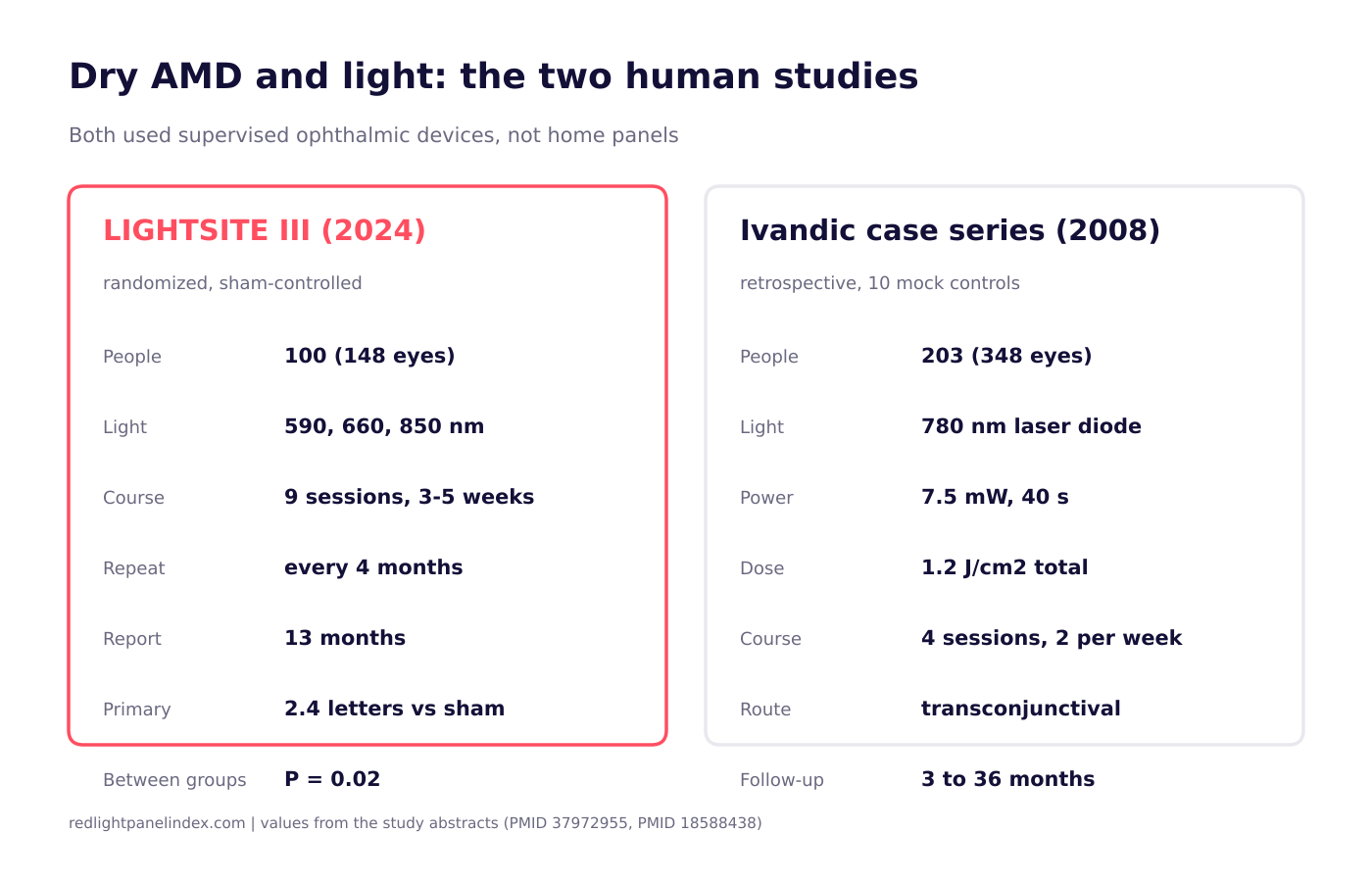
The evidence grade for photobiomodulation in dry age-related macular degeneration (AMD) is Limited: one randomized, sham-controlled trial of a clinic-based multiwavelength device reported a small visual acuity difference at 13 months (PMID 37972955), and an older, uncontrolled laser case series reported larger gains (PMID 18588438). Both used ophthalmic devices delivered under clinical supervision, and neither tested a home LED panel, so neither gives a protocol a panel owner can follow.
Choosing a panel? Our ranking of the best red light therapy panels is computed from published, method-labeled specs across 188 devices. For eye questions, the spec that matters is not irradiance but whether a trial dose exists at all, and for AMD none exists for a home panel.
Why the grade is Limited
This site grades evidence as Strong, Moderate, Limited or Insufficient, and the evidence grades explained page describes each level. AMD reaches Limited and not Insufficient because there is a randomized, sham-controlled trial with a stated protocol and a prespecified primary endpoint. It does not reach Moderate because the sham-controlled evidence here is one trial, the visual acuity difference was small, the device is a specialized clinic system, and the other human study is an uncontrolled case series. The broader eye health evidence page grades the wider eye question Limited as well.
What the studies found
LIGHTSITE III (2024)
Boyer and colleagues published the 13-month analysis of LIGHTSITE III in Retina (PMID 37972955; see the full LIGHTSITE III study review). It was a randomized, controlled trial of multiwavelength photobiomodulation in nonexudative (dry) AMD using the LumiThera Valeda Light Delivery System. Light at 590, 660 and 850nm was compared with sham treatment. Treatment was given in nine sessions over 3 to 5 weeks, repeated every four months over 24 months; this report covers the first 13 months.
The trial randomized 100 people, 148 eyes, with 91 eyes in the treated group and 54 in the sham group. The primary endpoint was best-corrected visual acuity, and the abstract reports it was met, with a between-group difference of 2.4 letters (95% CI -4.7 to -0.1; P = 0.02). Both groups improved from baseline: the treated group by 5.4 letters and the sham group by 3.0 letters. That second figure matters. Even the sham group gained, so most of the change in the treated group appeared in both arms, and the between-group difference is the part attributable to the light.
The abstract also reports a significant reduction in new-onset geographic atrophy in the treated group (P = 0.024, odds ratio 9.4) and describes a favorable safety profile, without giving adverse event counts. The authors conclude that clinical and anatomical outcomes improved in intermediate dry AMD. A trial this size cannot settle how large or durable the effect is, and 13 months is the first half of a 24-month design.
The 2008 laser case series
Ivandic and Ivandic reported a case series of 203 patients, 348 eyes, with dry or wet AMD (PMID 18588438). Of these, 193 patients (328 eyes) received low-level laser therapy and 10 patients (20 eyes) received a mock treatment as controls. The device was a 780nm semiconductor laser diode at 7.5 mW applied transconjunctivally to the macula for 40 seconds per session, which the abstract gives as 0.3 J/cm2 per session and 1.2 J/cm2 in total, over four sessions twice a week.
The abstract reports improved visual acuity compared with baseline in 162 of 182 eyes with cataracts and 142 of 146 eyes without, reduced frequency of metamorphopsia, scotoma and dyschromatopsia, and visual acuity in the control group that did not change. Improved vision lasted 3 to 36 months. No adverse effects were observed. Those are striking numbers, and they need caution. The analysis was retrospective, the control group was ten people, and a laser applied through the conjunctiva to the macula is a different intervention from any light a panel emits. The result is a reason the field kept going, not proof that the light caused the gains.
Why a clinic device is not a home panel
Three differences stand between these trials and a panel on a wall. The first is the dose. LIGHTSITE III specifies a schedule of nine sessions over 3 to 5 weeks repeated every four months, delivered by a system designed for the eye, and the abstract does not give irradiance in the form a home user could match. The second is delivery. The 2008 laser was applied transconjunctivally to the macula for 40 seconds, with the beam directed at the target. A panel emits a broad beam that is spread over a large area and falls off with distance. The third is supervision. In a clinical trial, outcomes such as visual acuity are measured by trained staff on a schedule. A person using a panel at home has no equivalent check on their vision.
What was not studied
- Home LED panels. No study in this evidence used a consumer panel at a distance, and the site's dose calculator has no AMD dose, because no trial supplies one.
- Wet (exudative) AMD in a controlled trial. LIGHTSITE III enrolled dry AMD. The 2008 series included wet AMD but without a meaningful control arm.
- Late-stage disease. The trial's own wording concerns intermediate dry AMD.
- Long-term outcomes. The 13-month report is part of a 24-month design, and the 2008 follow-up spanned 3 to 36 months of variable length.
- Independent replication. The sham-controlled evidence here is a single trial of a single device system.
What this means in practice
If you have been diagnosed with AMD, the practical point is about who is in charge of the decision. A treatment that is delivered in a clinic, to a defined protocol, with an ophthalmologist monitoring the retina is not something to approximate at home. Photobiomodulation for AMD is discussed in the clinical literature as a supervised therapy, and your eye specialist is the person to ask whether it is relevant to your stage of disease.
For readers who want to understand the physics, the trials used red and near-infrared bands that also appear on panels. The 660nm explainer and the 850nm explainer describe those bands, and the wavelengths overview puts them in context. Understanding them does not translate a clinic dose into a panel dose. Panel irradiance varies with distance and with how it was measured, as the irradiance page explains, and none of that has been tested against the retina.
A separate line of research asks whether 670nm light affects normal aging vision in healthy adults; it is covered in the 670nm vision study review and is not evidence about AMD.
Cautions
- Do not point a panel at your eyes to try to replicate these trials. Read the eye protection guide and the safety and side effects page first, and use the goggles supplied with a device for face sessions.
- Do not delay or replace standard AMD care, including monitoring and any prescribed treatment, on the basis of a photobiomodulation trial.
- Sudden changes in vision, new distortion of straight lines, or a new dark spot need prompt assessment by an eye professional, whatever light device you use.
- Some medications increase light sensitivity; the photosensitizing medications guide lists the main ones.
The honest summary is that dry AMD has the most credible controlled eye data in this field, and that the data describe a clinic device and a modest difference. They do not describe a panel.