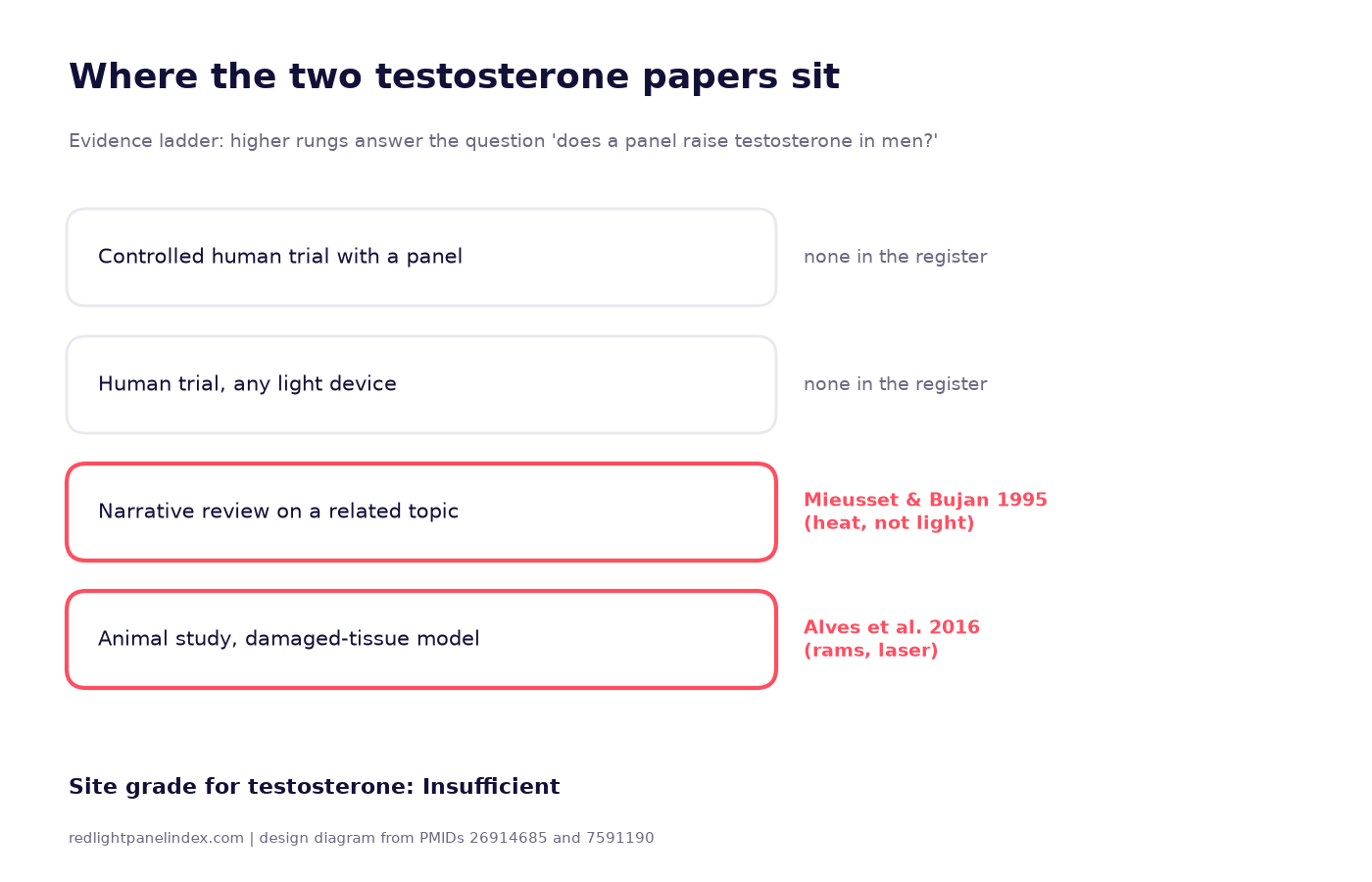
The testosterone evidence for red light panels consists of exactly two papers in this site's register: a veterinary study of low-level laser therapy in rams with testicular degeneration (PMID 26914685) and a 1995 review on how heating the testes affects sperm production (PMID 7591190). Neither is a trial of a red light panel in men, and neither measures a hormone outcome in a human, which is why the site grades testosterone as Insufficient.
Choosing a panel? Our ranking of the best red light therapy panels is computed from published, method-labeled specs across 188 devices. For a hormone claim, the spec that matters is none: no panel spec has been tied to a testosterone result in men.
What the studies asked
The ram study asked whether low-level laser therapy applied to degenerated testes could improve recovery. Judging by its published title, it looked at several outcomes together: seminal characteristics, scrotal temperature, plasma testosterone concentration and testes histopathology (PMID 26914685). The question was a veterinary one, about restoring breeding function in animals whose testes had degenerated.
The heat review asked a different question entirely. It examined whether raised testicular temperature could contribute to male infertility, covering both animal and human material and the idea that mild heating might even work as a contraceptive method (PMID 7591190). It is not about light at all. It belongs in the register because any honest discussion of a device that warms tissue near the groin has to address heat.
Who was studied
The first paper studied rams (sheep), specifically animals with testicular degeneration, which is a damaged-tissue model. That matters because a treatment that helps a damaged organ recover is a different claim from a treatment that raises a hormone in a healthy adult. The abstract could not be read in full for this review, so the number of animals and how they were grouped are not reported here.
The second paper is a narrative review. It studied no participants of its own; it gathers published work on testicular temperature in humans and animals. The PubMed record carries no abstract, so this page describes it by its title and subject only.
Device and parameters as stated
The ram study used laser light, not an LED panel. Its wavelength, power density, dose and session schedule are not reproduced here because the abstract was not available to read during this review, and this page does not guess at figures. For how laser and LED sources differ in beam, power and coverage, see the explainer on LED versus laser.
The heat review has no device parameters. The relevant variable is scrotal temperature, which is a thermal exposure, not a photochemical dose. A red or near-infrared panel is usually described as delivering light at the skin; how much a given session warms tissue depends on irradiance, distance and time, which the dose calculator helps estimate for any panel, though it cannot tell you a safe testicular temperature.
What was measured and found
From the ram study's title, the measured outcomes were seminal characteristics, scrotal temperature, plasma testosterone and testes histopathology. This review does not report figures for any of them, because the abstract was not readable here. The site's myths checked guide summarizes one finding from it: the lower of two tested laser doses was associated with reduced sperm motility and membrane integrity, which is the opposite of what the marketing claim needs. What can be said is what kind of evidence this is: an animal study, in a damaged-tissue model, using laser, with hormone level as one of several outcomes.
From the heat review, the settled point in its title and keywords is that testicular temperature is a recognized factor in sperm production and in male infertility. That is a finding about heat, in a 1995 review, and it is the reason the site cautions against treating the groin area as a place to experiment with prolonged exposure.
Limitations
Several limits are plain from the record itself:
- Species. Rams are not men. Findings in sheep cannot be carried over to human hormone levels.
- Damaged versus healthy tissue. The ram model used degenerated testes. A result in a damaged organ says little about a healthy one.
- Laser versus panel. The study used laser therapy, not a home LED panel. Dose, coverage and depth differ.
- No control of the kind a human claim needs. A claim about hormone levels in men would need a sham-controlled trial in men, with blinding and a pre-stated outcome. None is in the register.
- A review is not a trial. The heat paper synthesizes other work. It can explain a risk; it cannot show a benefit of light.
- Abstracts not fully read. Where this page says a detail is not reported, that is deliberate: only what could be read was used.
What this means for a home panel
A reader deciding whether a panel will raise testosterone should find nothing here to support that expectation. The ram paper is not a signal that a panel helps: the site's existing checks of it note that the lower of the two laser doses tested was associated with reduced sperm motility and membrane integrity, not better function. The heat review points the other way on caution: the testes are heat-sensitive, and pointing a powered device at them without evidence of benefit adds a thermal risk for no established gain.
The practical steps are modest. Treat any product page that promises a hormone result as making a claim the evidence does not back; the myths checked guide covers how marketing claims compare with the record. Keep sessions to the durations and distances suited to the skin area you are actually treating, and use the dose calculator to see what a panel delivers at a given distance and time. For general cautions on heat, eyes and medications, read safety and side effects. If a hormone concern is the reason for looking, that is a question for a clinician who can order a blood test, not for a panel.
How the grade follows from this
The site's evidence grade definitions reserve the top grades for controlled human trials. With one animal study and one review on heat, the testosterone page sits at Insufficient, and it would stay there until a controlled trial in men reports a hormone outcome. The full condition page is at red light therapy and testosterone, and it lists the same two papers. The underlying mechanism is covered in the overview of photobiomodulation, which explains why a cellular rationale is not the same as a demonstrated effect in a person. A separate explainer on thermal versus photochemical effects is planned; until it is live, the simple version is that heat and light act differently in tissue, and the heat literature here is the cautionary one.
The honest summary is short. There is a ram study that cannot speak for men, and there is a heat review that advises care. Together they leave the question open, not answered in either direction.