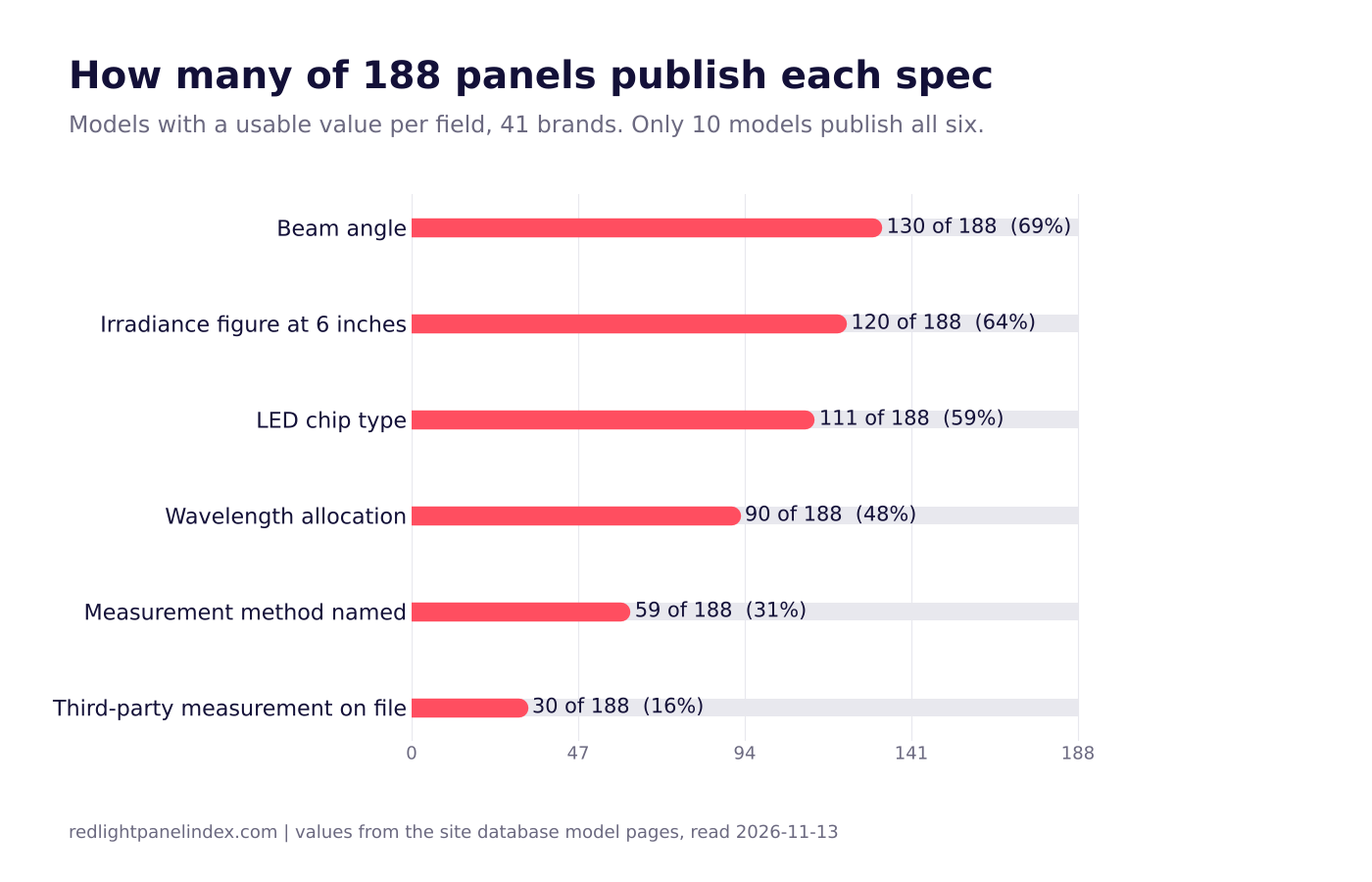
Out of 188 red light therapy panels from 41 brands in this site's database, only 10 publish all six specs a buyer needs to compare panels on paper: an irradiance figure at 6 inches, the method behind it, beam angle, wavelength allocation, LED chip type and a third-party measurement. The most common gap is the method. Only 59 models (31%) name the instrument behind their irradiance figure, and 13 brands publish no usable 6-inch figure for any model they sell. This page scores every brand on the same six fields, so a blank in the database reads as what it is: a spec the brand has not published.
Choosing a panel? Our ranking of the best red light therapy panels is computed from published, method-labeled specs across 188 devices. For judging how far a brand's numbers can be trusted, the spec that matters is a 6-inch irradiance figure with its measurement method named.
This is a transparency page, not a ranking. A brand that publishes everything can still sell a weak panel, and a brand that publishes little can sell a good one. What the scorecard measures is how much of the comparison you can actually do before you buy.
The six fields and why each one matters
Each field is one a buyer needs to turn a product page into a comparison. These are the rules used for every model, including RLT Home's.
| Field | Counts as published when | Models (of 188) |
|---|---|---|
| Irradiance at 6 in | A numeric mW/cm2 figure stated at 6 inches (about 15 cm). Figures at the panel face, 3 inches or an unstated distance do not count | 120 (64%) |
| Method named | The figure names its instrument: spectrometer, solar power meter, or both | 59 (31%) |
| Beam angle | A lens angle in degrees | 130 (69%) |
| Wavelength allocation | How the LEDs or output split across wavelengths, as percentages, counts or a stated ratio | 90 (48%) |
| LED chip type | Single-, dual-, quad-chip, COB or equivalent. A wattage alone does not count | 111 (59%) |
| Third-party measurement | A measurement by someone other than the brand's own staff is on file: a reviewer's spectrometer test or a commissioned lab report | 30 (16%) |
Why these six. Irradiance at a stated distance is the input to every dose calculation, and the dose calculator cannot use a number without one. The method matters because a solar power meter reads roughly double what a spectrometer records on an LED panel, so an unlabeled figure could mean either. Beam angle controls how fast output falls off and how evenly the panel covers a body area. Wavelength allocation shows whether a panel listing seven wavelengths gives each one a real share of the LEDs or a token row. LED chip type tells you whether red and near-infrared share a lens. A third-party measurement is the only check on the brand's own number, and the claimed vs measured comparison shows why that check matters: across the 44 panels with both a claim and a spectrometer reading, the claim averaged 2.11 times the measured figure.
The scorecard: all 41 brands
Each cell shows how many of the brand's models in the database publish that field. "Fields filled" is the share of all six fields across all the brand's models. Brands are sorted by that share, then alphabetically. Every value comes from the brand's model pages in the database, where each field shows its source.
| Brand | Models | 6-in figure | Method named | Beam angle | Allocation | LED type | Third-party | Fields filled |
|---|---|---|---|---|---|---|---|---|
| RLT Home | 5 | 5/5 | 5/5 | 5/5 | 5/5 | 5/5 | 5/5 | 100% |
| Helio Cure | 4 | 4/4 | 1/4 | 4/4 | 4/4 | 4/4 | 2/4 | 79% |
| BlockBlueLight | 9 | 9/9 | 8/9 | 9/9 | 7/9 | 8/9 | 1/9 | 78% |
| Mito Red Light | 15 | 14/15 | 15/15 | 15/15 | 14/15 | 8/15 | 4/15 | 78% |
| Rojo Light Therapy | 5 | 5/5 | 5/5 | 5/5 | 0/5 | 5/5 | 2/5 | 73% |
| MITO LIGHT (EU) | 5 | 5/5 | 5/5 | 5/5 | 0/5 | 5/5 | 1/5 | 70% |
| CytoLED | 6 | 6/6 | 6/6 | 6/6 | 6/6 | 0/6 | 1/6 | 69% |
| Red Light Rising | 4 | 4/4 | 4/4 | 3/4 | 4/4 | 0/4 | 1/4 | 67% |
| Hooga | 13 | 13/13 | 0/13 | 13/13 | 8/13 | 13/13 | 2/13 | 63% |
| GembaRed | 3 | 3/3 | 0/3 | 1/3 | 3/3 | 2/3 | 2/3 | 61% |
| Rouge Care | 5 | 4/5 | 4/5 | 4/5 | 0/5 | 5/5 | 1/5 | 60% |
| BioLight | 3 | 3/3 | 0/3 | 3/3 | 0/3 | 2/3 | 2/3 | 56% |
| LightpathLED | 5 | 0/5 | 0/5 | 5/5 | 5/5 | 5/5 | 1/5 | 53% |
| Red Light Man | 4 | 1/4 | 0/4 | 4/4 | 4/4 | 3/4 | 0/4 | 50% |
| Valo | 2 | 2/2 | 0/2 | 2/2 | 0/2 | 2/2 | 0/2 | 50% |
| Kala Therapy | 5 | 4/5 | 0/5 | 4/5 | 4/5 | 2/5 | 0/5 | 47% |
| Infraredi | 8 | 6/8 | 6/8 | 0/8 | 0/8 | 8/8 | 0/8 | 42% |
| LifePro | 2 | 2/2 | 0/2 | 0/2 | 2/2 | 1/2 | 0/2 | 42% |
| PlatinumLED | 8 | 0/8 | 0/8 | 5/8 | 3/8 | 8/8 | 3/8 | 40% |
| Orion | 6 | 4/6 | 0/6 | 4/6 | 4/6 | 2/6 | 0/6 | 39% |
| ATaPa | 4 | 4/4 | 0/4 | 1/4 | 4/4 | 0/4 | 0/4 | 38% |
| Leredd | 4 | 0/4 | 0/4 | 3/4 | 2/4 | 4/4 | 0/4 | 38% |
| Bestqool | 5 | 0/5 | 0/5 | 5/5 | 0/5 | 5/5 | 0/5 | 33% |
| iRestore | 2 | 2/2 | 0/2 | 2/2 | 0/2 | 0/2 | 0/2 | 33% |
| Red Therapy Co | 3 | 3/3 | 0/3 | 0/3 | 3/3 | 0/3 | 0/3 | 33% |
| RedLife | 4 | 4/4 | 0/4 | 0/4 | 0/4 | 4/4 | 0/4 | 33% |
| EMR-Tek | 5 | 2/5 | 0/5 | 2/5 | 0/5 | 5/5 | 0/5 | 30% |
| Recover Red | 3 | 2/3 | 0/3 | 3/3 | 0/3 | 0/3 | 0/3 | 28% |
| Sun Home | 2 | 0/2 | 0/2 | 2/2 | 1/2 | 0/2 | 0/2 | 25% |
| Sunlighten | 2 | 0/2 | 0/2 | 2/2 | 1/2 | 0/2 | 0/2 | 25% |
| TrueLight | 2 | 2/2 | 0/2 | 0/2 | 0/2 | 1/2 | 0/2 | 25% |
| TheThermoLab | 5 | 5/5 | 0/5 | 1/5 | 0/5 | 1/5 | 0/5 | 23% |
| LuminousRed | 3 | 0/3 | 0/3 | 2/3 | 0/3 | 2/3 | 0/3 | 22% |
| Vital Red Light | 4 | 0/4 | 0/4 | 4/4 | 0/4 | 0/4 | 1/4 | 21% |
| BON CHARGE | 3 | 0/3 | 0/3 | 2/3 | 1/3 | 0/3 | 0/3 | 17% |
| Comfytemp | 1 | 1/1 | 0/1 | 0/1 | 0/1 | 0/1 | 0/1 | 17% |
| Fringe | 1 | 1/1 | 0/1 | 0/1 | 0/1 | 0/1 | 0/1 | 17% |
| Megelin | 4 | 0/4 | 0/4 | 0/4 | 4/4 | 0/4 | 0/4 | 17% |
| Vellgus | 4 | 0/4 | 0/4 | 4/4 | 0/4 | 0/4 | 0/4 | 17% |
| Scienlodic | 4 | 0/4 | 0/4 | 0/4 | 1/4 | 1/4 | 0/4 | 8% |
| Joovv | 6 | 0/6 | 0/6 | 0/6 | 0/6 | 0/6 | 1/6 | 3% |
Read the table by column as well as by row. A brand can be strong on one field and silent on another, and the pattern tells you what to ask before buying.
What the table shows, brand by brand
Full rows. RLT Home fills all six fields on all five models, the only brand to do so on every model. The same caution applies to it as to anyone else in the third-party column: its spectrometer figures come from a lab test the brand commissioned (Electropossible, at 6 inches), and its model pages note that no unaffiliated reviewer measurement is on file. That puts it in the same category as the lab reports behind Helio Cure, BioLight and GembaRed, not the reviewer tests behind the Light Therapy Insiders figures. A commissioned lab report names its instrument and distance, which is more than most brands offer, but it is not the same as a reviewer buying a panel and measuring it.
Close behind. BlockBlueLight and Mito Red Light both publish a solar meter figure and a spectrometer figure side by side on almost every model, which is why their method columns are full or nearly full. Mito's gaps are LED chip type on seven models and an independent test on most of its range. Helio Cure fills four or five fields on every model and all six on the Helio Glow, but names the instrument on only that one; three of its four figures are catalog values, and one is marked as extrapolated.
A full 6-inch column with no method. Hooga publishes a 6-inch figure on all 13 models and a chip type on all 13, but names the instrument on none. Independent spectrometer readings on two ULTRA models came in well below the brand's figures; the ULTRA1500 is listed at 165 mW/cm2 by the brand and was measured at 81.7 average by Light Therapy Insiders. This is the pattern the solar power meter page describes: a large number with no instrument attached.
No usable 6-inch figure at all. Thirteen brands publish no 6-inch irradiance figure for any model: Bestqool, BON CHARGE, Joovv, Leredd, LightpathLED, LuminousRed, Megelin, PlatinumLED, Scienlodic, Sun Home, Sunlighten, Vellgus and Vital Red Light. The reasons differ. PlatinumLED states no numeric mW/cm2 on its product pages and links lab charts instead, and three of its panels carry independent measurements, so its row understates how checkable it is. LightpathLED quotes 76 mW/cm2 at 12 inches on four models and a panel-face figure on the fifth, which are real numbers at a different distance. Joovv quotes more than 100 mW/cm2 with no stated distance on all six models and publishes none of the other five fields; the one checkable data point is an independent Light Therapy Insiders reading of the Joovv Solo 3.0 at 72.4 mW/cm2 peak and 59.2 average. Vital Red Light quotes a range of 150 to 210 with no distance, and its one independent reading (Outliyr, Vital Elite) was 78.3 mW/cm2 at 12 inches.
Wavelength allocation is a split field. Rojo, MITO LIGHT and Rouge Care publish 6-inch figures with methods on most or all models but no allocation for any model. Megelin is the reverse: allocation on all four models and nothing else. A buyer comparing multi-wavelength panels should check the multi-wavelength ranking, which only uses published allocation tables.
What a blank field means
A blank in the database is not an estimate and not a zero. It means the brand's own pages, and any named third party, do not state that value in a form that can be compared. The behind the database guide explains the rule: a field that cannot be sourced is marked "not published" rather than filled in, and an irradiance figure is treated as unverified until a method is attached.
That rule has consequences you can see on the site:
- A panel with no method-labeled 6-inch figure cannot rank on irradiance. The highest-irradiance ranking only includes method-labeled figures, so a strong panel can be absent simply because its brand never said how it measured.
- The irradiance labels on every model page (spectrometer, solar meter, method not stated) come straight from the method field. Of the 188 models, 129 have no named method behind whatever figure the brand publishes, or no figure at all.
- A missing beam angle means the site cannot say how quickly output falls off with distance for that panel, which is why the inverse square law page treats lens angle as an input, not a footnote.
Spec disclosure is also separate from marketing language. A brand can publish every field and still use loose claims, which is what the "medical grade" claims audit covers. And a brand can publish a method-labeled number that does not hold up, which is what the claimed vs measured page covers. This scorecard only asks whether the number is there to check.
The spread across models
Most models sit in the middle. Counting fields per model across all 188:
| Fields published (of 6) | Models |
|---|---|
| 6 | 10 |
| 5 | 20 |
| 4 | 40 |
| 3 | 34 |
| 2 | 43 |
| 1 | 31 |
| 0 | 10 |
The ten models with all six are the five RLT Home panels, the BlockBlueLight PowerPanel MEGA, three Mito Red Light models (MitoPRO 300X, MitoPRO MegaX and MitoADAPT MAX 4.0) and the Helio Cure Helio Glow. Ten models publish none of the six.
How to use this before you buy
- Find the panel's model page in the full panel list and look at which fields say "not published".
- If the irradiance line has no method, ask the brand which instrument it used and at what distance. A spectrometer figure at 6 inches is directly comparable to other spectrometer figures; a solar meter figure is not.
- If allocation is missing on a multi-wavelength panel, ask how many LEDs carry each wavelength. A seven-wavelength label with no split could be mostly two wavelengths.
- Check whether the third-party measurement, if any, was commissioned by the brand or taken by an unaffiliated reviewer. Both are useful; they are not the same thing.
- You can check an irradiance claim yourself with a meter, as long as you know what your meter reads compared with a spectrometer.
For the bigger picture of how 41 brands disclose irradiance and price their panels, see the state of the market report, and for how method-labeled figures feed the rankings, see how rankings work.
How the counts were made
Every count above was made from the 188 model records in the site database on 2026-11-13, using the field rules in the first table. Where a brand states a 6-inch figure and a separate field notes the distance is unstated, the figure is not counted. "Method named" follows the same classification the model pages use for their irradiance labels. The third-party column counts any measurement recorded on the model page, whether by a reviewer (Light Therapy Insiders, Outliyr) or a lab report the brand commissioned or links. If a brand publishes a missing field, its model pages are updated and this scorecard changes with them.