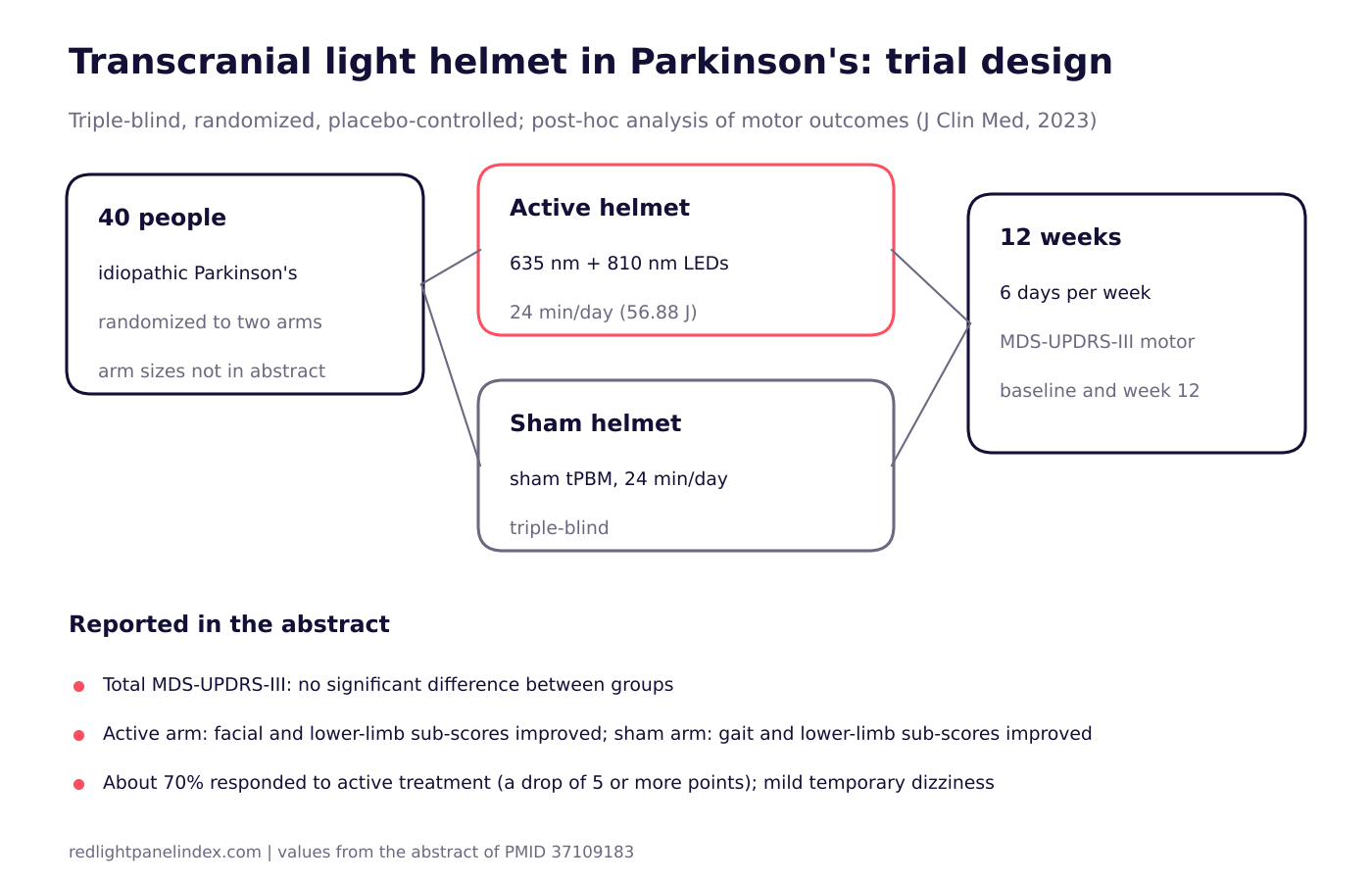
A 2023 trial in the Journal of Clinical Medicine randomized 40 people with idiopathic Parkinson's disease to an active or a sham transcranial light helmet, using 635nm and 810nm LEDs for 24 minutes a day, six days a week, for 12 weeks, and found no significant difference between the groups in total motor scores (PMID 37109183). Some motor sub-scores improved in the active group, and about 70 percent of participants responded to active treatment, but the paper's own title labels these results a post-hoc analysis, and the sham group improved on some measures too.
Choosing a panel? Our ranking of the best red light therapy panels is computed from published, method-labeled specs across 188 devices. For Parkinson's questions, the spec that matters is the published share of output at 810nm, but no panel has been tested for this condition, and a helmet worn on the head is a different intervention.
What the study asked
The authors set out to analyze the safety and efficacy of transcranial photobiomodulation (tPBM), meaning light applied to the head, for the motor symptoms of Parkinson's disease. The two primary measures named in the abstract were treatment safety and the motor section of a standard Parkinson's rating scale, the MDS-UPDRS-III, a 37-item assessment of movement scored by a clinician.
The title matters as much as the aim. The paper is described as a post-hoc analysis of motor outcomes. Post hoc means the analysis was shaped after the data were in, rather than fixed in advance. That does not make the findings wrong, but it changes how much weight they can carry. A pattern found after looking at the data is a reason to run a new test, not a confirmed result. The guide to sham-controlled trials explains why prespecified comparisons against a sham are the ones to trust most.
Who was studied
The abstract reports 40 participants with idiopathic Parkinson's disease, meaning Parkinson's without a known specific cause, randomized to active or sham treatment. It does not give the split between arms, ages, disease duration or medication status, so this review does not either.
Forty people across two arms is a small trial. In a condition where symptoms vary from day to day and with medication timing, a small sample means a few individuals can move a group average, and sub-score differences can appear by chance.
Device and parameters as stated
From the abstract:
- Device: a transcranial photobiomodulation helmet. The word helmet comes from the title; the abstract describes the treatment as tPBM.
- Wavelengths: 635nm plus 810nm LEDs.
- Session: 24 minutes per day.
- Energy per session: 56.88 J, as stated. This is total energy in joules, not a dose per square centimeter, and the abstract does not give the irradiance or the area treated.
- Schedule: six days per week for 12 weeks.
- Comparator: sham tPBM on the same daily schedule.
- Blinding: triple-blind.
- Assessments: at baseline and at 12 weeks.
The two wavelengths sit at opposite ends of the therapeutic range. 635nm is a visible red close to the 630nm band, which is absorbed mostly in the upper layers of skin. 810nm is near-infrared, the band most transcranial research used because it travels further through tissue. Even so, that 810nm page sets out a verified finding that only a small fraction of near-infrared light from 10 to 15 watt research lasers reaches 3 centimeters into tissue. A helmet at the scalp is the delivery route the trial tested. Because the abstract does not give an irradiance, the figures cannot be run through the dose calculator to compare with a panel.
What was measured and found
The abstract reports these results:
- Total motor score: no significant difference in total MDS-UPDRS-III scores between the active and sham groups. The authors attribute this to a likely placebo effect.
- Active group sub-scores: facial and lower-limb sub-scores improved significantly with active treatment.
- Sham group sub-scores: gait and lower-limb sub-scores improved significantly with sham treatment.
- Responders: approximately 70 percent of participants responded to active treatment, with a response defined as a drop of 5 or more points on the MDS-UPDRS-III. Active responders improved across all sub-scores; sham responders improved in lower-limb sub-scores only.
- Safety: the abstract reports occasional temporary and minor dizziness.
The abstract does not give p values, effect sizes or the sham responder rate in a form that can be quoted here. The authors conclude that tPBM appears safe and improved several motor symptoms in treatment responders, and describe it as an increasingly attractive possible non-drug adjunct therapy.
Read plainly, the main comparison, active against sham on the total motor score, did not show a difference. The positive findings come from sub-scores and from a responder analysis, which is exactly the kind of result a post-hoc analysis produces. The sham group's own improvement in gait and lower-limb scores shows how strong expectation and attention effects are in this condition.
Limitations
- Post-hoc analysis. By the paper's own description, the motor results come from an analysis shaped after the fact. Findings like these need a new trial with the comparison fixed in advance.
- Small sample. Forty participants split across two arms is too few to detect modest effects reliably or to rule out chance on individual sub-scores.
- No difference on the total score. The headline motor measure did not separate active from sham.
- Strong sham response. The sham group improved on gait and lower-limb scores, which makes within-group changes in the active group hard to interpret.
- Short course, no long follow-up. Assessments ended at 12 weeks. Nothing here speaks to whether any change lasts, or to disease progression.
- Missing parameters. The abstract gives energy in joules but not irradiance or treated area, so the dose cannot be compared with other devices.
The triple-blind sham design is a real strength, and it is the reason the null total score is informative. A trial without a sham would have reported improvement in the active group and had nothing to compare it with.
What it means for a home panel
The plain answer is that this trial tested a head-mounted LED helmet, not a panel, and it is not evidence that a panel pointed at the head would do the same thing.
- Different delivery. A helmet sits on the scalp and treats the head from many directions at once for a fixed time. A panel is aimed from a distance, usually at one side, and its output falls with distance, as the irradiance explainer shows. Matching wavelengths on a label does not make the dose the same.
- No efficacy signal on the main measure. The total motor score did not differ from sham. The sub-score and responder findings are hypotheses for the next trial.
- Keep Parkinson's care with the treating team. If you are reading this for yourself or a family member, nothing in the trial supports changing medication or care. Discuss any add-on with the neurologist who knows the history.
- Eyes and light. Any bright light used near the face needs care; the brain and mood evidence page covers safety for head-directed light and grades the wider transcranial evidence Insufficient.
The honest summary: a well-blinded but small trial of a light helmet found no difference from sham on total motor scores, with some sub-score changes reported in a post-hoc analysis. It is a reason for a larger, prespecified trial, not a reason to buy a device.