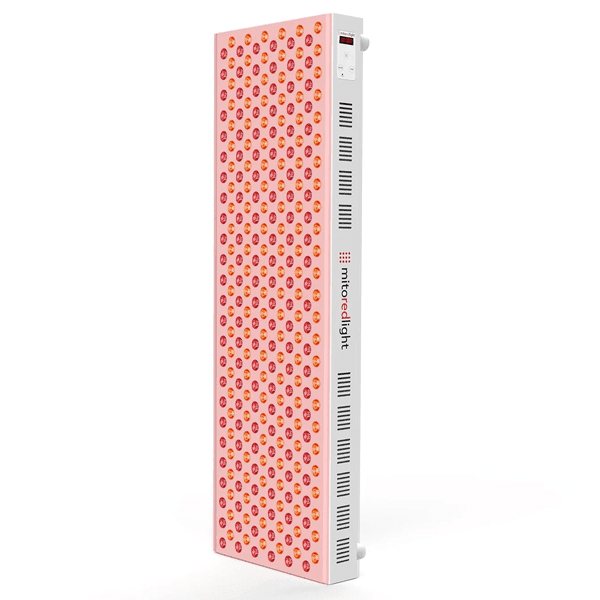
The best two-band panel on the database fields this site ranks by is the Mito Red Light MitoMEGA 2.0 at $1,049 (verified 2026-08-13): it splits its LEDs 50/50 between 660nm and 850nm, publishes a spectrometer figure of 74 mW/cm2 at 6 inches beside its solar meter headline, and comes with a 60-day trial and a 3-year warranty. Of the 66 models in the database that list exactly 660nm and 850nm, only 10 publish an irradiance figure with a named measurement method, and every ranked pick comes from that group.
Choosing a panel? Our ranking of the best red light therapy panels is computed from published, method-labeled specs across 188 devices. For a two-band panel, the spec that matters is a spectrometer-based irradiance figure, because the wavelength mix is already settled and the output is what separates one model from the next.
How this list was ranked
The method is the one described in how rankings work. RLT Home is one brand among 41 and is held to the same criteria as every other brand; none of its panels lists only two bands, so none is eligible here. Eligibility is simple: the database's wavelength field lists 660nm and 850nm and nothing else. At the last snapshot that is 66 of 188 models from 24 brands.
| Criterion | What counts |
|---|---|
| Irradiance method | A 6-inch figure with the instrument named; a spectrometer reading ranks above a solar meter reading or an unlabeled number |
| Wavelength mix | Published allocation between the two bands |
| Coverage | Panel face area from published dimensions |
| Price | Database price, its verification date, and price per square inch of face |
| Warranty and trial | Warranty length, trial window, restocking fee and return shipping |
Models are sorted first by whether the irradiance figure names its method, then by the labeled figure and coverage per dollar, then by terms.
Why the method filter removes most of the field
Of the 66 two-band models, 56 either print a figure without naming the instrument, give no distance, or quote a figure only at 3 inches or at the surface. That includes well-known panels: the Kala Red Light Quad Panel states 161 mW/cm2 at 6 inches with no instrument named, the Hooga HG300 states 73 mW/cm2 at 6 inches with the method not stated, and the BioLight ReStore states 56.9 mW/cm2 at 6 inches, a low and probably honest figure, but again without a named instrument.
The site's claimed versus measured analysis shows why this matters. Across 44 panels where a headline can be checked against a spectrometer, headlines average 2.11 times the spectrometer figure, with a range of 1.36 to 2.60. An unlabeled number could sit anywhere in that range, so it cannot be ranked against a labeled one. The spectrometer page and the solar power meter page explain the instrument gap.
The 10 models that pass are the four Mito Red Light 2.0 panels, which print a solar meter and a spectrometer figure side by side, and the six CytoLED panels, which publish spectrometer-benchmarked figures.
The picks
| Rank | Model | Price (verified) | Spectrometer at 6 in | Face area | Price per sq in | Warranty / trial |
|---|---|---|---|---|---|---|
| 1 | MitoMEGA 2.0 | $1,049 (2026-08-13) | 74 mW/cm2 | 432 sq in | $2.43 | 3 years / 60 days |
| 2 | MitoMAX 2.0 | $749 (2026-08-13) | 70 mW/cm2 | 324 sq in | $2.31 | 3 years / 60 days |
| 3 | CytoLED Triplex | $1,079 (2026-08-13) | 38 mW/cm2 (independent: 54) | About 331 sq in | $3.26 | 2 years / 30 days |
| Budget | MitoMIN 2.0 | $249 (2026-08-13) | 52 mW/cm2 | 108 sq in | $2.31 | 3 years / 60 days |
Spectrometer figures for the Mito panels are the brand's own disclosures as listed in the claimed versus measured analysis; the CytoLED figure is the brand's spectrometer-benchmarked number. Face areas are computed from each page's published dimensions.
1. Mito Red Light MitoMEGA 2.0: best overall
The MitoMEGA 2.0 is 36 by 12 inches with 300 LEDs split 50/50 between the two bands and a 60-degree beam. Mito prints 165 mW/cm2 by solar meter and 74 by spectrometer at 6 inches, a ratio of 2.23, close to the database average. That 74 is the highest labeled figure among the eligible two-band panels, and the 12-inch width covers more of the torso than the 9-inch panels below.
Cautions: the Mito brand page notes that the brand's dual figures are labeled inconsistently, and an independent spectrometer test cited there was run on a different model, the MitoPRO 1500+, not on any 2.0 panel. LED type is not published. A stand is sold separately, about $139 for a single panel. There is no restocking fee, but return shipping is on the buyer unless a paid add-on was chosen at checkout. Mito panels are FDA-registered, not cleared, and the site's medical grade claims audit explains why no home panel holds a medical-grade classification.
2. Mito Red Light MitoMAX 2.0: best value per square inch
The MitoMAX 2.0 is the same length at 36 by 9 inches, with 200 LEDs, the same 50/50 split and a 60-degree beam. Its disclosed pair is 155 by solar meter and 70 by spectrometer. At $749 it gives up a quarter of the MEGA's face area for $300 less, which makes it the lowest cost per square inch among the eligible full-length panels. For one person covering the front of the body in two positions, it is the sensible default. The same brand cautions apply.
3. CytoLED Triplex: lowest headline, best documented by a third party
The CytoLED Triplex is 97 by 22 cm, about 38 by 8.7 inches, with 210 LEDs split 50/50 and a 30-degree beam. CytoLED publishes 38 mW/cm2 at 6 inches and describes its figures as spectrometer-benchmarked, and the database also lists an independent reading of 54 at 6 inches for this panel. That is a modest output, about half the Mito figures, and here the outside reading came in above the brand's own number rather than below it.
The narrow beam keeps more of the output in front of each LED, as the beam angle page explains. The trade-offs are the terms: a 2-year warranty, a 30-day trial, no return shipping covered, and a wheeled stand sold separately at EUR 120. CytoLED is an EU brand whose site states its products have not been evaluated by the FDA. The smaller CytoLED One and the longer Duplex and Pentaplex carry figures between 37 and 39 mW/cm2 on the CytoLED brand page.
Budget pick: Mito Red Light MitoMIN 2.0
The MitoMIN 2.0 is a 12 by 9 inch panel with 60 LEDs and the same 50/50 split. Its disclosed pair is 115 by solar meter and 52 by spectrometer. It matches the MitoMAX on price per square inch but covers one area at a time: a face, a knee, a shoulder. It keeps the 60-day trial and 3-year warranty, which is unusual at $249. The budget panel ranking covers cheaper panels with any wavelength mix. The 19 by 9 inch MitoMID 2.0 at $449 (68 mW/cm2 by spectrometer) sits between the two.
Session length on each pick
Dose in J/cm2 is irradiance in W/cm2 multiplied by seconds. For a 20 J/cm2 example at 6 inches, inside the 10 to 60 J/cm2 range the database pages point to, the dose calculator gives:
- MitoMEGA 2.0 at 74 mW/cm2: about 270 seconds, or 4.5 minutes.
- MitoMAX 2.0 at 70 mW/cm2: about 286 seconds, under 5 minutes.
- MitoMIN 2.0 at 52 mW/cm2: about 385 seconds, under 6.5 minutes.
- CytoLED Triplex at 38 mW/cm2: about 526 seconds, under 9 minutes; at the independent 54, about 370 seconds.
Dosing the Mito panels from their solar meter headlines would cut each session to under half of these times and likely fall short. The irradiance page explains why distance changes every one of these numbers.
Who should choose two bands over seven
The two bands are the pair the site's 660nm vs 850nm page describes as working through the same mechanism at different depths: 660nm red for skin-level goals and 850nm near-infrared for tissue below it. Each appears on 93 percent of the panels in the database, and the trials in the site's register cluster around these bands or their close neighbors.
A two-band panel makes sense when:
- Your goal is skin, muscle or joints. The skin trials mostly used red near 660nm; the joint and muscle trials mostly used 810 to 850nm. A 50/50 split covers both.
- You want a known split. Every eligible pick publishes a 50/50 allocation. On many seven-band panels a share of the LEDs goes to bands with a small or untested role.
- You are comparing on price per square inch. Two-band panels in this group cost about $2.31 to $2.43 per square inch of face for the Mito models.
A multi-wavelength panel makes more sense when you want a specific extra band: 810nm, the band most transcranial trials were built around, as the 810nm vs 850nm page notes, or a deep infrared band near 1064nm, which the 1064nm page says has been tested with lasers rather than panels. Adding bands does not add benefit by itself; what reaches the target is the dose at the band that matters.
What this ranking cannot tell you
None of these figures was measured by this site. The Mito numbers are brand disclosures, and the brand's labeling is flagged as inconsistent. The CytoLED independent reading has no named method on its page. LED type is unpublished for every pick, flicker and power draw are not listed, and prices change. A panel left off this list may perform well; it simply does not publish a figure that can be checked. Confirm the price and terms on the brand site before you buy.