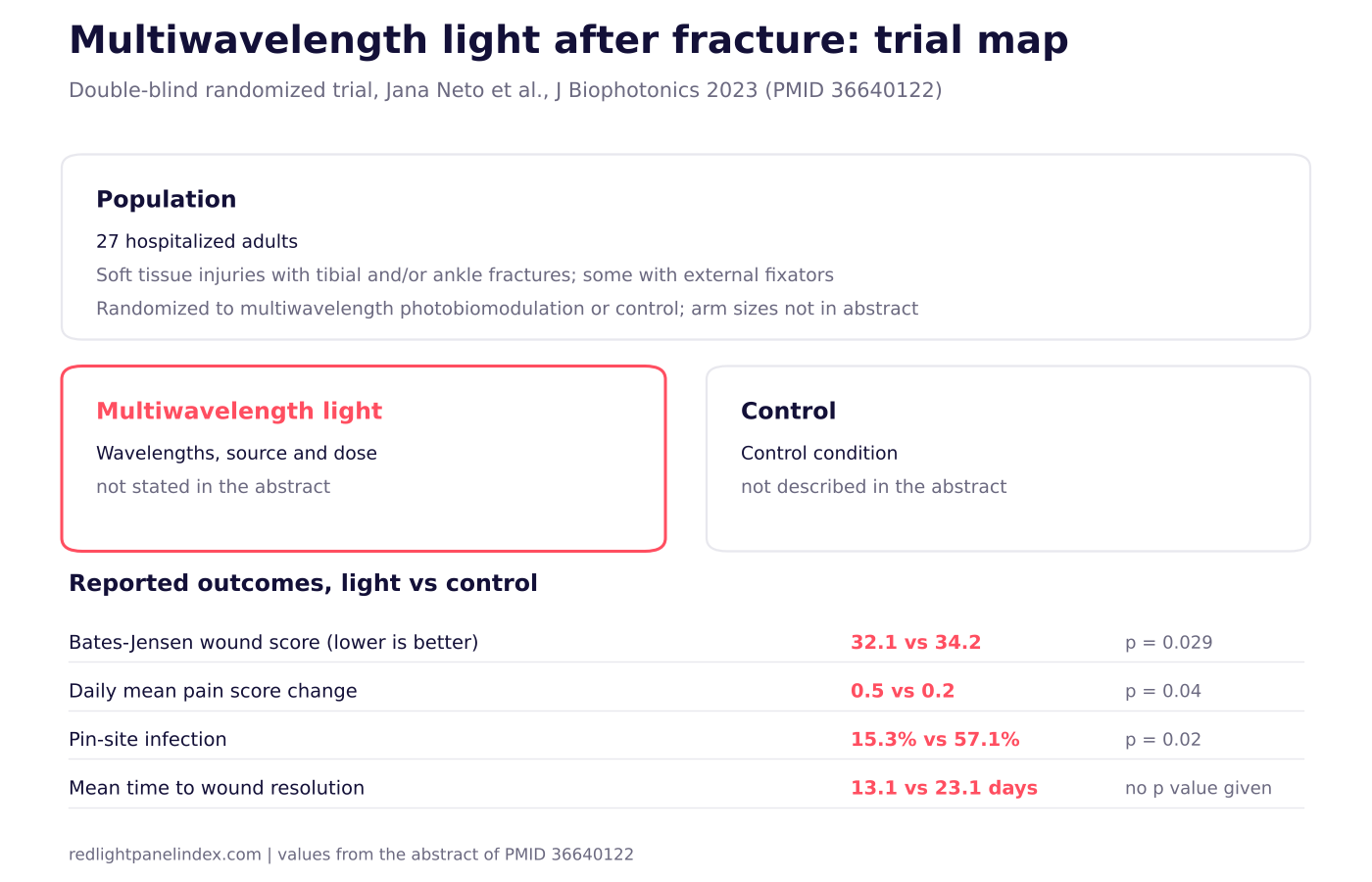
A 2023 double-blind randomized trial in 27 hospitalized adults with soft tissue injuries around tibial and ankle fractures reported that multiwavelength photobiomodulation was associated with better wound scores, more pain improvement, fewer pin-site infections and a shorter mean time to wound resolution than control (PMID 36640122). It is one of the few trials to deliver several wavelengths at once, which makes it relevant to the multi-wavelength panel question, but its patients were acute trauma inpatients, a long way from anyone using a panel at home.
Choosing a panel? Our ranking of the best red light therapy panels is computed from published, method-labeled specs across 188 devices. For a multiwavelength question like this one, the spec that matters is the published share of output each wavelength receives.
What the study asked
The trial, by Jana Neto and colleagues in the Journal of Biophotonics (2023), asked whether multiwavelength photobiomodulation helps the soft tissue damage that comes with a broken bone: the swollen, bruised and sometimes blistered or open skin around a fracture that often has to settle before definitive surgery can go ahead (PMID 36640122). The primary outcome was wound healing, scored on the Bates-Jensen scale, a structured wound assessment tool.
The question is narrower than "does light help fractures heal." It is about the skin and soft tissue over and around the fracture, not the bone itself. That distinction matters for reading this alongside our bone healing evidence page, which carries a Limited grade and is built on a 2020 meta-analysis from the same research group. That meta-analysis found only two placebo-controlled fracture trials and no radiographic healing difference; our review of the 2020 fracture meta-analysis covers it in detail. This newer trial does not change that picture for bone, because it did not measure bone healing.
Who was studied
Twenty-seven hospitalized adults with soft tissue injuries associated with tibial and/or ankle fractures were randomized to multiwavelength photobiomodulation or to a control group. The abstract describes a double-blind design. It does not give the number in each arm, the ages, the injury mechanisms or the fracture classifications, so we state none of those.
What the abstract does make clear is the setting. These were inpatients with acute trauma, many apparently waiting for definitive surgery, some with external fixators, the metal frames held in place by pins through the skin into bone. Daily assessments were part of the protocol. Nothing about that resembles a healthy adult standing in front of a panel at home.
Device and parameters as stated
The abstract describes the treatment as multiwavelength photobiomodulation but does not list the wavelengths, the light source (LED or laser), the irradiance, the energy per session, the session count or the treatment area. It also does not describe what the control group received beyond being called control. We therefore give no wavelength, dose or schedule for this trial, and nothing here should be read as a protocol.
This page therefore cannot be turned into a dose recommendation. If you want to see what your own panel delivers at a given distance and time, the dose calculator works from your device's published irradiance. It cannot tell you what this trial used.
What was measured and found
The abstract reports these results for the multiwavelength group against control:
- Wound score. Daily mean Bates-Jensen score was 32.1 against 34.2 (p = 0.029). On this scale, lower scores indicate a healthier wound, so the difference favored the light group.
- Pain. Daily mean change in pain score was 0.5 against 0.2 (p = 0.04), favoring the light group.
- Pin-site infection. Infection at external fixator pin sites was reported in 15.3% of the light group against 57.1% of the control group (p = 0.02).
- Time to wound resolution. Mean time to wound resolution was 13.1 days against 23.1 days. The abstract gives no p value for this comparison.
- Less severe patients. In a subgroup with less severe injuries, the Bates-Jensen score was 27.4 against 34.7 (p = 0.0081) and time to resolution was 7.0 against 14.6 days (p = 0.03).
- Time to definitive surgery. The abstract says this improved but gives no figures.
The authors concluded that multiwavelength photobiomodulation appears safe and effective in reducing wound resolution time in this population (PMID 36640122). The abstract does not list specific adverse events.
Limitations
- Small sample. Twenty-seven participants is small for any trial, and smaller still once it is split into two arms and then into severity subgroups. Effects this large in a trial this size often shrink when larger trials follow.
- Subgroup results. The strongest numbers come from the less severe subgroup. Subgroup findings in a small trial are best treated as hypotheses, not confirmations.
- One unreported p value. The ten-day gap in mean time to wound resolution, the headline clinical figure, has no p value in the abstract.
- Undisclosed parameters in the abstract. Without wavelengths, dose and the control condition, nobody can tell from the abstract which part of the treatment mattered, or reproduce it.
- Single trial. We found no second trial of multiwavelength light in this population to confirm the result. Under the site's evidence grades, one small trial cannot carry more than a Limited reading for any condition.
Why the multiwavelength design matters
Most photobiomodulation trials use one wavelength, so they cannot say anything about whether combining bands helps. This trial is one of the few that delivered several at once, which is why it comes up when people ask whether a panel with five or seven listed wavelengths should outperform a simpler red and near-infrared panel.
It does not answer that question. The trial compared multiwavelength light with control, not with a single wavelength, so it cannot show that the combination did better than one band alone would have. A positive result for "several wavelengths" is not evidence that more wavelengths are better than fewer. Our explainer on red vs near-infrared covers what the two main bands are thought to do differently in tissue, and the wavelengths guide lists what each band is used for.
For panel buyers, the more useful lesson is the one our best multi-wavelength panels ranking is built on: a list of wavelengths says little unless the brand also publishes how much of the output each one receives. A trial with stated wavelengths and doses could be compared against a panel that publishes its allocation. This abstract gives neither side of that comparison.
What it means for a home panel
Very little directly.
- The population. Acute fracture patients in hospital, often with open skin, external fixators and pending surgery, are under medical care for reasons a panel cannot address. Their soft tissue injuries are managed by a surgical team, and any light treatment in that setting is part of a supervised protocol.
- The device. We do not know from the abstract what device was used, and there is no basis for assuming it was anything like a consumer panel. Our page on LED vs laser explains why dose does not transfer between device types without recalculation.
- The outcome. Pin-site infection and time to surgery are clinical problems with clinical solutions. A home user should not treat a pin site, a surgical wound or an open fracture wound with a panel on their own judgment.
What the trial does add is a small, positive data point on light and acute soft tissue injury, a topic our wound healing evidence page covers more broadly. It sits next to a mixed literature: a 2026 meta-analysis on episiotomy found no significant benefit, and a 2026 review of LED trials in chronic leg and foot wounds found doses spread more than 50-fold, as our review of LED dosing in chronic wound trials explains.
Cautions
- A fracture, a surgical wound or an external fixator needs the care of the treating team. Do not add light to a fracture wound without asking them.
- Infection signs around a pin site, such as redness spreading, discharge, fever or increasing pain, need prompt medical review, not a panel.
- Skin with reduced sensation after injury can overheat without warning; stop if it feels hot.
- Protect your eyes with high-output panels; see the eye protection guide.
- This page is general information, not medical advice.
Bottom line
In 27 hospitalized adults with fracture-related soft tissue injuries, multiwavelength photobiomodulation was associated with better wound scores, more pain improvement and fewer pin-site infections than control, and with a shorter mean time to wound resolution that the abstract reports without a p value (PMID 36640122). The abstract does not state the wavelengths or dose, the trial did not compare multiwavelength light with a single wavelength, and its patients were acute trauma inpatients. It is a reason for a larger trial, not a reason to point a panel at a fracture.