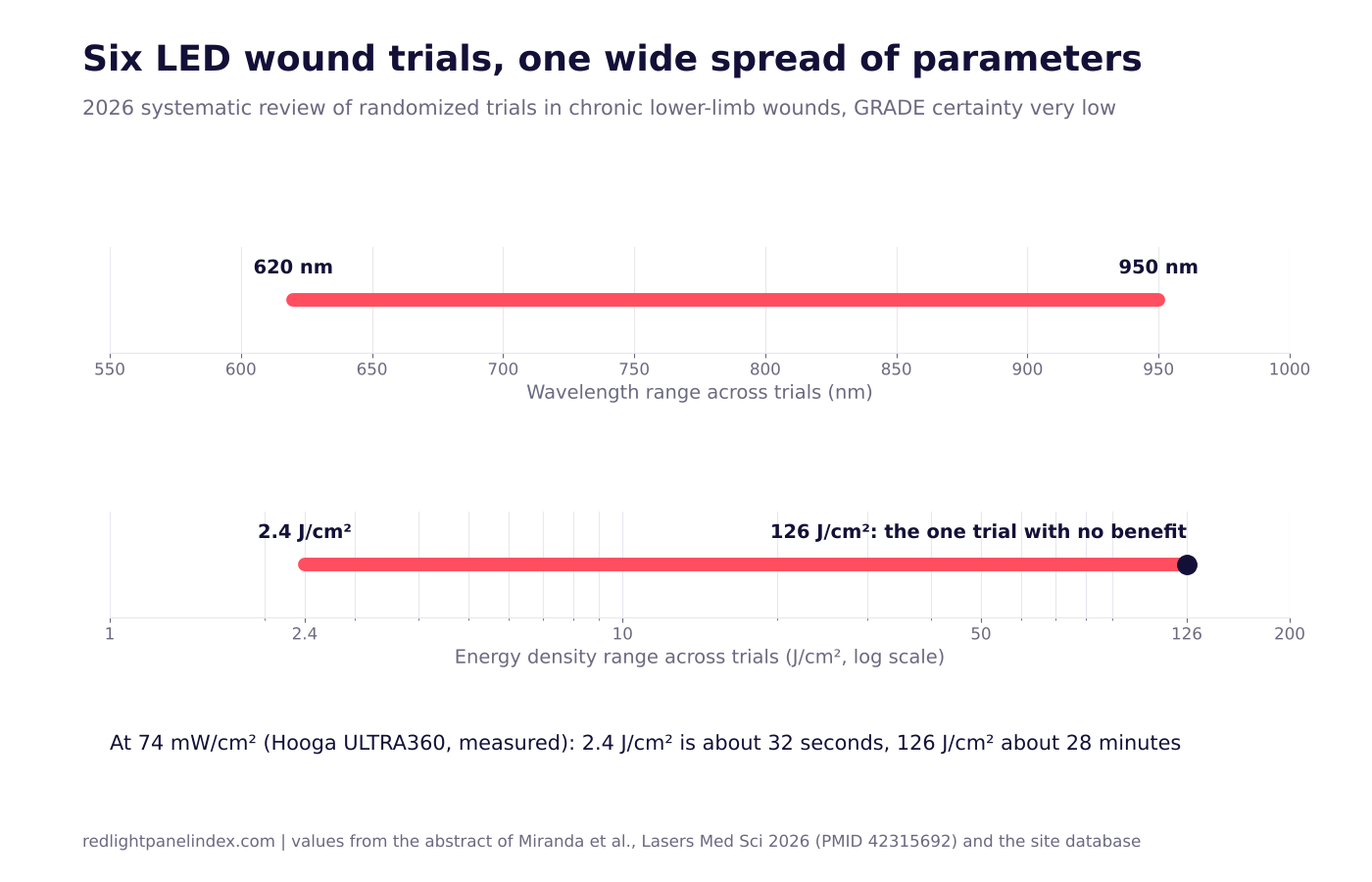
A 2026 systematic review of six randomized trials of LED photobiomodulation for chronic lower-limb wounds found that the trials used wavelengths from 620 to 950 nm and energy densities from 2.4 to 126 J/cm2, reported possible benefits for wound area and wound bed quality, and rated the overall certainty of the evidence as very low (PMID 42315692). Its most useful contribution is not the efficacy verdict but the dose spread it documents: a more than 50-fold range across trials of one condition.
Choosing a panel? Our ranking of the best red light therapy panels is computed from published, method-labeled specs across 188 devices. For dosing questions like this one, the spec that matters is a measured irradiance with a stated method, because without it no session length means anything.
What the study asked
The review, by Miranda and colleagues in Lasers in Medical Science (2026), set out to do two things: synthesize the randomized evidence on LED photobiomodulation for chronic lower-limb wounds, and identify which irradiation parameters were associated with better outcomes. The authors searched PubMed, Scopus, Web of Science and Embase up to May 2026 (PMID 42315692).
The focus on LEDs rather than lasers is what makes this review relevant to home panels, which are LED devices. Much of the older wound literature, including the meta-analyses behind our diabetic foot ulcer page, is dominated by clinic lasers. For why the two light sources cannot simply be swapped, see LED vs laser.
Who was studied
Six randomized clinical trials met the inclusion criteria. The population was people with chronic wounds of the lower limb, a group that the abstract says carries a heavy clinical burden because these wounds heal slowly and recur often. The abstract singles out diabetic foot ulcers as the wound type where the signals were clearest, but it does not give the number of participants, the mix of wound types across trials, or the trial durations, so this page states none of those.
This is a different question from our review of two diabetic foot ulcer meta-analyses. Those pooled mostly laser trials in one wound type. This review is limited to LED trials and covers chronic lower-limb wounds more broadly.
Device and parameters as stated
This is the heart of the paper. Across the six trials:
- Wavelengths ranged from 620 to 950 nm. That runs from the red band most panels use for skin, through the near-infrared bands around 810 and 850 nm, out to 950 nm. Our explainer on red vs near-infrared covers why those bands behave differently in tissue.
- Energy densities ranged from 2.4 to 126 J/cm2.
The top of that dose range is 52.5 times the bottom. The abstract does not break the range down trial by trial or report irradiance, session length or session counts, so we do not either.
What was measured and found
- Possible benefits. The authors write that LED photobiomodulation "may promote wound area reduction, improve wound bed quality, and increase microcirculation, particularly in diabetic foot ulcers."
- A high-dose null. One study using 126 J/cm2, the top of the range, did not show beneficial effects. The authors read this as suggesting a possible dose-dependent response.
- Safety. The authors describe LED photobiomodulation as appearing safe.
- Certainty. The overall certainty of the evidence under GRADE was very low, downgraded for inconsistency and indirectness among the included studies.
Their conclusion is careful: heterogeneity in irradiation parameters, small sample sizes and methodological limitations "preclude definitive conclusions regarding its clinical efficacy" (PMID 42315692).
The high-dose trial and the biphasic curve
The one null result came from the highest dose in the set. On its own, one trial cannot show that 126 J/cm2 is too much; it could have failed for many reasons, including the wound population, the wavelength or simply chance. But it fits a pattern the field has described for years. The biphasic dose response is the observation that benefit rises with dose only up to a point, after which more light stops helping or works against the effect. Our review of the biphasic dose response papers covers the evidence behind that idea, and a 2018 parameters review reported that ineffective results were more often explained by over-dosing than under-dosing.
What the abstract does not support is a specific ceiling. It gives no dose that worked best, only the range that was tried and the one high-dose failure.
Why a wide range means you cannot copy one trial's dose
The site keeps returning to one dosing point, and this review is a clean illustration of it. Dose in J/cm2 is irradiance in mW/cm2 multiplied by seconds, divided by 1000, as our joules per cm2 explainer sets out. So the same dose range translates into very different sessions on a real panel.
Take the Hooga ULTRA360, whose database page lists about 74 mW/cm2 from an independent spectrometer test. At that irradiance:
- 2.4 J/cm2, the bottom of the review's range, is 2,400 divided by 74, about 32 seconds.
- 126 J/cm2, the top of the range and the dose of the one null trial, is 126,000 divided by 74, about 1,703 seconds, or roughly 28 minutes.
Both figures are "a dose used in a randomized wound trial." One is half a minute and one is close to half an hour, and the longer one is the only dose in the set reported as not beneficial. Picking one trial and copying its number to a home panel therefore tells you very little. You do not know whether that trial sat on the useful part of the curve, whether its wound type matches yours, or whether its wavelength matches your panel's mix.
Two more things break the copy. The trials measured dose at the wound, under clinical conditions, often with a device held at a fixed and known distance. A home panel's irradiance falls with distance, so your dose depends on where you stand, which the dose calculator lets you work through with your own panel's figure. And many panels publish claimed irradiance rather than measured irradiance; the ULTRA360's own claimed figure on its database page is 132 mW/cm2, which would roughly halve every session time above if taken at face value. Our irradiance explainer covers why the method behind a number matters.
Limitations
- Six trials. A small base, with small samples within each trial, by the authors' own account.
- Very low certainty. GRADE downgraded for inconsistency and indirectness.
- No pooled effect size. The abstract reports directions, not a pooled estimate, so there is no number for how large any benefit was.
- Parameters as ranges only. The abstract does not link specific doses or wavelengths to specific outcomes, apart from the one high-dose null.
- Mixed wound types. Chronic lower-limb wounds include different causes; the signal was described as clearest in diabetic foot ulcers.
What it means for a home panel
A chronic leg or foot wound is a medical problem that needs a clinician, usually with offloading, dressings, infection control and attention to circulation and blood sugar. Nothing in this review suggests a home panel can replace that, and our wound healing page says the same: the evidence supports adjunctive use under supervision, not self-treatment of serious wounds. If a clinician does suggest light, the dose and wavelength should come from them, not from a trial abstract.
For everyone else, the lesson travels beyond wounds. When trials of a single condition span 2.4 to 126 J/cm2 and 620 to 950 nm, a published study dose is a reference point, not a setting. Treat a trial's published dose as a ceiling rather than a floor, as our biphasic page puts it, keep the session length tied to a measured irradiance, and read our guide to dosing before assuming more minutes means more benefit.
This page is general information, not medical advice.