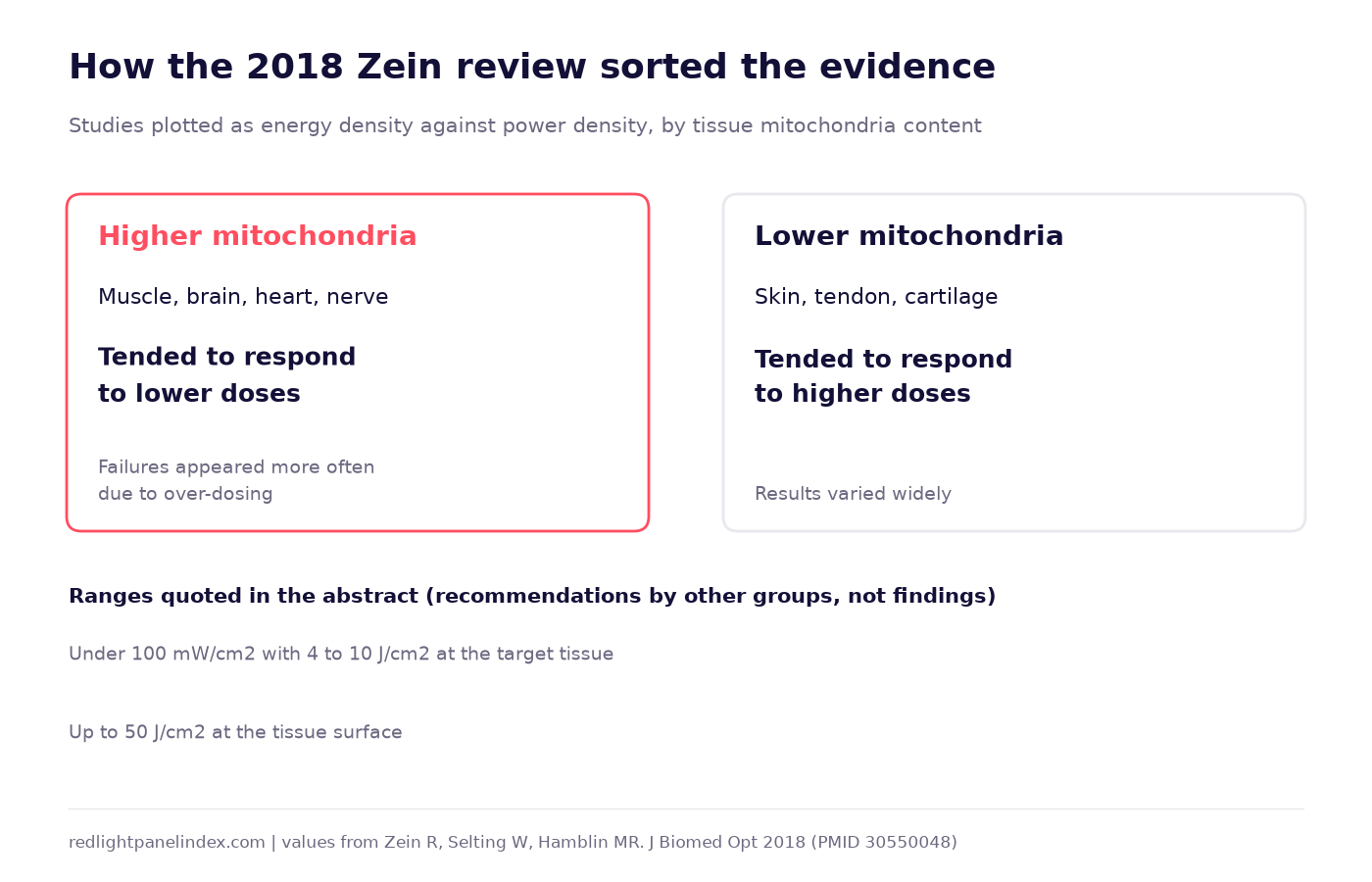
A 2018 review by Zein, Selting and Hamblin in the Journal of Biomedical Optics looked at why photobiomodulation studies contradict each other and concluded that dose depends on the tissue: cells and tissues rich in mitochondria (muscle, brain, heart, nerve) tended to respond to lower doses of light than tissues with fewer mitochondria (skin, tendon, cartilage), and ineffective studies in the high-mitochondria group appeared to be more often over-dosed than under-dosed (PMID 30550048). It is a narrative review of published cell and animal work, not a trial, and its abstract gives ranges rather than a prescription.
Choosing a panel? Our ranking of the best red light therapy panels is computed from published, method-labeled specs across 188 devices. For applying a dose range like this one, the spec that matters is an irradiance figure with a named measuring instrument and distance.
What the study asked
The review starts from a plain problem: photobiomodulation (PBM), previously known as low-level laser therapy, was discovered more than 50 years ago, yet there is still no agreement on the parameters and protocols for clinical use (PMID 30550048). The abstract notes that some groups recommend a power density below 100 mW/cm2 and an energy density of 4 to 10 J/cm2 at the level of the target tissue, while others recommend as much as 50 J/cm2 at the tissue surface.
The authors list the settings that can be varied: wavelength, energy, fluence, power, irradiance, pulse mode, treatment duration and repetition. That range of choices, they say, has in some cases led to contradictory results. Their question was whether the effective and ineffective parameter sets in the literature fall into a pattern that explains the contradictions.
Who was studied
Nobody was enrolled. The review evaluated earlier studies, either "in vitro with cultured cells or in vivo with different tissues," and sorted them into two groups. One group covered tissues with higher numbers of mitochondria: muscle, brain, heart and nerve. The other covered tissues with lower numbers: skin, tendon and cartilage (PMID 30550048).
The abstract does not state how many studies were included or how they were found, so this page does not either. That is the first thing to keep in mind: the sample is the published literature as the authors assembled it, with all the variability that implies.
Device and parameters as stated
There is no single device. The abstract describes the method instead of a protocol: the authors plotted graphs of energy density against power density for the studies in each tissue group, marking which studies were effective and which were not (PMID 30550048). Energy density is the joules per square centimeter a tissue receives, and power density is the irradiance in mW/cm2, so the graphs are a map of dose against delivery rate.
The only numbers in the abstract are the two ranges already quoted: under 100 mW/cm2 with 4 to 10 J/cm2 at the target tissue, and up to 50 J/cm2 at the surface. They are described as what "some groups" and "others" recommend, not as findings of this review. The abstract does not give wavelengths for the pooled studies; the wavelengths page covers which bands home panels use.
What was measured and found
The main finding is a tendency, and the authors word it that way. The abstract reports "a high degree of variability" in the results, but cells and tissues with high numbers of mitochondria tended to respond to lower doses of light than those with lower numbers (PMID 30550048). The second finding follows from it: ineffective studies in cells with high mitochondrial activity appeared to be more often due to over-dosing than to under-dosing.
That second point reverses a common assumption. It is easy to think a failed study used too little light. For muscle, brain, heart and nerve, this review suggests the opposite was the more frequent problem. It matches the rise-then-fall pattern described in the site's biphasic dose response explainer and in the Huang reviews, which approach the same idea from cell mechanisms rather than from a survey of parameters.
The abstract does not report effect sizes, response percentages or a numeric dose at which effectiveness changes. This page therefore does not either.
Limitations
The authors themselves flag the variability, and there are further limits the abstract makes plain.
- It is a narrative review of in vitro and in vivo work, so it can show a pattern across studies but cannot prove that changing the dose changes the outcome in a person.
- The two tissue groups are broad. Skin, tendon and cartilage are lumped together, as are muscle, brain, heart and nerve, even though a home user is treating a specific area at a specific depth.
- Surface dose and dose at the target tissue are different quantities. Some recommendations quoted in the abstract are stated at the target tissue and one is stated at the surface, so the ranges are not directly comparable.
- The abstract does not say how much light reaches a deep tissue through skin, which is the number a panel owner would need.
What this means for a home panel
The review does not give a number to copy, but it gives a way to read dosing advice. For muscle, brain, heart and nerve, its suggestion is that too much light is the likelier mistake, so a lower dose is the safer direction to test. For skin, tendon and cartilage, the same review says the tissues tended to respond at higher doses, so a very short session may be too little. Which exact dose applies to which area is not something the abstract states.
Session arithmetic shows how small the numbers can be. Using the dose calculator formula and the Hooga ULTRA360's spectrometer-measured 74 mW/cm2 at 6 inches (see its database page), 4 J/cm2 takes about 54 seconds, 10 J/cm2 about 135 seconds and 50 J/cm2 about 675 seconds. Those times are simple division, not figures from the review, and they assume the measured value, not a manufacturer claim. The gap between claimed and measured output is documented on the claimed versus measured page, and the irradiance label guide explains what to look for on a spec sheet.
There is also an honest gap between this review and a panel. The reviewed work spans cultured cells and different tissues in the lab, and the abstract does not describe a consumer panel used at home distance. The LED versus laser page covers why that matters. For evidence on specific conditions, see the site's grades for sports performance and skin anti-aging, where the trial doses actually used are listed.