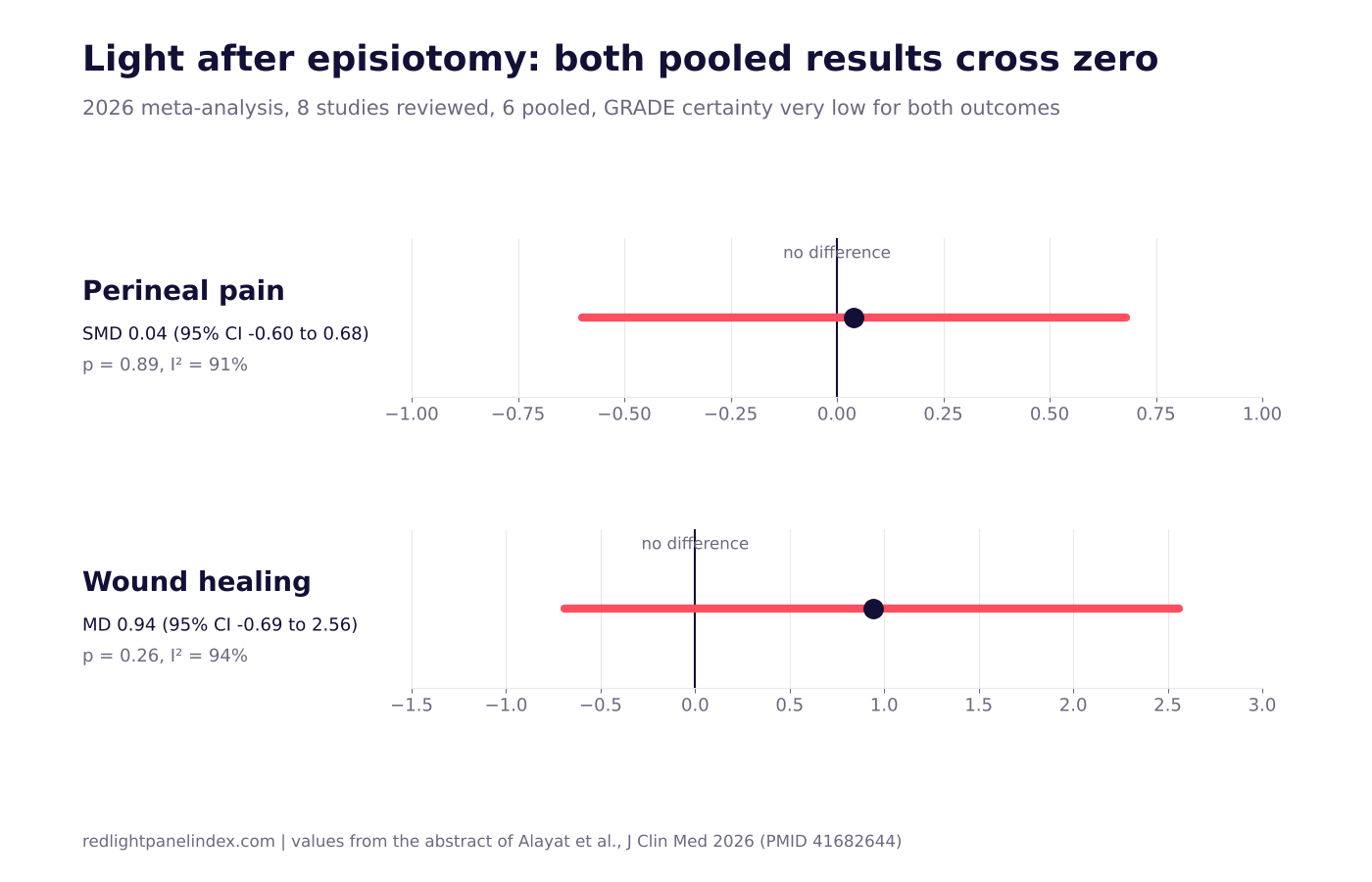
A 2026 systematic review and meta-analysis of photobiomodulation after episiotomy found no significant benefit for either perineal pain or wound healing compared with control, and rated the certainty of the evidence for both outcomes as very low (PMID 41682644). It is a negative result, and it matters precisely because it cuts against the many small positive trials that sit behind our wound healing evidence page.
Choosing a panel? Our ranking of the best red light therapy panels is computed from published, method-labeled specs across 188 devices. For a postpartum wound, the spec that matters is none of them: no panel spec turns a consumer device into perineal wound care, and this review found no pooled benefit to chase.
What the study asked
The review, by Alayat and colleagues in the Journal of Clinical Medicine (2026), asked a narrow question: does photobiomodulation reduce perineal pain or improve wound healing after episiotomy, the surgical cut made to widen the vaginal opening during birth? An episiotomy wound is a fresh surgical wound in a sensitive area, which makes it a reasonable test case for the broader claim that light speeds the healing of surgical wounds.
The authors searched electronic databases for both randomized controlled trials and non-randomized studies, assessed risk of bias with RoB 2 for the randomized trials and ROBINS-I for the non-randomized ones, rated the certainty of the evidence with the GRADE approach, and pooled results with random-effects models (PMID 41682644).
Who was studied
Eight studies met the inclusion criteria, and six of them had data that could be pooled in the meta-analysis. The participants were women recovering from an episiotomy. The abstract we read does not give the total number of women, their ages, or whether births were first or later deliveries, so this page states none of those.
The risk-of-bias picture is spelled out, and it is not reassuring:
- Of the randomized trials, one was judged at low risk of bias, two raised some concerns, and three were at high risk of bias.
- The two non-randomized studies were judged at serious risk of bias under ROBINS-I.
In other words, only one of the eight included studies cleared the bar for low risk of bias.
Device and parameters as stated
The abstract does not state wavelengths, whether the devices were lasers or LEDs, power, dose, session length or number of sessions. We therefore give none. That absence is worth noticing. The authors' own call is for trials "with standardized PBM protocols," which tells you the included studies did not share one. When the parameters differ from trial to trial and are not summarized, there is no recipe here that a home panel could copy, and the WALT dosing recommendations for clinical lasers do not fill the gap either, because they are written per treatment point rather than for a panel's spread-out light. A panel session is planned in J/cm2 from a measured irradiance, which is what the dose calculator does, but with no trial dose to aim for, the calculator has nothing to reproduce here.
What was measured and found
Two outcomes were pooled, and both came back null:
- Perineal pain. Standardized mean difference 0.04, 95% confidence interval -0.60 to 0.68, p = 0.89. Heterogeneity was considerable, with I-squared at 91%.
- Wound healing. Mean difference 0.94, 95% confidence interval -0.69 to 2.56, p = 0.26. Heterogeneity was substantial, with I-squared at 94%.
- Certainty. GRADE certainty was very low for both outcomes.
The authors concluded that photobiomodulation "did not demonstrate a significant benefit for reducing perineal pain or improving wound healing after episiotomy compared with control interventions" (PMID 41682644).
How to read the numbers
Both confidence intervals cross zero. That is the plain meaning of "no significant difference": the data are compatible with a small benefit, no effect, or a small disadvantage, and the analysis cannot tell these apart. The pain estimate of 0.04 sits almost exactly on zero. The wound-healing estimate leans in one direction, but its interval runs from below zero to well above it.
The I-squared figures matter as much as the point estimates. An I-squared of 91% or 94% means most of the variation between studies reflects real differences between them, not chance. The trials were not measuring the same thing in the same way, which is consistent with different devices, doses, schedules and comparison groups. A pooled average across studies that disagree this much is a weak summary, and the authors say so: they could not run sensitivity or subgroup analyses to find out why the studies differed.
Why a pooled null outweighs a count of positive trials
The wound healing literature contains many small single trials that report faster healing with light, and our wound healing hub draws on that body of work. This review points the other way for one specific surgical wound, and it is worth explaining why that is not simply "one study against many."
First, a meta-analysis is not one study. It is a structured combination of every eligible study the authors could find on the question, including the small positive ones. Here those studies, pooled, did not add up to a significant effect.
Second, small positive trials are the studies most prone to inflate an effect. A trial at high risk of bias, with a small sample and loose blinding, is more likely to report a benefit than a well-run trial of the same treatment. Three of the six randomized trials in this review were judged at high risk of bias. Our explainer on how to read a sham-controlled trial covers the design features that separate a reliable trial from a fragile one.
Third, counting positive results ignores the size and precision of each result. Ten weak positives do not make one strong one. The site's evidence grades put systematic reviews and meta-analyses at the top of the hierarchy for exactly this reason, and a grade can fall when a better analysis contradicts earlier positive results.
None of this proves light does nothing for episiotomy wounds. Very low certainty means the true effect could turn out different once better trials are done. It does mean the honest summary for this wound type is "no demonstrated benefit," not "promising."
Limitations
- Small evidence base. Eight studies in total, six pooled, with only one at low risk of bias.
- Mixed designs. Non-randomized studies were included in the review, both at serious risk of bias.
- Heterogeneity. I-squared of 91% for pain and 94% for healing, with no sensitivity or subgroup analyses possible.
- Very low certainty. The authors' GRADE rating for both outcomes.
- Unstated parameters. The abstract gives no wavelength, dose or schedule, so the null result cannot be tied to a particular protocol, and a well-chosen protocol tested properly could in principle perform differently.
What it means for a home panel
For a person recovering from an episiotomy, this review offers no reason to add a home panel to aftercare. The pooled result showed no significant benefit for pain or healing, and every included study was a clinical protocol, not a consumer panel used at home. A fresh perineal wound is also the kind of wound our wound healing page and our scars page both say should not be self-treated with light without a clinician's guidance. Postpartum pain, swelling, discharge or a wound that is not closing needs a midwife or doctor, not a device.
If you already own a panel and want to use it for other reasons while recovering, ask your care team first, keep it away from the healing wound unless they agree, and read our safety and side effects page. For questions about light during pregnancy itself, see red light therapy and pregnancy safety.
For the site's wider wound coverage, the diabetic foot ulcer evidence carries its own grade, built on clinic lasers and meta-analyses that also reported very low certainty. Our review of the two foot ulcer meta-analyses sets out what they pooled. Reading the two side by side is useful: the same caution about small, heterogeneous trials applies to both, even though the pooled direction differs.
This page is general information, not medical advice.