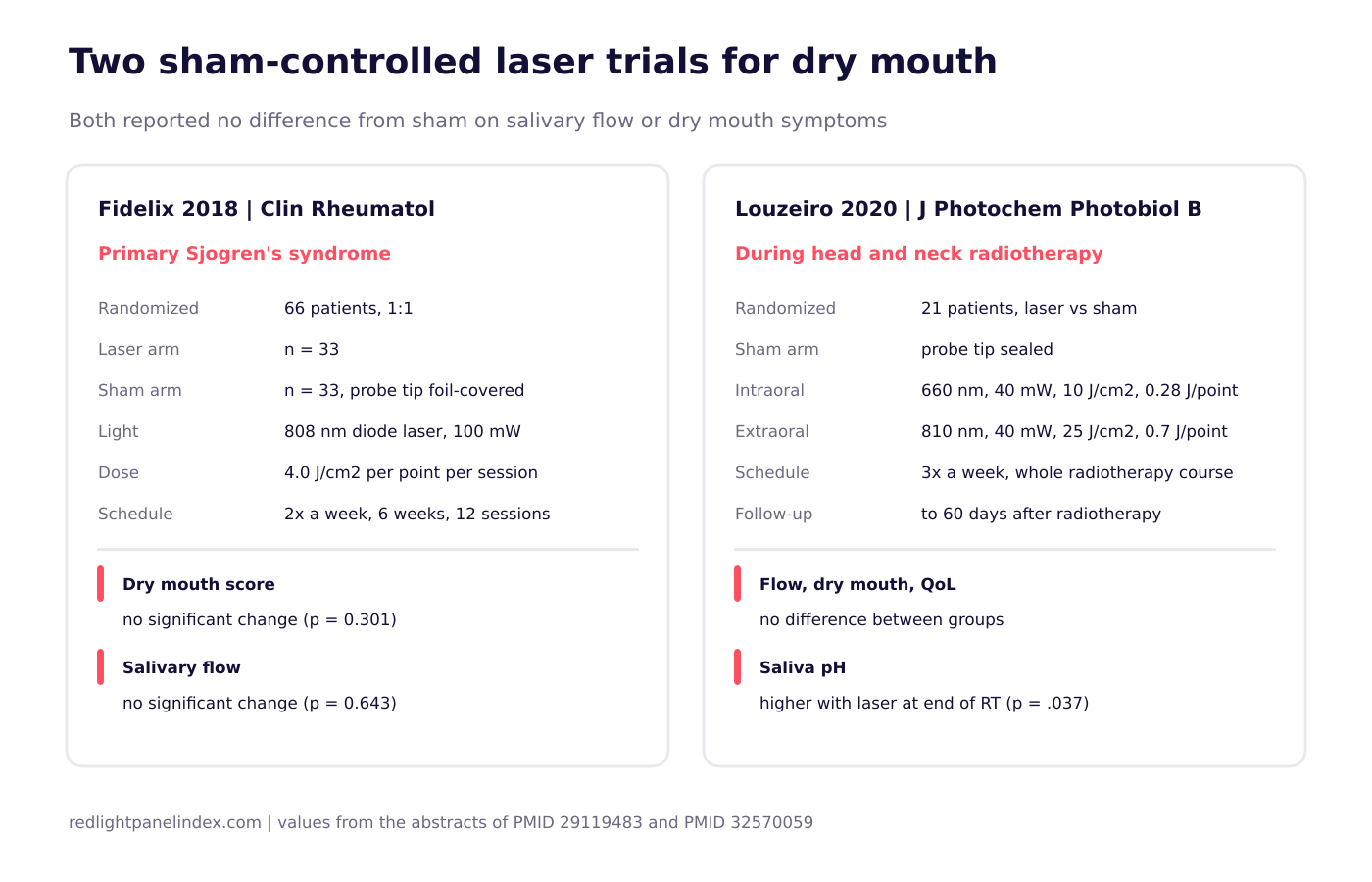
A 2018 randomized trial of 66 people with primary Sjogren's syndrome found that twelve sessions of 808 nm low-level laser over six weeks did not improve dry mouth or salivary flow compared with a sham laser (PMID 29119483). A smaller 2020 sham-controlled trial during head and neck radiotherapy also found no difference between groups in salivary flow, dry mouth or quality of life (PMID 32570059). Both were clinic lasers applied over the salivary glands, and neither result supports using a home panel for dry mouth.
Choosing a panel? Our ranking of the best red light therapy panels is computed from published, method-labeled specs across 188 devices. For dry mouth, no panel spec is a reason to buy, because the controlled trials used salivary-gland lasers and reported no benefit; if you own a panel for other uses, the spec to check is method-labeled irradiance.
Where this fits
Xerostomia is the feeling of a dry mouth. It often comes with hyposalivation, a measurably low flow of saliva, though the two do not always go together. Sjogren's syndrome is an autoimmune disease in which the immune system attacks the glands that make saliva and tears, so dry mouth and dry eyes are its signature symptoms. "Primary" Sjogren's occurs on its own; "secondary" Sjogren's accompanies another autoimmune disease such as rheumatoid arthritis or lupus.
Head and neck radiotherapy causes dry mouth by a different route: the radiation beam damages the salivary glands that sit in its path. Clinics already use photobiomodulation in that setting for a related problem, sore mouth lining, which our oral mucositis evidence page covers and grades. Dry mouth is a separate question, and the two trials below are the site's first reviews of it. The wider gum and dental health page does not address saliva at all.
Everything below comes from the abstracts, read through their database records. Where an abstract is silent, this page says so.
What the study asked
Fidelix and colleagues, writing in Clinical Rheumatology, asked whether low-level laser therapy could relieve xerostomia in people with primary Sjogren's syndrome. They chose outcomes that cover both how dry the mouth feels and what the glands actually produce. The trial was registered as NCT02066896.
Who was studied
The trial enrolled 66 patients with xerostomia due to primary Sjogren's syndrome at a university hospital. They were randomly assigned in a 1:1 ratio, 33 to laser and 33 to placebo. The abstract does not give ages, the sex split, how long people had had the disease, or what medication they were taking.
Device and parameters as stated
- Light source: an aluminum-gallium-arsenide (AlGaAs) diode laser.
- Wavelength: 808 nm, in the near-infrared band covered on our 810nm page.
- Output power: 100 mW.
- Dose: 4.0 J/cm2 per irradiation point per session.
- Schedule: twice a week for 6 weeks, 12 sessions in total.
- Control: the same device and protocol with no active emission, and the probe tip covered in aluminum foil.
The abstract does not name the treatment points or say how many there were, so the total energy per session cannot be worked out. It also does not give the spot size or the time per point.
That sham design is a strength. Patients in both arms went through the same visits and the same handling of the probe, which is the point our sham-controlled trials guide makes about separating the light from the ritual around it.
What was measured and found
The outcomes were scores on the xerostomia inventory (a questionnaire on dry mouth symptoms), salivary flow rate, and three markers in saliva: beta-2 microglobulin, sodium and chlorine.
- Dry mouth symptoms: neither group showed a significant improvement in xerostomia inventory scores (p = 0.301).
- Salivary flow: no significant improvement in either group (p = 0.643).
- Saliva markers: no differences before and after treatment, or between the two groups.
The authors concluded that the protocol "effected no improvement in xerostomia or salivary flow rate in patients with primary SS." This is a negative trial: the laser did no better than sham on any outcome reported.
The companion trial: dry mouth during radiotherapy
Louzeiro and colleagues, in the Journal of Photochemistry and Photobiology B, tested photobiomodulation as prevention rather than relief. They randomized 21 patients about to undergo head and neck radiotherapy to a laser group or a sham group, in which the probe tip was sealed so no light came out. The abstract does not give the split between the two groups.
The laser was applied over the salivary glands three times a week for the whole course of radiotherapy, from two directions:
- Inside the mouth: 660 nm, 40 mW, 10 J/cm2, 0.28 J per point.
- Outside, over the glands: 810 nm, 40 mW, 25 J/cm2, 0.7 J per point.
Measurements were taken before radiotherapy, after the 15th session, at the end of radiotherapy and 60 days later. Everyone got worse during treatment, in unstimulated flow (p = .003), stimulated flow (p < .001), dry mouth (p < .05) and quality of life (p = .001), which is what radiation to the glands is expected to do. The two groups did not differ in salivary flow, saliva composition, dry mouth or quality of life.
One secondary finding favored the laser: unstimulated saliva was less acidic in the laser group at the end of radiotherapy (p = .037). The authors suggested photobiomodulation "may help in preserving salivary pH," a cautious reading of a single measure at a single time point in a small trial.
Limitations
- Two trials, two different conditions. Autoimmune gland damage and radiation damage are not the same problem, so the second trial supports the first only loosely. A 2021 systematic review of photobiomodulation for dry mouth pooled a wider set of trials and reached a more positive conclusion, but rated 10 of its 11 trials at high risk of bias.
- Small samples. Sixty-six and 21 patients are enough to detect a large effect, not a modest one. A null result in a small trial means no effect was shown, not that one was ruled out.
- Fixed protocols. Each trial tested one wavelength plan and one dose. The biphasic dose idea holds that too little or too much light can both miss; neither trial compared doses.
- Missing details. The Sjogren's abstract does not say which points were treated or for how long, and the radiotherapy abstract does not give the group sizes.
- No long-term follow-up in Sjogren's. Outcomes were measured around the six-week course; the abstract does not report later checks.
Neither trial shows harm, and neither was designed to.
What it means for a home panel
- There is no positive controlled trial here to build on. On the site's evidence grades, a condition earns Limited when a single trial supports it. These two controlled trials did not support the main outcome at all, so nothing in them justifies buying or using a panel for dry mouth.
- The delivery is nothing like a panel. Both trials placed a laser probe on or in the mouth over specific glands, at measured energy per point. A panel lights a wide area from a distance, and the LED vs laser explainer covers why those doses are not interchangeable. The dose calculator can estimate what a panel puts on the skin, but there is no successful trial dose to aim for.
- Light aimed at the face reaches the eyes. Anyone who uses a panel near the face for another purpose should read the eye protection guide, which matters more for people with Sjogren's, whose eyes are often already dry.
- Dry mouth needs a diagnosis. It can come from medication, dehydration, Sjogren's, diabetes or radiotherapy, and each has its own care. Saliva also protects teeth, so persistent dryness is a reason to see a dentist and a physician, not to experiment with a device. The safety and side effects page covers the general cautions.
The Sjogren's trial is worth knowing about because it was sham-controlled and clearly reported. Its message is that this laser protocol did not help, and a home panel has even less behind it.