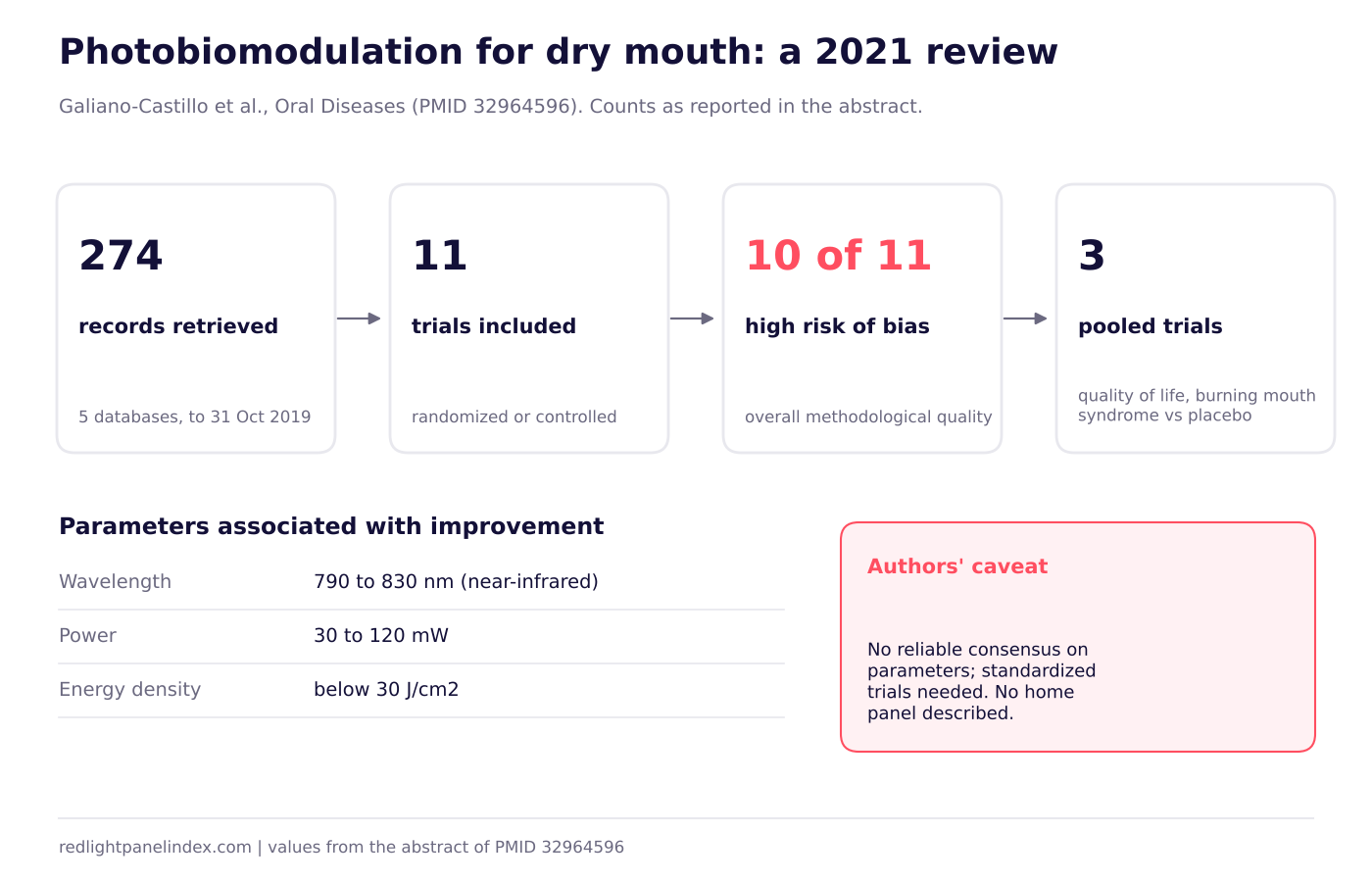
A 2021 systematic review by Galiano-Castillo and colleagues found 11 controlled trials of photobiomodulation for dry mouth and reported that improvements were associated with near-infrared wavelengths of 790 to 830 nm, but 10 of the 11 trials had a high overall risk of bias and the authors could not reach a reliable consensus on parameters (PMID 32964596). The only pooled result was for quality of life in burning mouth syndrome, and none of the included trials is described as using a home panel.
Choosing a panel? Our ranking of the best red light therapy panels is computed from published, method-labeled specs across 188 devices. For dry mouth, no panel spec is a reason to buy, because the reviewed trials used clinic protocols; if you own a panel for other uses, the spec to check is method-labeled irradiance.
What the study asked
The review, published in Oral Diseases, set out "to explore the effectiveness of photobiomodulation therapy for treating patients who suffer xerostomia and/or hyposalivation due to the most prevalent clinical diagnoses." Xerostomia is the feeling of a dry mouth; hyposalivation is a measurably low flow of saliva. The two often travel together but are not the same thing, which is why the review named both.
The title promises a distinction between acute and cumulative benefits, and that distinction is worth understanding even though the abstract does not report it separately:
- An acute effect is a change seen right after a single session, such as more saliva measured minutes after the light is applied.
- A cumulative effect is a change that builds over a course of sessions and is measured at the end of the course or later, such as less dryness after several weeks.
The two answer different questions. An acute rise in saliva flow after one session shows that something happened in the glands that day. It does not show that a course of treatment leaves a person with less dry mouth a month later. Claims of "results after one session," for dry mouth or anything else, describe the first kind of effect and should not be read as evidence of the second.
Who was studied
The authors searched PubMed, Scopus, Web of Science, CINAHL and the Cochrane Library for randomized or controlled clinical trials published up to 31 October 2019. Of 274 records retrieved, 11 trials met the inclusion criteria.
The abstract describes the patients only as people with dry mouth "due to the most prevalent clinical diagnoses." It names one diagnosis, burning mouth syndrome, in connection with the pooled analysis. It does not list the other diagnoses, the number of patients, their ages or how many trials covered each condition. Dry mouth has several common causes, including head and neck radiotherapy, Sjogren's syndrome and medication, but this page cannot say from the abstract which of those the 11 trials covered or in what proportion.
The 2018 Sjogren's trial by Fidelix and colleagues falls inside the search window, but the abstract does not list the included trials, so we cannot confirm whether it was one of the 11. Its negative result is covered in our review of the Sjogren's dry mouth laser trial.
Device and parameters as stated
The abstract does not name the device type in the included trials; it uses the general term photobiomodulation therapy throughout. It reports the range of parameters associated with improvement:
- Wavelength: 790 to 830 nm, in the near-infrared. That band overlaps the one covered on our 810nm page.
- Power: 30 to 120 mW.
- Energy density: below 30 J/cm2.
Power in milliwatts is the output of a single source, not irradiance over an area, so these figures describe a probe-style device rather than a panel. The LED vs laser explainer covers why a probe placed over a gland and a panel lighting a wide area from a distance deliver light very differently, and the joules per square centimeter page explains what an energy density figure does and does not tell you.
The abstract does not give the number of sessions, their spacing, the treatment points or how long each was lit.
What was measured and found
The review looked at improvements in xerostomia or hyposalivation and at quality of life.
- Parameters: in the authors' words, interventions "whose parameters ranged between wavelengths of 790-830 nm (infrared), 30-120 mW of power and an energy density below 30 J/cm-2 were associated with improvements in xerostomia/hyposalivation." This is a pattern across trials, not a tested dose.
- Risk of bias: "10 of the 11 articles included had a high risk of overall bias."
- Pooled result: only 3 trials had enough data to combine. They concerned quality of life in burning mouth syndrome, compared with placebo, and the standardized mean difference from baseline was -0.90 (95% confidence interval -1.48 to -0.32). The abstract does not name the quality-of-life scale, so this page does not convert that figure into a size of benefit.
The authors concluded that photobiomodulation "is an effective, non-invasive and safe approach in patients with xerostomia," and in the same conclusion that "it is not possible to reach a reliable consensus on the parameters to be used." They called for future trials with standardized protocols.
Limitations
- The conclusion is stronger than the data under it. Ten of 11 trials were at high risk of bias, and the only pooled figure covers one condition and one outcome. On the site's evidence grades, a body of evidence like this does not support a confident claim for dry mouth in general.
- The pooled result is not about saliva. The meta-analysis measured quality of life in burning mouth syndrome. It does not show more saliva or less dryness in radiotherapy or Sjogren's patients.
- Acute and cumulative effects are not separated in the abstract. The title raises the question; the abstract does not report a separate answer for each, so this page does not attribute one.
- Parameter ranges are not a protocol. A range of wavelengths, powers and energy densities associated with improvement, drawn from mostly high-bias trials, cannot be turned into a dose.
- Safety was asserted, not detailed. The abstract calls the approach safe but does not describe how adverse events were recorded.
- Controlled trials disagree. Sham-controlled laser trials in Sjogren's syndrome and during radiotherapy, covered in our Sjogren's review, found no difference from sham on dry mouth or salivary flow.
What it means for a home panel
- No trial here used a panel. The parameters describe probe devices in milliwatts at specific points, the delivery our gum and dental health page describes for clinic photobiomodulation in the mouth. A panel aimed at the face does not reproduce it, and the review's result should not be read as transferring to one.
- Do not chase a single-session effect. If a product claims dry mouth relief after one use, that is at best an acute effect. Whether any course of light leaves a lasting change was not settled by this review.
- Dose math does not help here. The dose calculator can estimate what a panel puts on the skin, but there is no validated dry mouth target to aim for.
- Radiotherapy patients have a separate question. Clinic photobiomodulation is used during cancer care for mouth sores, which our oral mucositis evidence page grades. Dry mouth during radiotherapy belongs with the oncology team, not a home device.
- Eyes and diagnosis come first. Light near the face reaches the eyes, so read the eye protection guide. Persistent dry mouth needs a diagnosis, because saliva protects teeth and gums, a point that ties into the periodontitis evidence page. The safety and side effects page covers general cautions.
The review is useful mainly as a map: it shows that a cluster of small, mostly high-bias trials pointed in a positive direction with near-infrared probe devices, that only burning mouth syndrome yielded a pooled number, and that the parameters remain unsettled.