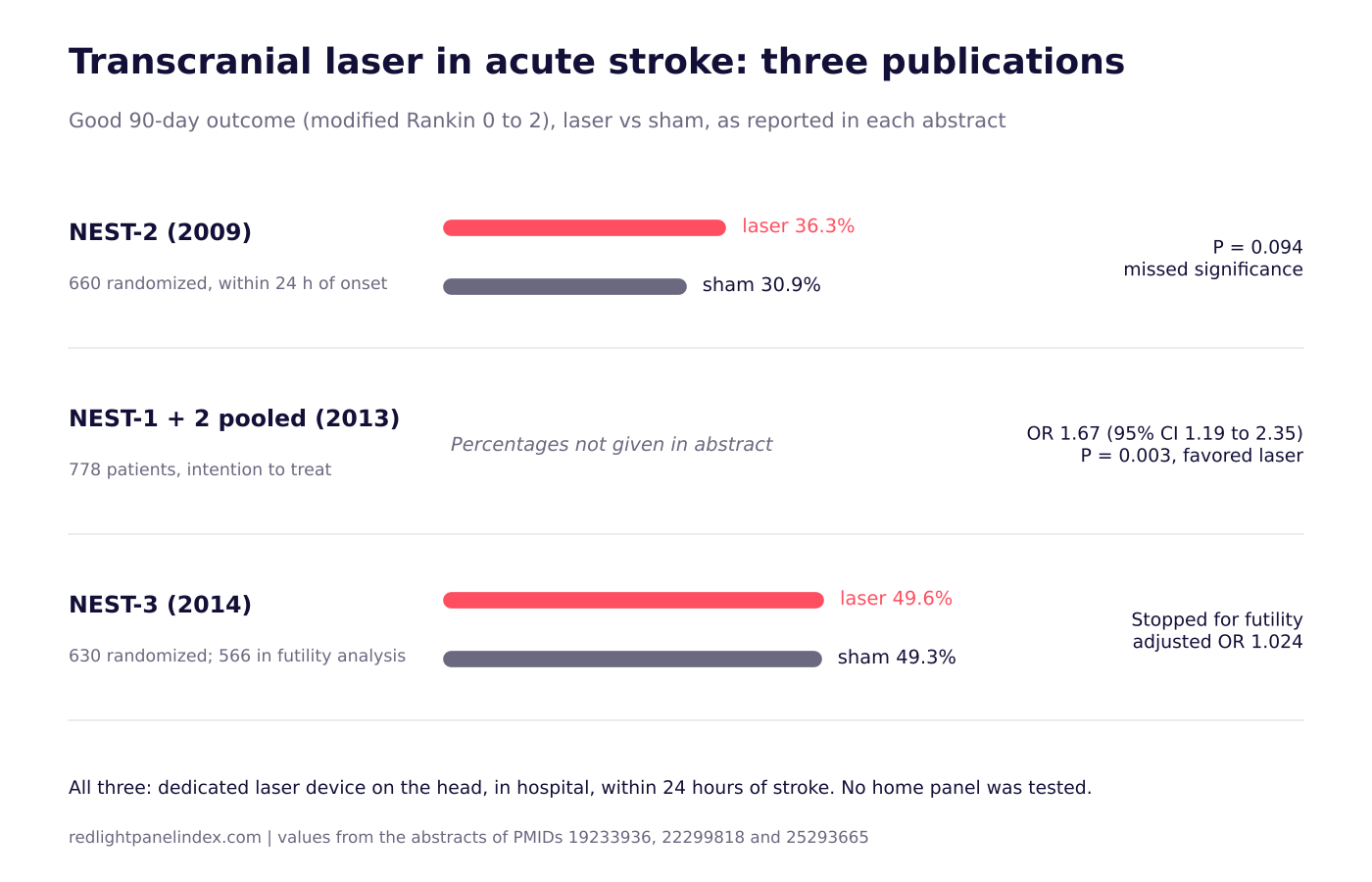
NEST-3, published in Stroke in 2014, was a phase III, double-blind, sham-controlled trial of transcranial laser therapy given within 24 hours of an acute ischemic stroke, and it was stopped early after a futility analysis found no difference between the laser and sham arms on 90-day functional outcome: 49.6 percent of laser patients and 49.3 percent of sham patients had a good outcome (PMID 25293665). An earlier pooled analysis of the two smaller trials had reported a benefit (PMID 22299818). The bigger trial did not confirm it.
Choosing a panel? Our ranking of the best red light therapy panels is computed from published, method-labeled specs across 188 devices. For brain questions, the spec that matters is verified irradiance at your real distance, because NEST-3 used a dedicated laser device on the head, not a panel, and still found no effect.
What the study asked
The question was whether near-infrared laser light shone through the skull in the first day after an ischemic stroke could protect brain tissue well enough to improve how people functioned three months later. The authors' conclusion frames it as a test of a neuroprotective effect, and that was the whole point of the program: if light could limit damage in the hours after a stroke, it would be a treatment for patients who could not receive clot-dissolving drugs.
NEST-3 was the third trial in the NeuroThera Effectiveness and Safety Trial series, and it was designed to settle a question the first two had left open. That history matters, so here it is in order.
- NEST-2 (2009). 660 patients were randomized, 331 to laser and 327 to sham, within 24 hours of onset. A favorable 90-day outcome was reported in 36.3 percent of the laser group and 30.9 percent of the sham group, P = 0.094, which did not reach statistical significance. Mortality (17.5 versus 17.4 percent) and serious adverse events (37.8 versus 41.8 percent) did not differ. A post hoc subgroup with less severe strokes looked favorable, and the authors planned a definitive trial with refined entry criteria (PMID 19233936).
- The pooled analysis (2013). Combining NEST-1 and NEST-2 gave 778 patients, 410 laser and 368 sham. On the same 90-day outcome the pooled result favored laser, odds ratio 1.67 (95% CI 1.19 to 2.35), P = 0.003, and the authors read it as supporting a likely benefit pending confirmation (PMID 22299818).
- NEST-3 (2014). The confirmation trial. It found nothing.
The pooled result looked convincing on paper. It is a good example of why the evidence grades on this site come down when a large replication trial contradicts an earlier positive result.
Who was studied
NEST-3 enrolled adults with acute ischemic stroke who were treated within 24 hours of onset and who did not receive thrombolytic therapy. The trial planned to enroll 1,000 patients, with interim analyses after 300 and 600. It had randomized 630 when it stopped, and the futility analysis covered 566 patients who had completed follow-up: 282 in the laser arm and 284 in the sham arm (PMID 25293665).
This is a very different population from anyone reading about a home panel. These were patients in the first hours after a stroke, under acute care, in a trial with a registered protocol (NCT01120301) and a data monitoring committee. Nothing about the trial speaks to stroke recovery months or years later, which is a separate question with no controlled trial behind it.
Device and parameters as stated
The NEST-3 abstract describes the intervention as transcranial laser therapy and compares it against a sham procedure, but it does not give the wavelength, power, dose or number of treatment sites. The NEST-2 abstract describes the approach as near-infrared laser technology and also gives no wavelength or dose (PMID 19233936). Because neither abstract states those figures, this review does not supply them.
What can be said from the abstracts is the shape of the intervention: a dedicated laser device applied to the head, used once in the acute window, under double-blind conditions with a sham comparator. If you want to understand why a near-infrared source was chosen for the brain at all, and how little light crosses the skull, the 810nm explainer and the penetration depth page cover the measurements this site has verified.
What was measured and found
The primary end point was functional outcome at 90 days on the modified Rankin Scale, a 0 to 6 disability score, analyzed with a hierarchical Bayesian method. A good outcome was defined as a score of 0 to 2, meaning the person could look after their own affairs without assistance.
The results in the abstract:
- Laser arm: 140 of 282 patients (49.6 percent) had a good outcome.
- Sham arm: 140 of 284 patients (49.3 percent) had a good outcome.
- Adjusted odds ratio, all 630 randomized: 1.024 (95% CI 0.705 to 1.488).
The same number of patients, 140, had a good outcome in each arm. The confidence interval runs from a meaningful harm to a meaningful benefit and sits squarely across 1.0, which is what no effect looks like. On that basis the data monitoring committee recommended stopping, and the authors concluded that transcranial laser therapy does not have a measurable neuroprotective effect when given within 24 hours of stroke onset.
The abstract does not report adverse event or mortality figures for NEST-3, so none are quoted here.
Limitations
A negative trial has limits too, and they are worth stating fairly.
- Stopped early. NEST-3 stopped at 630 of a planned 1,000 patients. Early stopping for futility means the committee judged that finishing would be very unlikely to change the answer, not that every possible subgroup was ruled out.
- One device, one protocol. The trial tested a specific laser and a specific treatment schedule. It cannot say what a different wavelength, dose or timing would do.
- One window. Treatment was within 24 hours of onset. Later rehabilitation was not tested.
- Abstract-level detail. The abstract does not give device parameters or safety numbers, so this review cannot comment on them.
None of those limits rescues the earlier positive result. The point of NEST-3 was to confirm the pooled analysis with a larger, prespecified trial, and it did not. The guide to reading sham-controlled trials explains why a well-blinded comparison against a convincing sham is the result to weigh most.
Why the pooled analysis and NEST-3 disagree
The abstracts do not explain the disagreement, so any account of it is interpretation. Three general points are worth knowing.
First, NEST-2 on its own missed significance. A pooled analysis that combines a smaller earlier trial with a non-significant larger one can reach a P value under 0.05 without either trial being conclusive. Second, the NEST-2 abstract highlighted a post hoc subgroup, and subgroups found after the fact often shrink when tested again. Third, every positive pilot carries some luck. A large trial with a fixed protocol is how that luck gets measured, and here it measured zero.
This is the single clearest large negative device trial in the light therapy literature this site tracks. It is also a reminder that P = 0.003 in a pooled analysis is not the same thing as a replicated finding. The evidence grades explainer sets out why a grade needs more than one trial pointing the same way.
What it means for a home panel
Very little transfers, and the direction of what does transfer is cautionary.
- This was not a panel. NEST-3 used a dedicated laser device on the head, in an acute hospital setting, within a day of a stroke. A home panel is a different source at a different distance and a different dose. The irradiance explainer covers why a panel's output falls with distance, and the dose calculator shows what any irradiance and time add up to.
- Even the research device did not work for this use. If a purpose-built transcranial laser, given in the acute window under trial conditions, showed no difference from sham, there is no basis for expecting a panel to help stroke outcomes.
- Stroke is an emergency. Anyone with stroke symptoms needs emergency care. No light device belongs anywhere in that pathway.
- Other brain questions are separate. Transcranial light for mood, cognition and brain injury has its own small literature, graded on the brain and mood evidence page and the traumatic brain injury page. NEST-3 does not prove those questions wrong, but it does show how often an early positive signal in this field fails to hold up.
The honest summary: three trials, one pooled analysis that looked positive, and a phase III trial that found 140 good outcomes in each arm. For stroke, transcranial laser therapy has been tested properly, and it did not show an effect.