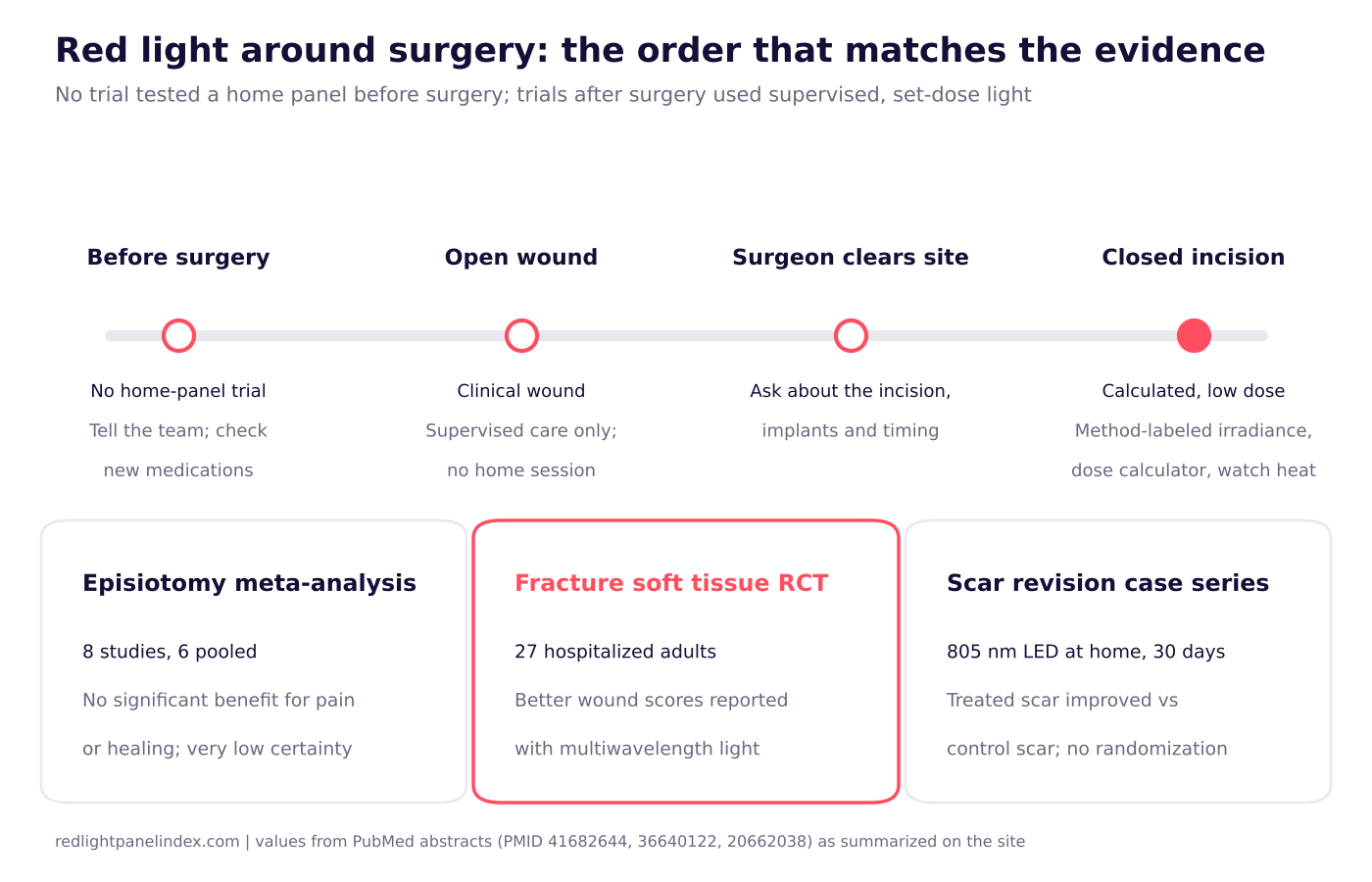
Red light therapy around surgery is a question for your surgeon first, not a home experiment: the research that supports light for wound repair was run in clinics, with set doses, on supervised wounds, and the pooled evidence on fresh surgical wounds is mixed rather than settled. Before an operation there is no trial evidence that a home panel improves the outcome, and after one the sensible order is surgeon's clearance, a closed incision, then a conservative, calculated dose.
Choosing a panel? Our ranking of the best red light therapy panels is computed from published, method-labeled specs across 188 devices. For use near a healing incision, the spec that matters is a method-labeled irradiance figure, because without it the dose your skin receives can only be guessed.
What the surgical wound evidence actually shows
Our wound healing evidence page grades light for wound repair as Strong, on the basis of controlled studies across surgical wounds, ulcers and burns. That grade describes clinic-delivered light under supervision, as an add-on to standard wound care. It does not describe a person hanging a panel near a fresh incision without their surgeon knowing.
The surgical studies this site has reviewed are a useful reality check:
- Episiotomy wounds. A 2026 meta-analysis of photobiomodulation after episiotomy, a surgical cut made during birth, found no significant benefit for perineal pain or wound healing compared with control, and rated the certainty of evidence for both outcomes as very low (PMID 41682644). Only one of its eight included studies was judged at low risk of bias. Our review of the episiotomy meta-analysis covers it in full.
- Soft tissue around fractures. A 2023 double-blind randomized trial in 27 hospitalized adults with soft tissue injuries around tibial and ankle fractures reported better wound scores, more pain improvement, fewer pin-site infections and a shorter mean time to wound resolution with multiwavelength light than with control (PMID 36640122). These were acute trauma inpatients treated by a research team, as our review of the multiwavelength fracture trial explains, not people at home.
- Scars after revision surgery. A small case series applied an 805 nm near-infrared LED at home for 30 days after surgical or CO2 laser scar revision and reported improvement on the treated scar compared with the control scar, with no significant treatment-related adverse effects (PMID 20662038). It had no randomization, which is why the scars evidence page grades scars Limited.
Put together: there is a real research signal for light as an adjunct to wound care, one negative pooled analysis on a common surgical wound, and one small home-use scar series. That is enough to make the question reasonable to raise with a surgeon, and not enough to make home use a default part of recovery.
Before surgery: what is known
No trial on this site tested a home panel in the days or weeks before an operation to see whether it changed healing afterward. There is no evidence-based "pre-hab" light protocol to follow. The practical points before surgery are about avoiding problems rather than chasing a benefit:
- Tell the surgical team you use a panel. It belongs on the list alongside supplements and other routines, so they can say whether to pause.
- Check new medications. Some antibiotics given around surgery belong to classes, such as tetracyclines and fluoroquinolones, that are flagged as photosensitizing. Our guide to photosensitizing medications explains why most of that evidence concerns UV light and why asking the prescriber is still the reasonable step.
After surgery: the practical steps
If your surgeon agrees that light is reasonable, these steps keep home use close to what the trials did and away from what they did not.
- Get explicit clearance for the specific site. A general "fine to resume normal activities" is not the same as clearance to put light on an incision. Ask about the incision itself, any implant beneath it, and timing.
- Wait until the wound is closed. The trials applied light to wounds under clinical supervision. An open wound, drain site, packed wound or weeping incision is a clinical wound, and our wound healing page treats anything beyond a minor cut as a matter for a clinician. Light does not disinfect a wound or replace dressings.
- Keep the dressing plan the surgical team gave you. Do not remove a dressing early to expose the skin to a panel.
- Calculate the dose instead of guessing. Use the panel's method-labeled figure (our irradiance explainer explains why the method matters) and the dose calculator to set distance and session length. Our session length guide covers typical timings.
- Start low. Photobiomodulation follows a biphasic dose response: past a point, more light does less, and the wound healing page notes that overdosing compromised tissue is a real way to do harm. Healing skin is not the place to test the top of the range.
- Watch for heat. A panel at close range warms the skin, and fresh scar tissue or numb skin near an incision may not report heat normally. Our page on heat and thermal management explains why distance matters.
- Protect your eyes. Treating the face, neck or upper body brings the panel into view; see the eye protection guide.
Translating a trial protocol to a home panel
Most surgical wound trials used clinic lasers or purpose-built LED arrays at a stated dose per point or per square centimeter. A home panel spreads light over a wide area at a distance, so a trial's dose cannot be copied onto a session timer. Our LED vs laser explainer sets out why the wavelength appears to matter more than the source, but also why dose delivery differs enough that a protocol has to be recalculated from the panel's own measured output. The joules per square centimeter page shows how that calculation works.
Wavelength choice follows the same caution. The scar series used 805 nm near-infrared, while many skin protocols use red light around 630 to 660 nm; our wavelength guide explains how each band is absorbed. No surgical trial on this site compared red against near-infrared on incisions, so there is no evidence-based reason to prefer one band for post-operative skin.
When to ask the surgeon before anything else
Some situations call for a clear yes from the surgical team before any light is used near the site:
- Cancer surgery. The safety and side effects page describes a systematic review that found no tumor safety problems in pooled supportive-care studies (PMID 31109692), but the general caution against treating over active malignancy still applies, and the oncology team should decide. Swelling after breast cancer surgery has its own clinic evidence on the lymphedema evidence page.
- Implants, grafts and flaps. A graft or flap depends on a fragile blood supply; let the surgeon decide whether any heat or light is acceptable.
- Signs of infection. Redness that spreads, warmth, discharge or fever need a clinician, not a light session.
- Diabetes or poor circulation. These change wound healing in ways light cannot compensate for, as the wound healing page notes.
- Cosmetic procedures. Procedures that break the skin on purpose follow their own timing; see red light after microneedling or chemical peels and the guide to red light after Botox or fillers. A hair transplant is a scalp procedure with grafts in fresh wounds; our guide to red light after a hair transplant covers how clinic aftercare and the hair trials fit together.
What was not studied
No trial on this site tested home panel use before surgery, compared timing after surgery (days versus weeks), compared red with near-infrared on incisions, or followed home users long enough to say whether light changes the final appearance of a surgical scar. Until that kind of evidence exists, a home panel after surgery is an optional add-on your surgeon agrees to, used at a calculated dose on a closed wound.