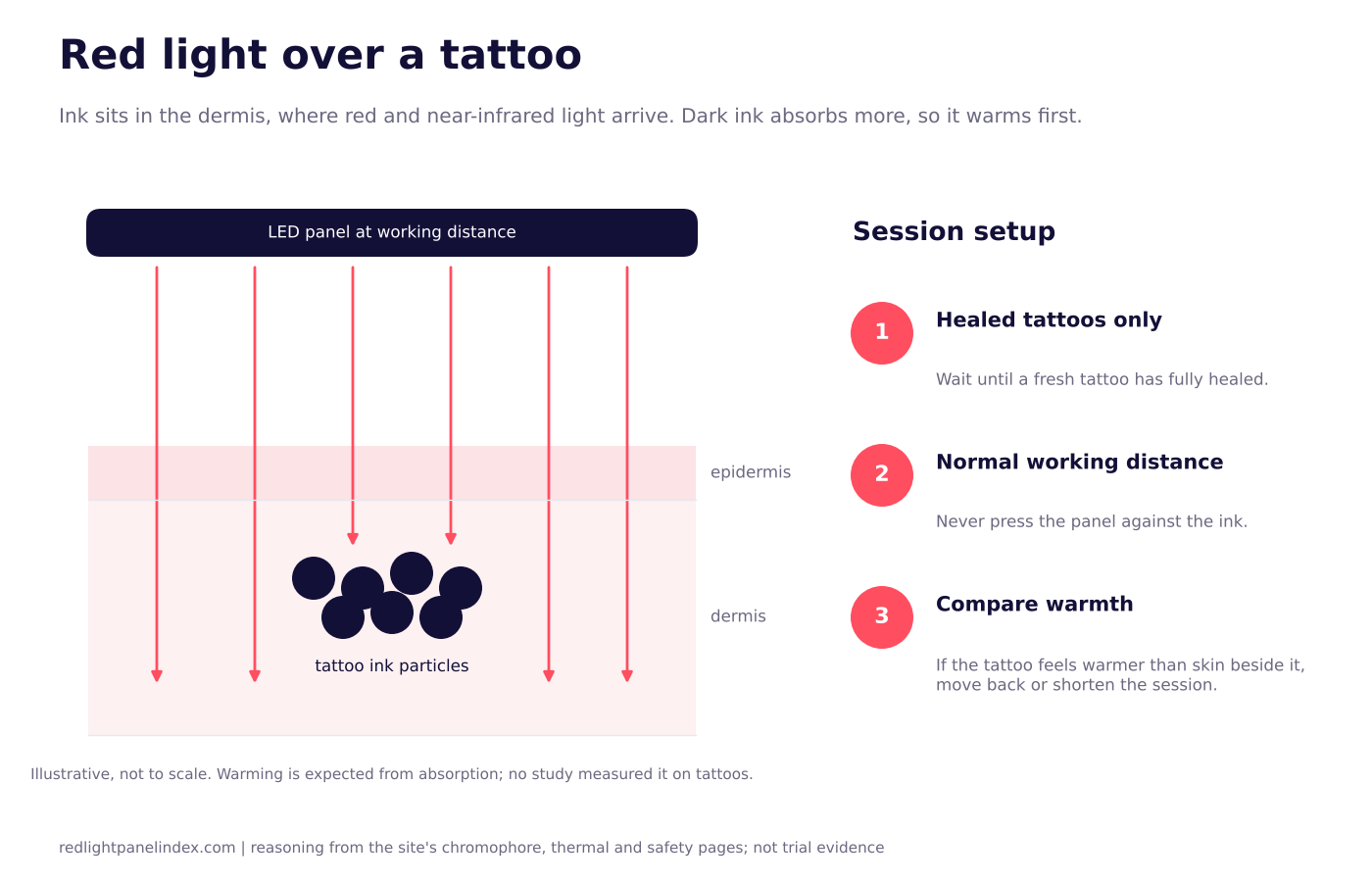
A healed tattoo is not a reason to avoid a red light panel, but it is a reason to watch for warmth. Tattoo ink sits in the dermis, the layer red and near-infrared light reaches, and dark ink absorbs that light more strongly than the skin around it, so tattooed skin can warm faster than bare skin at the same distance. No trial in this site's register tested home panels on tattoos, so everything below is reasoning from how light is absorbed, not trial evidence: keep the panel at a normal working distance, move back if the tattoo feels warmer than the skin around it, and wait until a fresh tattoo has fully healed.
Choosing a panel? Our ranking of the best red light therapy panels is computed from published, method-labeled specs across 188 devices. For tattooed skin, the spec that matters is a method-labeled irradiance figure, because it tells you how much light, and therefore how much warmth, reaches the ink at your distance.
Why ink behaves differently from skin
Light only does anything in tissue when something absorbs it. The site's page on chromophores covers the molecules that matter in untattooed skin: cytochrome c oxidase, the mitochondrial enzyme the field associates with red and near-infrared effects, plus melanin, hemoglobin and water, which compete for the same light. Light absorbed by the "wrong" molecule is usually turned into a little heat.
Tattoo ink adds a chromophore that skin does not normally have, packed densely into the dermis. Dark inks, black in particular, absorb broadly across visible and near-infrared light, which is why clinical tattoo removal lasers can target black ink with near-infrared wavelengths. The difference is scale: a removal laser delivers extremely short, extremely intense pulses designed to shatter pigment particles, while a home LED panel delivers a continuous, much lower irradiance. Nothing about a panel at a normal distance resembles that process, and there is no published evidence that red light therapy fades or removes tattoos.
What the absorption point does predict is warmth. If black ink absorbs more of the light arriving at the dermis than the surrounding skin does, that energy ends up as heat in the inked area. The site's page on thermal versus photochemical effects notes that skin warmth is common with strong near-infrared and that the database holds no skin temperature measurements, so there is no number for how much warmer a tattoo gets. Expect it as a direction, not a size.
Healed tattoos: practical steps
- Start at a normal working distance, not touching. Use the distance you would use on bare skin and avoid pressing the panel against a tattoo. The guide to distance from the panel explains why irradiance rises quickly as you move closer.
- Use a method-labeled irradiance figure to set time. Enter a spectrometer figure, or half a solar-meter or method-unstated figure, into the dose calculator. Most studied protocols sit between 10 and 60 J/cm2 per area, so there is no reason to push past that range over a tattoo.
- Compare the tattoo with the skin next to it. Partway through the first few sessions, touch the inked area and the bare skin beside it. If the tattoo feels clearly warmer, move the panel back or shorten the session. Warmth is the only feedback you get, because near-infrared light is invisible.
- Watch large solid black areas most closely. A blackwork sleeve or a filled-in piece has far more pigment per square inch than fine linework, so it has more ink to absorb light.
- Check the skin afterward. Lingering redness, itching or raised skin in the inked area that you do not see elsewhere is a reason to stop and ask a dermatologist.
Colored inks are a less clear case. Their absorption depends on the pigment, and the site has no data on how individual colors respond to red or near-infrared light, so treat them with the same warmth check.
Fresh tattoos
A new tattoo is a wound, and that changes the advice. Wait until the skin has fully healed, on the timeline your tattoo artist gives you, before running sessions over it. Light on a fresh tattoo has not been tested in any study this site tracks, healing skin is more easily irritated, and an open tattoo needs to be kept clean, which a session at close range does not help.
The wound healing evidence page summarizes trials of light on wounds, but those were clinical wounds treated under defined protocols, not tattoos. Do not read them as support for using a panel to speed up tattoo healing.
Fading: what is and is not known
People worry that a panel will fade ink because they have been told to keep tattoos out of the sun. The light from a red light panel is not the same as sunlight: the red light versus UV phototherapy page explains how the two differ, and panels in this database emit red and near-infrared bands, not ultraviolet. That said, no study in this site's register measured tattoo color before and after panel use, so "red light does not fade tattoos" is an expectation, not a finding. If preserving a specific piece matters to you, covering it with an opaque cloth during sessions is a simple way to remove the question.
Exceptions: when to ask first
- A tattoo that has ever reacted to light. Some people get raised, itchy or swollen reactions in particular ink colors after sun exposure. If that has happened, ask a dermatologist before adding a light source.
- Photosensitizing medications. The guide to photosensitizing medications explains why a prescriber should weigh in before regular sessions, tattoo or not.
- Reduced sensation in the area. The warmth check only works if you can feel it. Neuropathy, scar tissue or a numb patch under a tattoo means using a longer distance and shorter sessions, and checking the skin by eye afterward.
- Tattoos near the eyes. Cosmetic eyeliner or brow tattoos put the light source near the face; follow the eye protection guidance first.
- A tattoo over a mole or a changing lesion. Any lesion that is growing or changing should be seen by a clinician before it is exposed to anything.
- Darker skin plus dark ink. The page on skin phototype and dosing explains that more melanin means more light absorbed near the surface. Melanin and dark ink both pull light toward the upper layers, so starting with shorter sessions or more distance is a reasonable precaution, though no study has tested the combination.
What the evidence grade means here
The site grades the overall safety evidence for red light therapy as Limited on its safety and side effects page, because most of the reassurance comes from efficacy trials rather than studies designed to find harms. Tattooed skin was not a studied subgroup in any of them, and the review the site uses for skin mechanisms describes how light is absorbed in skin cells without addressing tattoo pigment (PMID 24049929). The practical answer is the one at the top: use a healed tattoo like any other skin, keep a normal distance, and let warmth tell you when to back off.