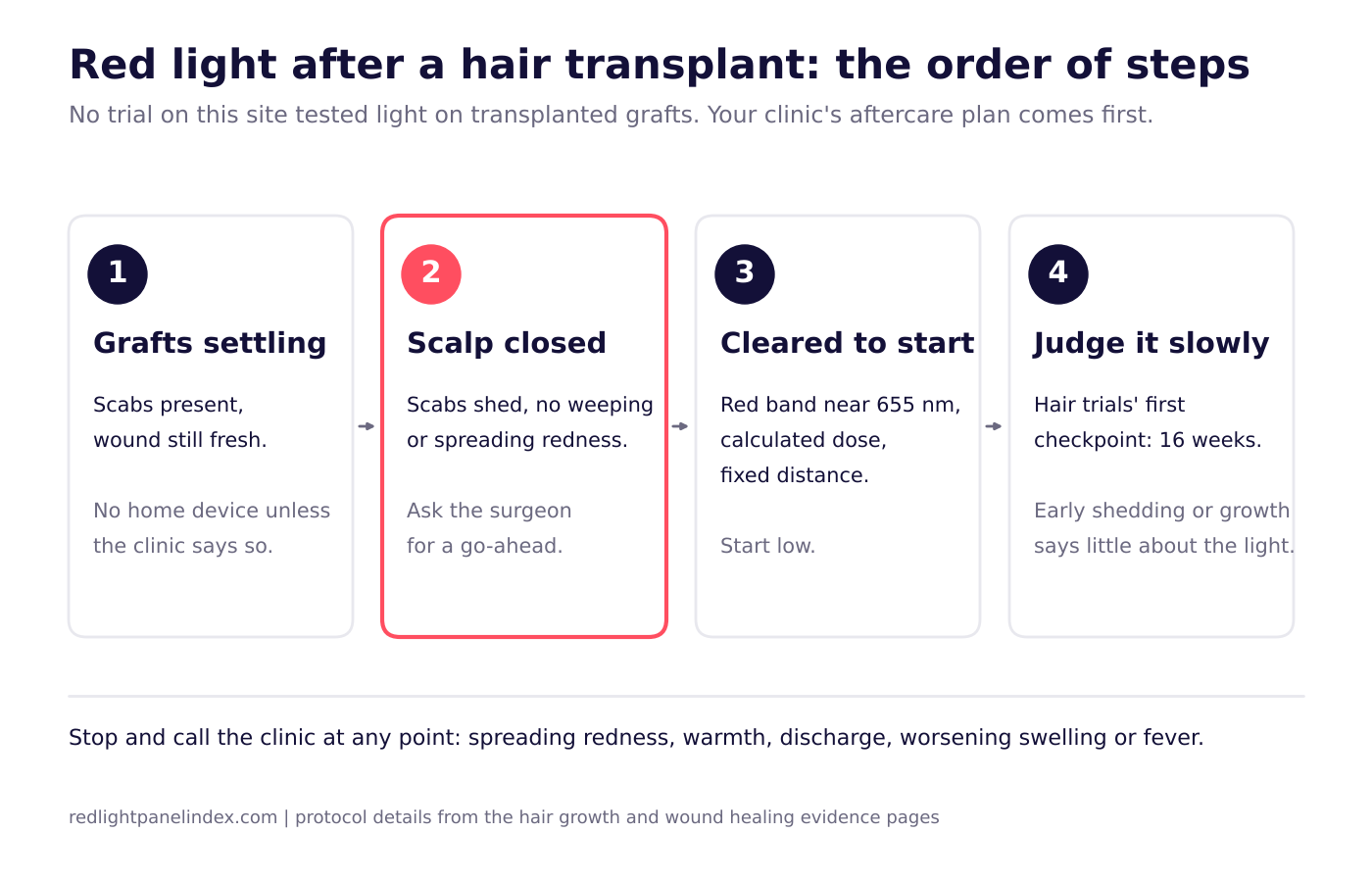
Red light after a hair transplant is a question for your surgeon, not a protocol you can take from the research: this site has no trial of home red light on transplanted grafts, and the hair growth evidence it does have comes from people with pattern hair loss who had not had surgery. If your clinic clears it, the sensible approach is to wait until the grafts are settled and the scalp has closed, then use a calculated dose with a red band near 655 nm, and judge the result over months, not weeks.
Choosing a panel? Our ranking of the best red light therapy panels is computed from published, method-labeled specs across 188 devices. For scalp use after a hair transplant, the spec that matters is a method-labeled irradiance figure, because a healing scalp is the last place to guess at the dose.
What the hair growth evidence covers
Our hair growth evidence page grades light for pattern hair loss as Strong. That grade rests mainly on two sham-controlled trials run by the same group with the same head-worn device. The men's trial reported a significant hair count increase over a sham helmet after 16 weeks (PMID 24078483), and the women's trial reported a comparable result (PMID 25124964). Our review of the male hair growth trial sets out the design: a helmet holding 655 nm laser diodes and LEDs against the scalp, worn at home every other day for 25 minutes, for 16 weeks.
Three details of those trials matter for anyone thinking about a transplant:
- Who was studied. People with androgenetic alopecia, the common pattern form of hair loss. Nobody in either trial had recently had scalp surgery.
- What was measured. Hair count in a small marked patch of scalp. The trials did not measure graft survival, scab healing or the shedding that often follows a transplant.
- How the light arrived. A sealed helmet at a fixed distance. As our hair growth cap vs panel guide explains, a flat panel at a varying distance is already an extrapolation from that evidence, before surgery enters the picture.
The hair growth page also notes that gains regressed when treatment stopped and that the evidence does not cover scarred or long-dormant follicles. Neither point was tested in transplant patients.
Why transplant recovery is a different question
A transplant moves follicles into small wounds in the scalp. For the first stretch of recovery, the question is not "will this grow more hair" but "will this help or harm a fresh, healing wound with grafts in it." That is a wound question, and our wound healing evidence page is clear about where wound care belongs: diagnosed or non-healing wounds and anything beyond a minor cut are matters for a clinician, light is an adjunct to standard care rather than a replacement for it, and light does not disinfect a wound.
The wound page adds a point that applies directly to grafts: photobiomodulation follows a biphasic dose response, so past a certain dose more light does less, and overdosing compromised tissue is a real way to do harm. A recipient area full of new grafts is compromised tissue for a while. That is the strongest reason to let the surgeon set the timing.
Our guide to red light before and after surgery covers the general case, and the order it recommends fits here too: the surgeon's clearance for the specific site, a closed wound, then a conservative, calculated dose.
What clinics tend to advise
Hair transplant clinics write their own aftercare plans, and they do not agree on light. Some clinics offer in-office light sessions soon after surgery or recommend a low-level laser cap as part of aftercare. Others ask patients to keep any device off the grafts for at least the first week, or until the scabs have shed. These are clinic protocols, not findings from a trial on this site, and the clinic that did your procedure knows the technique it used, how many grafts were placed and how your scalp is healing.
Two practical consequences follow:
- Your clinic's sheet overrides anything general. If it says no device until a follow-up visit, wait for that visit.
- Ask a specific question. "Can I use a red light panel on the recipient and donor areas, and from when?" gets a more useful answer than "is red light okay?"
The practical steps, once you are cleared
If your surgeon agrees, these steps keep home use as close as possible to what the hair trials did, without pretending those trials covered transplants.
- Wait for a closed scalp. No weeping, no open scabs over the grafts, no redness that is spreading. Keep any washing and dressing routine the clinic gave you.
- Pick the band the trials used. The trials used 655 nm. Panels that publish a 660 nm share sit close to it; our 660 nm explainer covers why that band is the most studied red wavelength, and our ranking of the best red light devices for hair growth compares tracked panels on 660 nm share, method-labeled irradiance, price and trial terms. Close is not identical, and none of those panels was tested in a hair trial.
- Calculate the dose, do not guess it. Use the method-labeled irradiance from your panel's database page and the dose calculator to set a distance and session length, then keep both fixed. The irradiance methods page explains why a figure with no stated method is treated as unverified on this site.
- Start below the top of the range. On healing skin, a shorter session at a fixed distance is the safer starting point, for the biphasic reason above.
- Mind the hair. Hair absorbs and scatters light before it reaches the scalp. Our page on how light passes through clothing and hair explains why parting the hair matters; early after a transplant, recipient areas are often short or bare, so less light is lost there than over the donor area.
- Watch for heat. A panel at close range warms the skin, and a scalp that is numb after surgery may not report heat normally. Back off if the skin turns red or stays warm after a session.
- Protect your eyes. Treating the scalp puts the panel near your face; see the eye protection guide.
- Judge it on the trials' timescale. The first meaningful checkpoint in the hair trials was 16 weeks, and our results timeline guide explains why weekly mirror checks tell you little. Transplanted hair also follows its own growth cycle after surgery, so do not credit or blame the light for early shedding or early growth.
The exceptions
Some situations call for a clear yes from the clinic, or a no:
- Signs of infection. Spreading redness, warmth, discharge, swelling that gets worse or a fever need a clinician, not a light session.
- New medications. Antibiotics are sometimes prescribed around surgery, and some classes are flagged as photosensitizing. The photosensitizing medications guide explains why most of that evidence concerns UV and why asking the prescriber is still the reasonable step.
- Scarring conditions. If hair loss came from a scarring form of alopecia, the hair growth evidence does not apply; the hair growth page says it does not cover scarred follicles.
- Hair loss of unclear cause. A transplant does not remove the need to know why hair was lost. Sudden or patchy loss warrants a medical evaluation, as our female pattern hair loss evidence page notes for women.
What was not studied
No trial on this site tested red light on transplanted grafts, compared starting times after a transplant, measured graft survival or post-transplant shedding, or compared a cap with a panel after surgery. Using light after a transplant is therefore an extrapolation in two steps: from pattern hair loss to a post-surgical scalp, and from a head-worn helmet to whatever device you own. That can still be a reasonable choice with your surgeon's agreement. It is not an evidence-based recovery protocol, and it should not replace anything the clinic prescribes.