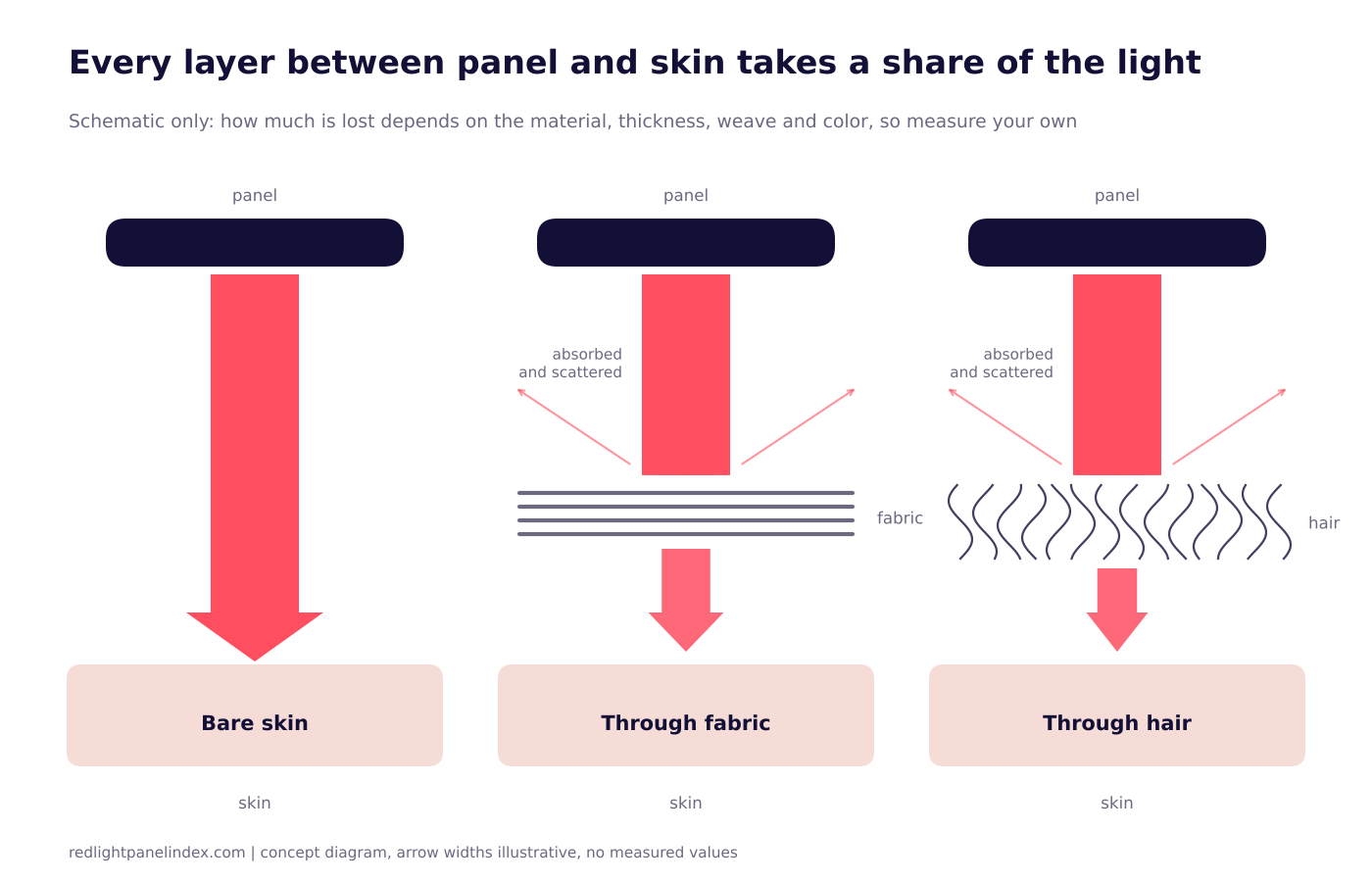
Some red and near-infrared light does pass through thin clothing and hair, but every layer between the panel and your skin absorbs and scatters part of it, so less reaches the skin than the panel's irradiance figure describes. How much is lost depends on the material, its thickness, its weave and its color, which is why the published trials treat bare skin and why the only reliable way to know what your own shirt or hair costs you is to measure it.
Choosing a panel? Our ranking of the best red light therapy panels is computed from published, method-labeled specs across 188 devices. For treating through clothing or hair, the spec that matters is a method-labeled irradiance figure at a stated distance, since that is the number any loss gets subtracted from.
What "attenuation" means here
Attenuation is the loss of light intensity as it passes through something. Skin itself attenuates light, which is the subject of the site's page on how deep red and near-infrared light penetrates: intensity falls gradually with depth rather than stopping at a fixed point. Clothing and hair add more of the same problem before the light even reaches the skin surface.
Three things happen to light at any layer:
- Absorption. Pigments and fibers take up some of the light and turn it into a little heat.
- Scattering. Fibers and strands redirect light sideways and backward, so some of it never arrives where you aimed it.
- Transmission through gaps. Light that passes between fibers or strands arrives more or less unchanged.
What reaches the skin is whatever is left after the first two. A tight, thick or dark layer leaves less; a loose, thin, light-colored layer leaves more. The skin reflectance and melanin page describes the same three processes at the skin surface, where a further share is reflected before any of it gets in.
Fabric: color, thickness and weave
There is no single "percentage through a T-shirt" that holds across fabrics, and the site does not publish one, because the answer changes with each garment. The factors that move it are well understood, though:
- Thickness and layers. Each layer absorbs and scatters again, so two layers lose more than one.
- Weave density. An open knit lets more light through the gaps than a tight weave of the same thickness.
- Color. Dark dyes absorb more visible light, including the red bands near 630nm and 660nm. The color you see describes visible light only, so a fabric's behavior at 850nm can differ from what its color suggests.
- Wet or dry. Water absorbs more strongly toward the longer near-infrared wavelengths, as the optical window page explains, so a damp layer adds a little more loss there.
Dressings and tape behave like fabric in principle: they are layers of fiber, adhesive or film, and none of them is designed to pass red light. If you are thinking about a panel near a dressed wound, the wound healing evidence page covers what the studies actually used, and the dressing question belongs with whoever is managing the wound.
Hair: why scalp devices part it
Hair is a dense mat of strands that contain melanin, the same pigment that absorbs red light in skin. Darker and thicker hair contains more of it. Light aimed at the top of the head therefore has to pass a pigmented, scattering layer before it reaches the scalp, and it meets that layer at a shallow angle on most of the head.
This is why devices built for hair are designed the way they are. The hair growth evidence page, graded Strong for pattern hair loss, limits that grade to dedicated scalp devices at roughly 650 to 655nm held at a fixed short distance. The two sham-controlled trials behind it used a head-worn 655nm device (PMID 24078483, PMID 25124964), and the cap versus panel guide notes that devices built for this job place emitters close to the scalp, often in a layout that lets light pass between strands. A wall panel aimed at your head has to work through the hair instead.
If you use a panel on the scalp, parting or lifting the hair over the area you are treating removes most of that barrier for the part you expose. Short or thinning hair is less of a barrier than a full head of long, dark hair, but it is never zero.
Why trials treat bare skin
The studies the site grades describe dose at the tissue surface: irradiance in mW/cm2 multiplied by time to give J/cm2. A layer of cotton or hair between the source and the skin changes that number by an amount nobody recorded, so a dose that was tested on bare skin cannot be assumed to arrive through clothing. Treating bare skin keeps the arithmetic honest. The dosing explainer covers how the target dose is chosen, and the dose calculator does the multiplication.
A worked example with database figures
Take the BlockBlueLight PowerPanel MID, one of the panels in the site's claimed versus measured analysis. The brand publishes 158 mW/cm2 by solar meter and 61 mW/cm2 by spectrometer, both at 6 inches, and the panel was $700 when verified on 2026-09-12. The spectrometer figure is the one to dose from.
On bare skin at 6 inches, a 20 J/cm2 session at 61 mW/cm2 takes about 328 seconds, or roughly 5.5 minutes.
Now suppose, purely as an illustration, that a meter reading with a shirt over the sensor comes out at half of the bare reading. The light reaching the skin is then about 30 mW/cm2, and the same 20 J/cm2 takes about 656 seconds, roughly 11 minutes. If the layer passed a quarter, it would take about 22 minutes. The half and quarter here are example ratios to show the arithmetic, not measured values for any fabric. Your own ratio is what the meter test below gives you.
Two things follow. First, a layer does not just shorten a session's effect a little; it can multiply the time needed. Second, stretching the session to compensate assumes you know the ratio, and the ratio differs by wavelength, which a home meter cannot separate. Exposing the skin is simpler and more predictable.
A simple meter test
If you own a handheld solar power meter, you can measure what a particular garment or hair layer costs you. The full method for setting up a repeatable reading is in the guide to checking irradiance at home; the short version for this question:
- Fix the meter at your usual session distance, in a dark room, with the panel running and settled.
- Take the bare reading at the center of the panel.
- Lay a single layer of the fabric flat over the sensor, without stretching it, and read again. For hair, a clipped lock laid across the sensor gives a rough idea.
- Divide the covered reading by the bare reading. That ratio is the share getting through.
- Repeat with two layers, or a darker garment, to see how fast it falls.
Read the ratio, not the absolute numbers. A consumer meter is calibrated for sunlight and reads LED panels high, as the solar power meter page explains, but its bias is the same for both readings, so the ratio is still a useful guide. It cannot tell you whether the fabric blocks red more than near-infrared, because the meter sums both. Keep your eyes away from the panel face while you work and follow the eye protection guide.
What to look for on a spec sheet
No panel spec sheet tells you how much light passes clothing, and a claim that a panel "works through clothes" is not something the database can verify. What you can check:
- A method-labeled irradiance figure. Any loss through a layer is a fraction of this number, so it needs to be real. The irradiance page explains the labels.
- The stated distance. Moving closer to make up for a layer changes the figure, and not in a straight line; see the inverse square law explainer and the distance guide.
- The wavelength mix. If the target is skin or scalp, the red bands matter most, and those are the bands dark fabric and dark hair absorb more.
- For hair, the device geometry. A scalp device that sits close and parts the hair matches the trials more closely than a panel at a distance; the hair growth device ranking shows what the database can compare.
The short version
Clothing, hair and dressings let some light through but never all of it, and the amount varies too much to assume. Treat bare skin where you can, part the hair over the scalp area you are treating, and if you must treat through a layer, measure the ratio yourself before you change a session time.