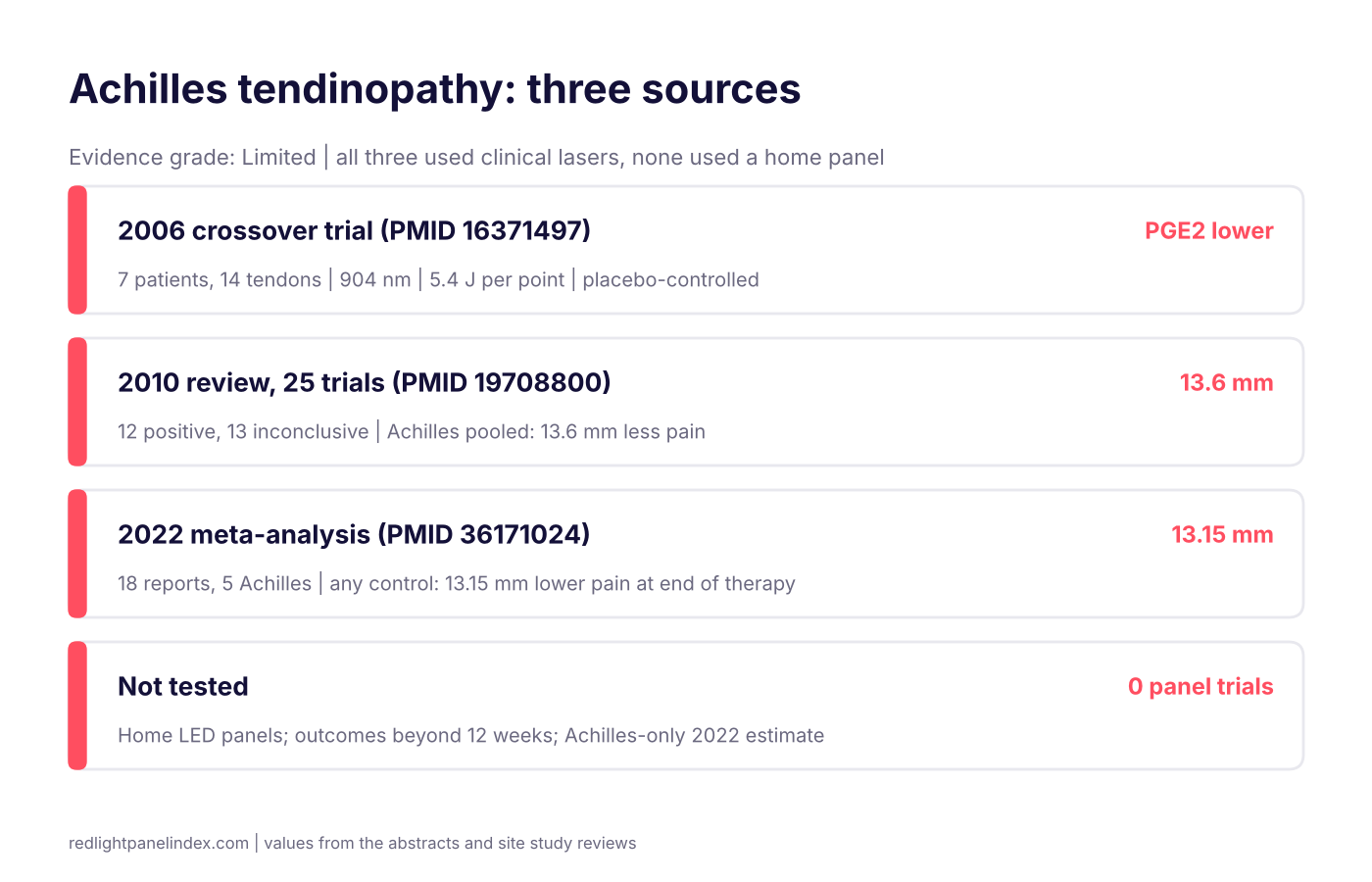
The evidence for red and near-infrared light on Achilles tendinopathy is graded Limited. A 2010 review reported 13.6 mm less pain on a 100 mm scale in pooled Achilles laser trials (PMID 19708800), and a 2006 trial in seven people reported a lower inflammatory marker in the tendon after laser (PMID 16371497), but both rest on clinical lasers at small spots, the numbers are modest, and no trial tested a home panel.
Choosing a panel? Our ranking of the best red light therapy panels is computed from published, method-labeled specs across 188 devices. For the Achilles, the spec that matters is method-labeled near-infrared irradiance at the distance you would actually use, because the trials turned on delivered dose.
How the grade was reached
The site's evidence grades run from Strong to Insufficient. The Achilles lands at Limited for these reasons:
- The one Achilles-specific pooled figure comes from a 2010 review, which is more than a decade old.
- The only direct tissue measurement is from seven people and covers about two hours.
- A 2022 meta-analysis includes five Achilles trials, but the text reviewed here does not report an Achilles-only effect size (PMID 36171024).
- Every source used a clinical laser, not an LED panel.
The broader tendon grade on the tendinopathy evidence page is Moderate. One tendon site, with thin condition-specific data, is held lower.
The studies
Bjordal trial (2006): a mechanism in seven people
A randomized, placebo-controlled trial enrolled seven patients with bilateral activated Achilles tendinitis, 14 tendons in all, and treated one tendon with 904 nm laser and the other with placebo (PMID 16371497). The dose was 5.4 J per point at 20 mW/cm2. Doppler ultrasound showed increased blood flow in all 14 tendons at baseline. Peritendinous prostaglandin E2 was significantly lower 75, 90 and 105 minutes after active laser than before treatment (p = 0.026) and than after placebo (p = 0.009), and pressure pain threshold was higher after active treatment (p = 0.012).
This is a surrogate marker over about two hours, not a recovery outcome. The abstract reports p values rather than sizes of change, so none are given here. Full detail is in our Bjordal study review, and the inflammation evidence page places it next to the mechanism literature.
Tumilty meta-analysis (2010): the dose split
A systematic review pooled 25 controlled laser trials for tendinopathy. Twelve reported a positive effect and 13 were inconclusive or showed no effect, and the authors reported that the positive trials used dosages close to recommended guideline ranges (PMID 19708800). Achilles tendinopathy was one of two conditions with enough comparable data to pool: treated groups reported 13.6 mm less pain on a 100 mm visual analogue scale than controls. See the Tumilty study review.
Naterstad meta-analysis (2022): lower-limb tendons
This BMJ Open review pooled 18 trial reports with 784 participants: 11 plantar fasciitis, 5 Achilles tendinopathy and 2 patellar tendinopathy (PMID 36171024). Against any control, pain was 13.15 mm lower at the end of therapy (95% CI 7.82 to 18.48) and 12.56 mm lower at 4 to 12 weeks (95% CI 5.69 to 19.42). Trials with WALT-recommended doses against placebo reported 14.98 mm (95% CI 3.74 to 26.22), while the one trial with a non-recommended dose reported -3.0 mm, not significant. The authors noted wide intervals, no long-term data and a lack of large trials. See the Naterstad study review and the sister page on plantar fasciitis.
What the three sources agree on
- A modest pain difference, on the order of 13 to 15 mm on a 100 mm scale, was reported in pooled controlled trials.
- Dose appeared to separate trials that reported benefit from those that did not, in both meta-analyses.
- A mechanism consistent with that signal was measured in tissue, though in a very small sample.
A 13 mm difference is modest. Around 10 mm is often treated as a rough point where a patient might notice a change, but the intervals are wide and pain scores are self-reported. The Achilles figure from 2010 and the lower-limb figure from 2022 also pool different protocols, so neither identifies a best protocol.
What was not studied
- Home LED panels. Every device in these sources was a laser delivering joules per point. The Bjordal trial used 904 nm, a wavelength most panels do not carry.
- Long-term outcomes. The 2022 pooled follow-up ran 4 to 12 weeks, and the mechanism trial ran about two hours. Faster healing or return to sport was not shown.
- An Achilles-only effect from the 2022 review. The five Achilles trials are pooled with plantar and patellar trials in the text reviewed here.
- Midportion versus insertional tendinopathy. The sources reviewed here do not separate the two.
- Comparison with loading exercise. The 2022 review reported laser as an add-on to exercise, but this page draws no conclusion about laser against a loading program.
- Panel doses. No source defines a dose for a panel placed at a distance.
A practical section for panel owners
The Achilles lies just under the skin at the back of the ankle, so depth matters less than for a hip or a deep joint. Position, distance and dose matter more.
- Compute the dose. Use the method-labeled irradiance at your treatment distance and the dose calculator. Point doses from trials do not translate directly into panel minutes; see WALT dosing recommendations.
- Keep the distance repeatable. The distance guide and the inverse square law explainer show how quickly irradiance falls with distance.
- Look at the near-infrared bands. The 2022 lasers ranged from 635 to 904 nm. Our 810nm page and wavelengths overview show the bands panels carry, and the irradiance explainer shows how to read the measurement method.
- Match the panel to a small target. The targeted versus full panel guide covers coverage, and the best panels for neuropathy and foot pain ranks models on database fields; see how rankings work for the criteria.
For another tendon with a similar evidence base, see the tennis elbow evidence page.
Cautions
- A tendon that is suddenly worse, swollen, hot, or painful after an injury, or a heel that cannot bear weight, needs assessment, not a light session. A sudden snap or pop at the back of the ankle is an emergency.
- Light was studied alone or as an add-on in controlled trials. It was not shown to replace rehabilitation or medical care.
- People who are pregnant, have a history of skin cancer over the site, or take photosensitizing medication should speak with a clinician first; see the list of photosensitizing medications.
- Eye protection matters with bright near-infrared sources; see the eye protection guide.