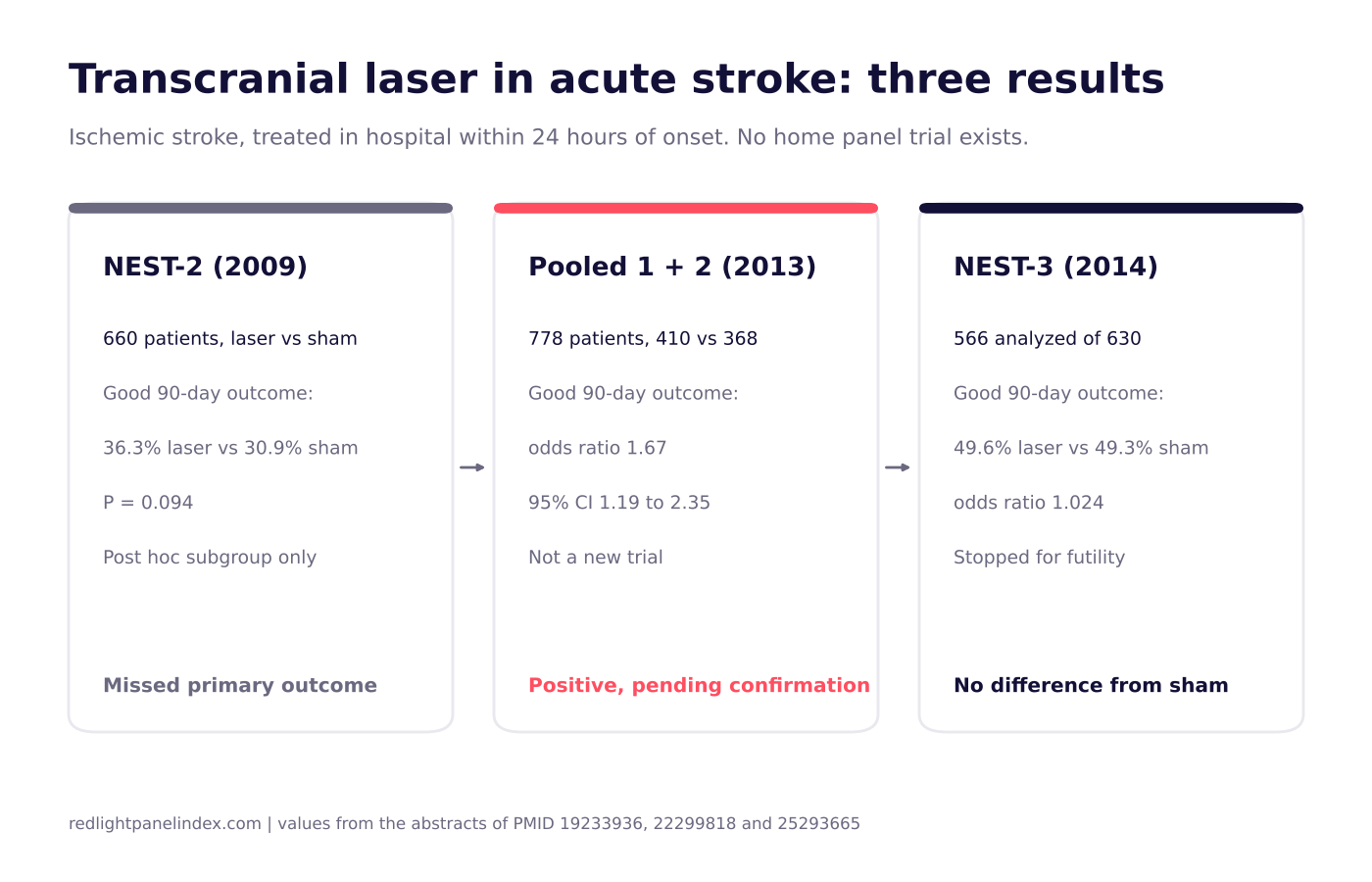
The evidence grade for red and near-infrared light in stroke recovery is Insufficient for home use: every controlled human trial in this index's sources tested a dedicated transcranial laser device, in hospital, within 24 hours of an acute ischemic stroke, and the largest of them, a phase III trial, was stopped for futility with no difference from sham (PMID 25293665). There is no trial of a home red light panel in stroke recovery at all, early or late, and nothing on this page should be read as support for using one.
Choosing a panel? Our ranking of the best red light therapy panels is computed from published, method-labeled specs across 188 devices. For stroke, the spec that matters is verified irradiance at your real distance, but no panel has been tested for this condition, and the purpose-built laser that was tested showed no effect.
Why this page tells the story in order
Three publications carry this question, and they only make sense read in sequence. A large sham-controlled trial narrowly missed its primary outcome. A pooled analysis that combined it with an earlier, smaller trial then reported a statistically significant benefit. A phase III trial built to confirm that benefit found none. That arc is the clearest example on this site of why one positive pooled result does not settle a question, and it is why the evidence grades explainer says a grade comes down when a large replication trial contradicts an earlier positive signal.
All three publications come from the NeuroThera Effectiveness and Safety Trial (NEST) program. The figures below are taken only from the abstracts.
The studies
NEST-2 (2009): a large trial that missed its primary outcome
- Population: 660 adults with acute ischemic stroke, randomized within 24 hours of onset, 331 to laser and 327 to sham. Patients who received tPA (the clot-dissolving drug) or had a hemorrhagic infarct were excluded.
- Device and wavelength as stated: the abstract describes near-infrared laser technology applied to the head, double-blind against a sham. It does not state the wavelength, power or dose.
- Primary outcome: a favorable 90-day score on the modified Rankin Scale, a 0 to 6 disability score where 0 to 2 means the person can manage their own affairs.
- Result: 36.3 percent of the laser group (120 of 331) and 30.9 percent of the sham group (101 of 327) had a favorable outcome, P = 0.094, odds ratio 1.38 (95% CI 0.95 to 2.00). No prespecified test reached significance.
- Safety: mortality was 17.5 percent with laser and 17.4 percent with sham; serious adverse events were 37.8 and 41.8 percent.
- What the authors did next: a post hoc analysis of patients with less severe strokes (a baseline NIH Stroke Scale score under 16) looked favorable, and the authors planned a definitive trial with refined entry criteria (PMID 19233936).
Read plainly, NEST-2 was a safe trial that did not show efficacy. The favorable subgroup was found after the data were in, which makes it a hypothesis for the next trial rather than a result.
The pooled analysis (2013): NEST-1 and NEST-2 combined
- Population: 778 patients from the two trials in the intention-to-treat population, 410 laser and 368 sham, all treated within 24 hours of onset.
- Device and wavelength as stated: the abstract does not give wavelength or dose; it pools the same transcranial laser program.
- Outcome: the same dichotomized 90-day modified Rankin Scale.
- Result: the laser group had a higher rate of good outcome, odds ratio 1.67 (95% CI 1.19 to 2.35), P = 0.003, and the shift across the whole 90-day scale also differed (P = 0.0005). Moderate stroke severity was identified as a predictor of better response.
- The authors' reading: the data support a likely benefit, if confirmed by further trials (PMID 22299818).
The pooled P value looked convincing. But it combined a smaller earlier trial with NEST-2, which on its own was not significant, and it was not a new test. The authors themselves made the claim conditional on confirmation.
NEST-3 (2014): the confirmation trial, stopped for futility
- Population: adults with acute ischemic stroke treated within 24 hours, excluding anyone who received thrombolysis. The plan was 1,000 patients with interim looks at 300 and 600.
- Device and wavelength as stated: transcranial laser therapy against a sham procedure, double-blind. The abstract does not state wavelength, power or dose.
- Primary outcome: good functional outcome, modified Rankin Scale 0 to 2, at 90 days.
- Result: a futility analysis of 566 patients who had completed follow-up found 140 of 282 (49.6 percent) with a good outcome in the laser arm and 140 of 284 (49.3 percent) in the sham arm. Across all 630 randomized patients, the adjusted odds ratio was 1.024 (95% CI 0.705 to 1.488).
- Outcome of the trial: the data monitoring committee recommended stopping, and the authors concluded that transcranial laser therapy has no measurable neuroprotective effect when given within 24 hours of stroke onset (PMID 25293665).
The same number of patients did well in each arm, and the confidence interval sits squarely across 1.0. The NEST-3 study review walks through the design, the limits of early stopping, and why the pooled analysis and the phase III result disagree.
What the three trials add up to
Put side by side, the program went from a trend (NEST-2), to a significant pooled result built partly on that trend, to a clean null in the trial designed to answer the question. That is a common pattern in medicine, not a quirk of light therapy: subgroups found after the fact tend to shrink, and pooling a non-significant large trial with a smaller one can produce a P value under 0.05 without any single trial being conclusive. The guide to reading sham-controlled trials explains why a prespecified, well-blinded comparison against a convincing sham is the result to weigh most. Here that comparison was run at scale, and it came back even.
Two things the trials did show are worth keeping. NEST-2 reported no difference in mortality or serious adverse events between laser and sham, so the research device did not appear to cause harm in that setting. And the program was well designed: double-blind, sham-controlled, large and registered. A null result from a trial of that quality is informative, which is exactly why it moves the grade.
What was not studied
This section matters more than any figure above, because people who search this topic are usually asking about something the trials never tested.
- No home panel trial. Not one controlled trial in this index's sources tested a consumer red light panel, a pad, or any LED device in stroke. All three publications used a transcranial laser in hospital.
- No rehabilitation phase. Every trial treated within 24 hours of onset, aiming at neuroprotection. Recovery in the weeks, months or years after a stroke, which is what most people mean by stroke recovery, was not tested at all.
- No hemorrhagic stroke. The trials enrolled ischemic stroke; NEST-2 explicitly excluded hemorrhagic infarct.
- No combination with clot-dissolving treatment. Patients who received thrombolysis were excluded, so nothing is known about light alongside standard acute care.
- No stated device parameters. None of the three abstracts gives a wavelength, irradiance or dose, so there is no published dose to compare a panel against.
- No long-term outcomes. Follow-up ended at 90 days.
Transcranial light for mood, cognition and brain injury is a separate literature with different populations and devices, and it has its own pages: the brain and mood evidence page and the traumatic brain injury page. The stroke trials neither support nor refute those questions, and those questions say nothing about stroke.
Practical notes for a home panel
There is no home protocol for stroke to give, because none has been tested. What can be said is why a panel cannot be assumed to reach the same tissue the research device aimed at.
- Wavelength is not dose. The stroke abstracts describe near-infrared laser light. The 810nm explainer sets out the verified measurement that only a small fraction of near-infrared light from 10 to 15 watt research lasers penetrated 3 centimeters of tissue, and a home panel delivers far less power than that. The wavelengths overview and the penetration depth page cover the rest of the depth evidence.
- Distance changes everything. A panel's output falls with distance, as the irradiance explainer shows, and a laser applied to the head is a different source. The LED vs laser explainer covers why the two are not interchangeable.
- The dose calculator works for skin, not for a stroke. The dose calculator converts a panel's irradiance and minutes into energy per square centimeter at the surface. It cannot tell you what reaches the brain, and no trial has set a stroke dose to aim for.
If you already use a panel for something else, such as skin or a joint, nothing on this page suggests a stroke history rules that out, but nothing suggests the panel will help stroke outcomes either.
Cautions
- A stroke is an emergency. Sudden weakness on one side, facial droop, slurred speech or sudden loss of vision needs emergency services immediately. No light device belongs anywhere in that pathway, and time spent on one is time lost.
- Keep rehabilitation with the care team. Physical, occupational and speech therapy, and secondary prevention medicines, are the parts of stroke recovery with evidence behind them. Do not drop or delay any of them for a light device.
- Ask before adding anything. If you are considering a panel for another reason after a stroke, raise it with the treating clinician, particularly if you take medicines that increase light sensitivity. The safety and side effects page covers the general cautions.
- Protect the eyes. Any bright source near the head needs eye protection; the eye protection guide explains what to use.
- Be wary of stroke claims in marketing. A product page that cites the early NEST results without the phase III null is telling half the story.
The honest summary: transcranial laser for acute stroke was tested properly, in a program of large double-blind trials, and the trial built to confirm an early positive signal found 140 good outcomes in each arm. For stroke recovery with a home panel, there is no evidence at all.