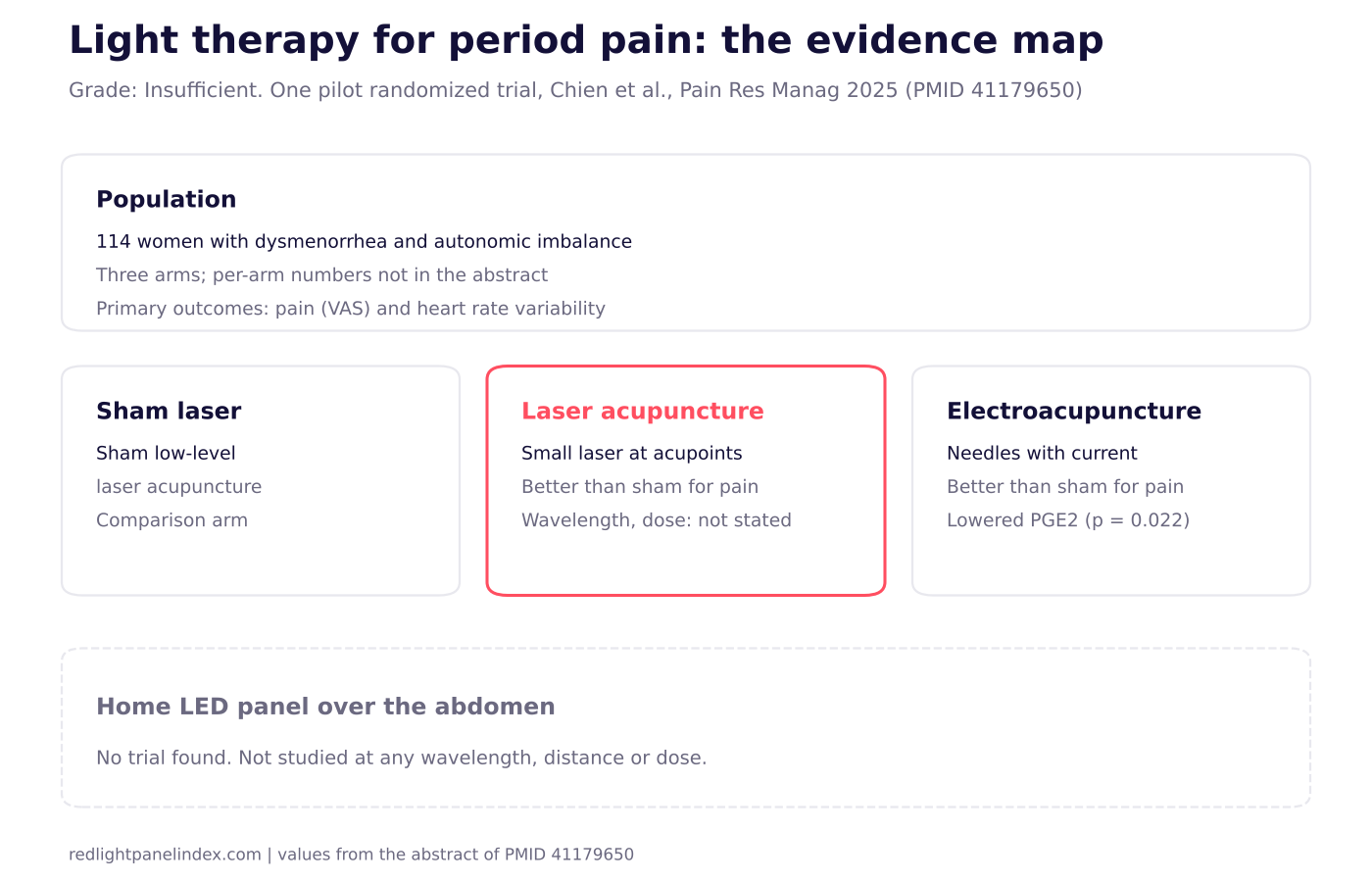
The evidence grade for red light therapy and period pain (dysmenorrhea) is Insufficient: the only randomized trial we found is a single pilot study in which low-level laser acupuncture and electroacupuncture both reduced pain against a sham in 114 women, and it delivered light through a small laser at acupuncture points, not a panel over the abdomen (PMID 41179650). No trial of a home red light panel for period pain exists in the sources this site reviews, so there is nothing yet to say about whether a panel helps.
Choosing a panel? Our ranking of the best red light therapy panels is computed from published, method-labeled specs across 188 devices. For period pain, no panel spec has been tested, so the one worth comparing is method-labeled irradiance, which at least tells you what dose your device delivers.
How we grade this topic
The grades on this site run Strong, Moderate, Limited and Insufficient, and the evidence grades page explains what each one requires. Insufficient means there is not enough human evidence on the question being asked to draw a conclusion either way. Here the question is whether red or near-infrared light from a home device is associated with less period pain. One pilot trial of a different delivery method, at points away from where a panel would be placed, does not answer that question, even though its result was positive for the method it tested.
An Insufficient grade is not a finding that light does nothing. It is a statement about how much has been studied.
The one trial
The trial, by Chien and colleagues in Pain Research and Management (2025), was a pilot randomized controlled trial registered as NCT04178226 (PMID 41179650).
- Population. 114 women with dysmenorrhea and what the authors call autonomic imbalance, meaning measurable differences in heart rate variability, a marker of how the nervous system's "rest" and "alert" branches are balanced. The abstract does not give ages, the split between primary and secondary dysmenorrhea, or the diagnostic criteria used.
- Arms. Three groups: sham low-level laser acupuncture, low-level laser acupuncture, and electroacupuncture. The abstract does not give the number in each arm.
- Device and parameters. The abstract describes the active light treatment as low-level laser acupuncture, meaning a low-power laser applied to acupuncture points. It does not state the wavelength, the power, the dose per point, which acupoints were used, the number of sessions or the schedule. We therefore state none of those.
- Outcomes. Pain on a visual analog scale and heart rate variability were the primary outcomes. Secondary outcomes were symptom scores, prostaglandin E2 (a hormone-like compound linked to uterine cramping), progesterone and quality of life on the SF-12 questionnaire.
What was reported
- Both laser acupuncture and electroacupuncture reported pain relief and better autonomic balance than sham, whatever the participant's starting heart rate variability.
- Across all participants, laser acupuncture and electroacupuncture were reported as similar for pain and quality of life. The abstract does not give the size of the pain reduction.
- In women with low baseline LF/HF ratio, a heart rate variability index, laser acupuncture was reported as better than electroacupuncture on three heart rate variability measures (p < 0.001).
- Electroacupuncture lowered prostaglandin E2 (p = 0.022). The abstract does not report a prostaglandin result for laser acupuncture, or a progesterone result for either group.
- The authors conclude that laser acupuncture was noninferior to electroacupuncture for autonomic dysfunction and may be a noninvasive alternative that warrants larger trials (PMID 41179650). The abstract does not state the noninferiority margin, follow-up length or adverse events.
The delivery route is the whole story
The honest core of this page is how the light got into the body. Laser acupuncture uses a small, low-power laser held to specific points on the skin, often on the lower leg, hand or lower abdomen depending on the acupoint protocol. The beam is narrow, the spot is small, and the dose is delivered point by point. The abstract does not say which points this trial used, so we cannot say whether any of them were over the abdomen at all.
A home panel works differently. It floods a broad area, usually from 6 inches or more away, with LED light spread over thousands of square centimeters. The total energy, the area it lands on and the energy per square centimeter are all different from a laser on an acupoint. Our page on LED vs laser explains why coherence itself has not been shown to matter, but why dose delivery differs between the two in ways that do not transfer without recalculation.
There is also a conceptual gap. The trial's framing is acupuncture: stimulate points thought to influence pain and autonomic balance. A panel user pointing light at the lower abdomen is trying something else, closer to local warmth or a local tissue effect on the uterus or abdominal wall. A positive result for one does not carry over to the other. The trial also ran against electroacupuncture as well as sham, which tells you laser acupuncture was in the same range as another acupuncture method, not how it compares with the usual first-line options for period pain.
What was not studied
- Home LED panels. No trial we found tested a red or near-infrared panel for period pain, at any distance, dose or schedule.
- Light over the abdomen. The trial abstract does not describe any treatment that matches placing a panel over the lower abdomen.
- Wavelength. With no wavelength stated in the abstract, there is no basis for choosing red over near-infrared, or the reverse, for this condition. Our explainer on red vs near-infrared covers how the two bands differ in tissue in general.
- Comparison with standard care. The trial compared laser acupuncture with sham and electroacupuncture. It did not compare it with pain relievers, hormonal options, heat or exercise.
- Secondary dysmenorrhea. Pain caused by conditions such as endometriosis, fibroids or adenomyosis is a separate problem, and the abstract does not tell us whether these women were included.
- Inflammation markers at panel doses. The trial's prostaglandin result was reported for electroacupuncture, not for laser acupuncture. Our inflammation evidence page explains how thin the human data on light and inflammatory markers is generally.
- Long-term use and pregnancy. Nothing here covers repeated use over many cycles, or use in someone who could be pregnant.
A practical section, kept short
There is no tested protocol for period pain with a home panel, so this page does not offer one. If you already own a panel and decide to try it over the lower abdomen during your period, treat it as an untested personal experiment, not a treatment, and keep the session within the ranges you would use for any other area. The dose calculator turns your panel's published irradiance and your distance into a dose, so you know what you are actually delivering, and the session length guide covers typical timing. For what each band is used for in general, see the wavelengths guide.
Keep a simple pain log across a few cycles, with and without the panel, so you can judge your own experience honestly. Period pain varies from cycle to cycle anyway, which is exactly why trials need sham arms.
Cautions
- Get undiagnosed pelvic pain looked at. New period pain, pain that is getting worse, pain between periods, pain with sex, heavy bleeding or pain that does not respond to usual measures can signal conditions such as endometriosis, fibroids, infection or an ovarian cyst. These need a diagnosis, and light is not a substitute for one.
- Pregnancy. If there is any chance you are pregnant, do not use a panel over the abdomen until you have asked a clinician. Our pregnancy safety guide explains why no data is not the same as safe.
- Heat. Panels warm the skin. Do not combine a panel with a heating pad over the same area, and stop if the skin feels hot.
- Eyes. Protect your eyes with high-output panels; see the eye protection guide.
- Medications. Some medications increase light sensitivity. The safety and side effects page covers this and other general cautions.
- This page is general information, not medical advice.
Bottom line
One pilot randomized trial in 114 women reported that low-level laser acupuncture and electroacupuncture both relieved period pain and improved autonomic balance against sham, with laser acupuncture reported as noninferior to electroacupuncture for autonomic dysfunction (PMID 41179650). It used a small laser at acupoints, not a panel, and its abstract gives no wavelength or dose. With no panel trial at all, the grade for home red light therapy and period pain is Insufficient. We will revisit it if a trial of broad-area LED light for dysmenorrhea is published.