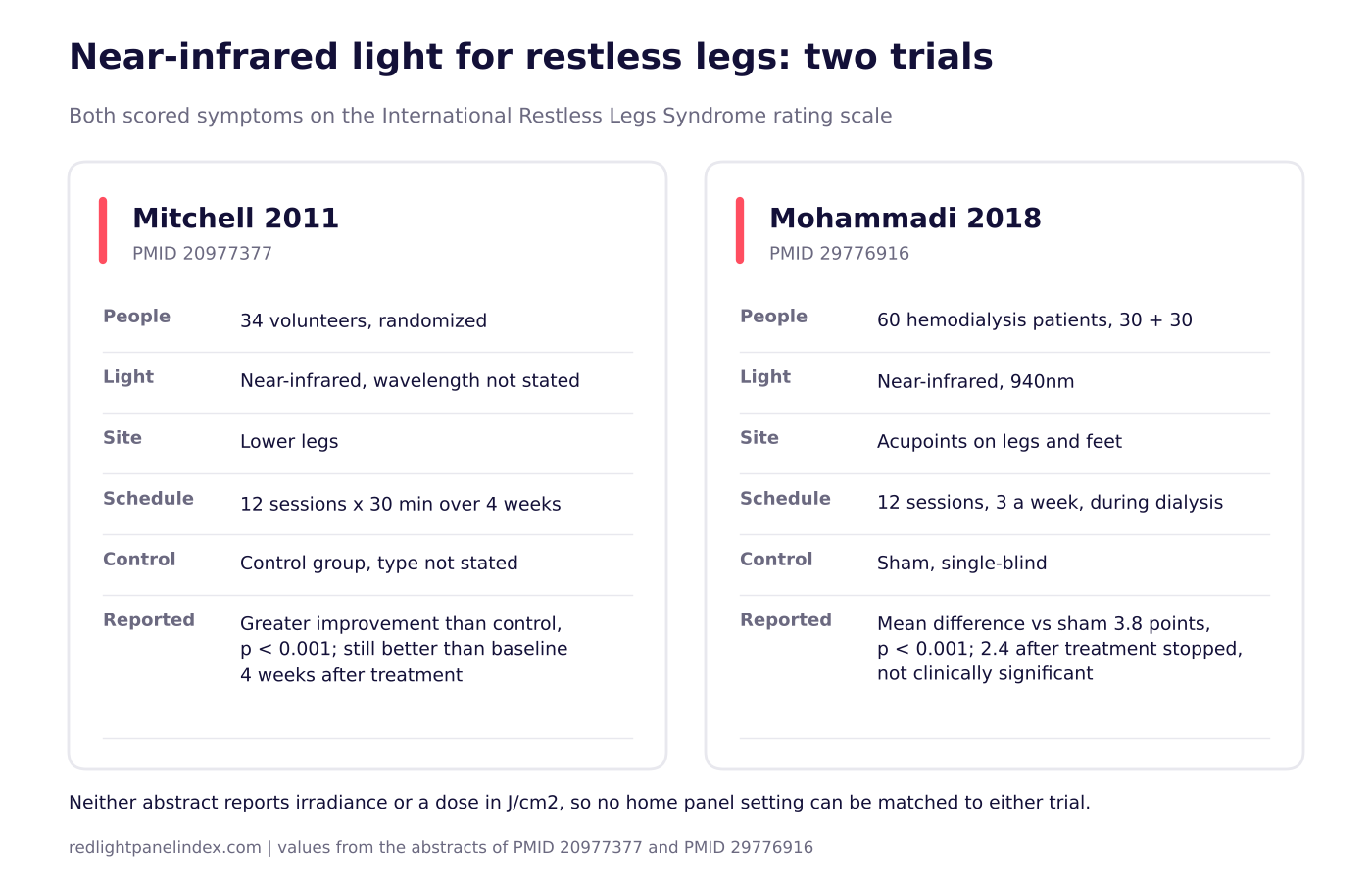
Two small randomized trials have tested near-infrared light on the legs for restless legs syndrome, and both reported lower symptom scores on the International Restless Legs Syndrome rating scale in the light group than in the comparison group. A 2011 study of 34 volunteers gave twelve 30-minute sessions to the lower legs over four weeks (PMID 20977377), and a 2018 single-blind trial of 60 hemodialysis patients applied 940nm light to leg and foot acupoints against a sham (PMID 29776916). Neither abstract reports a dose a home panel could be set to, and in the 2018 trial the difference after treatment stopped was no longer judged clinically meaningful, so this is an early signal, not an established use.
Choosing a panel? Our ranking of the best red light therapy panels is computed from published, method-labeled specs across 188 devices. For the lower legs, the spec that matters is method-labeled near-infrared irradiance at your working distance, because both trials used near-infrared light rather than red.
Where this fits
Restless legs syndrome is an urge to move the legs, usually with uncomfortable sensations, that is worse at rest and in the evening and often disturbs sleep. The site's sleep evidence page grades red light for sleep as Limited and does not cover restless legs, and the neuropathy evidence page deals with nerve damage in the feet rather than this movement disorder. These two trials are the only direct tests of light on the legs for restless legs that this review found, and the restless legs syndrome evidence page gives the condition-level grade, what was not studied and what a home panel can reproduce. Every figure below comes from the two abstracts, read through their database records. Where an abstract is silent, this page says so.
What the studies asked
Mitchell and colleagues (2011). Writing in Physiotherapy Theory and Practice, the authors asked whether monochromatic near-infrared light applied to the lower legs could reduce restless legs symptoms as a non-drug option (PMID 20977377).
Mohammadi and colleagues (2018). Writing in Clinical Medicine and Research, the authors asked a narrower question: does near-infrared light applied to acupoints on the legs and feet during dialysis sessions reduce the severity of restless legs in people on hemodialysis (PMID 29776916)?
Who was studied
The 2011 study randomly assigned 34 volunteers with restless legs to a treatment group or a control group. The abstract does not give the size of each group, ages, how long participants had had symptoms, or whether any were taking medication for the condition.
The 2018 trial randomized 60 hemodialysis patients with restless legs into two groups of 30. People on dialysis have a serious underlying illness, so restless legs in this group may not respond the way it does in otherwise healthy adults. The abstract does not report ages, time on dialysis or medication use.
Device and parameters as stated
| Mitchell 2011 | Mohammadi 2018 | |
|---|---|---|
| Design | Randomized, 2 groups, 6 repeated measures | Randomized, single-blind, sham-controlled |
| People | 34 volunteers | 60 hemodialysis patients (30 and 30) |
| Light | Monochromatic near-infrared, wavelength not stated | Near-infrared at 940nm |
| Site | Lower legs | Acupoints on the legs and feet |
| Schedule | 12 sessions of 30 minutes over 4 weeks | 12 sessions, 3 a week, during dialysis |
| Session length | 30 minutes | Not stated |
| Control | Control group; type not stated | Sham treatment |
| Scale | International RLS rating scale | International RLS rating scale |
Neither abstract gives the device's power, the irradiance at the skin, the area treated or a dose in joules per square centimeter. The 2011 abstract does not say what the control group received or whether anyone was blinded. Both were clinic or research devices applied at or near the skin, not a panel at a distance, and the abstracts do not say whether either was an LED or a laser.
What was measured and found
Mitchell 2011. Symptoms were scored at baseline, weekly through the four weeks, and again four weeks after treatment ended. The abstract reports a steady fall in symptom scores in the treatment group and a significantly greater improvement than in the control group after four weeks (p below 0.001). Four weeks after the last session, scores were still significantly better than at baseline (p below 0.001). The abstract gives no actual scores, so the size of the change cannot be stated here.
Mohammadi 2018. At the end of the twelve sessions, the light group's severity score was lower than the sham group's by a mean difference of 3.8 points (p below 0.001), which the authors judged both statistically and clinically significant. Within the light group, the score fell by a mean of 3.2 points across the sessions (p below 0.001). After treatment stopped, the between-group difference was 2.4 points and the within-group difference 1.67 points, and the authors judged neither clinically significant. The abstract does not say how long after the last session that measurement was taken.
The two results point in the same direction during treatment. They part ways afterward: the 2011 study reported a lasting improvement against baseline, while the 2018 trial reported that the benefit shrank below the clinically meaningful threshold once sessions ended.
Limitations
- Small samples. 34 and 60 people in total, from two different populations.
- Unclear control in 2011. The abstract does not describe a sham, and restless legs scores are self-reported, which is where expectation effects are largest. The site's guide to reading sham-controlled trials explains why that matters.
- Single blinding in 2018. Patients were blinded; the abstract does not say whether assessors were.
- No dose. Without irradiance or energy figures, neither protocol can be reproduced or compared with a home device.
- Acupoint targeting. The 2018 trial chose sites by acupuncture points, a rationale separate from light physics, and its results may not apply to light spread over the whole lower leg.
- No replication. No larger trial in this search tested the same question.
How this reads on the site's grading scale
The site's evidence grades explainer reserves Limited for a pilot, a single trial or parameters a consumer panel is not built to reach. Two small trials with undisclosed doses, one with an undescribed control, fit that description. This page reviews studies and does not assign a condition grade, but on those terms restless legs would sit at Limited at best for home panels.
What it means for a home panel
Most panels carry near-infrared light: the site's 850nm page notes it is on 93 percent of the 188 panels in the database. The 2018 trial used 940nm, a less common band covered on the 940nm page, and the 2011 abstract does not name its wavelength, so no panel can be said to match either trial. On depth, the penetration depth page explains that near-infrared reaches farther into tissue than red, but that modeled depths are measured in millimeters, not inches. Whatever these trials did, they did it at the skin and the tissue just beneath it.
Because neither trial published a dose, you cannot calculate an equivalent session. You can, however, check what a given session would deliver. Dose in J/cm2 is irradiance in mW/cm2 times seconds, divided by 1000. On the dose calculator, a panel delivering a method-labeled 50 mW/cm2 at your distance reaches 10 J/cm2 in about 3.3 minutes and 60 J/cm2 in 20 minutes. Copying the 2011 trial's 30-minute session length at that irradiance would deliver about 90 J/cm2, above the 10 to 60 J/cm2 range most studied protocols use, which is a reason not to copy session length alone. More light is not automatically better; the biphasic dose response page explains why.
If you try a panel on your legs in the evening, treat it as an experiment layered on top of medical care. Restless legs can be linked to low iron, kidney disease, pregnancy and some medications, so it deserves a clinician's assessment before any self-treatment, and anyone on dialysis should ask their care team first. Use the panel at the distance its irradiance figure was measured, keep a simple symptom diary, and stop if anything gets worse. The site's safety and side effects page covers eye protection and other cautions. This page describes studies; it is not medical advice.