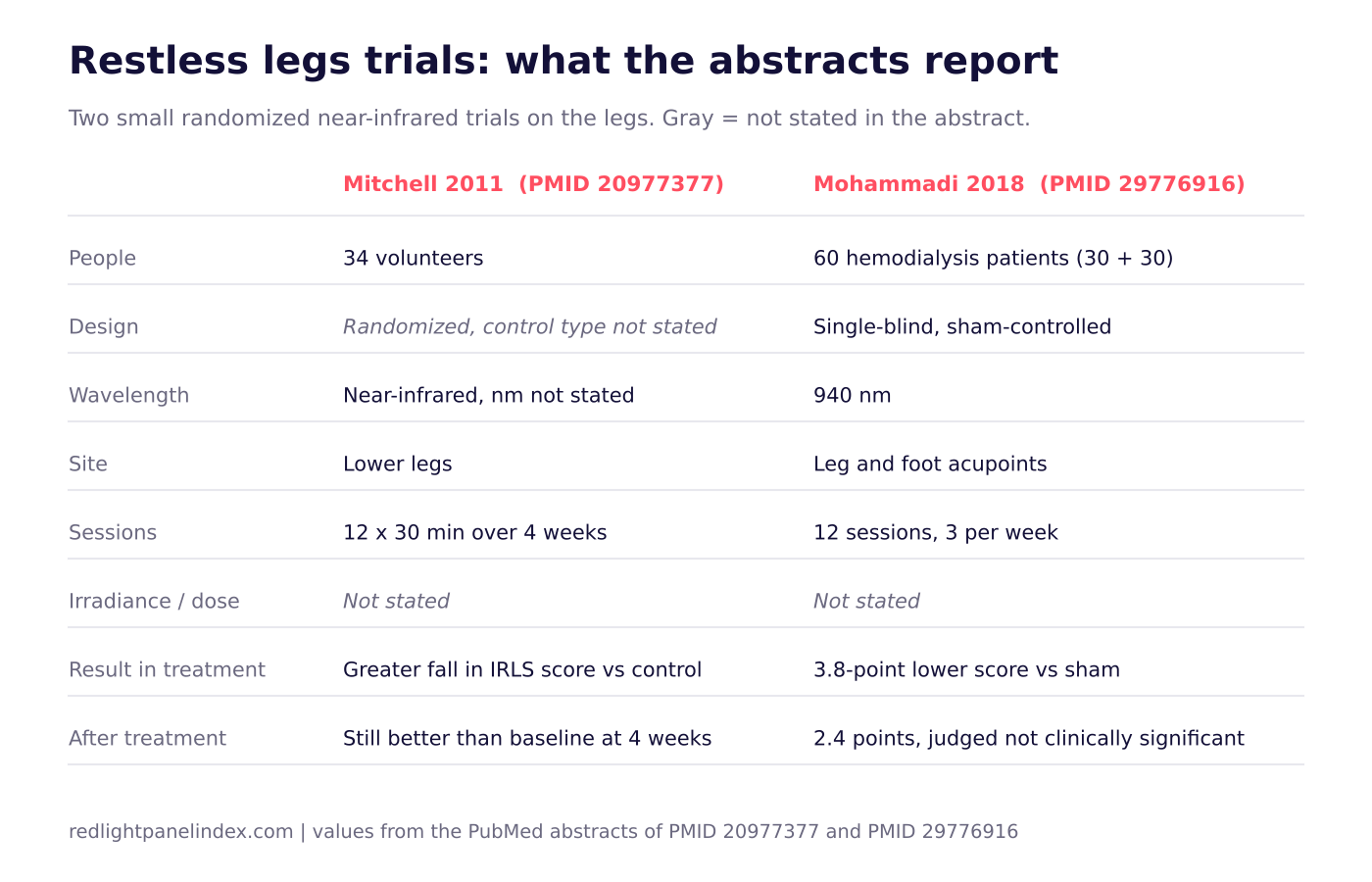
The evidence for red or near-infrared light in restless legs syndrome is Limited: two small randomized trials put near-infrared light on the legs and both reported lower scores on the International Restless Legs Syndrome rating scale than in the comparison group (PMID 20977377, PMID 29776916), but neither abstract reports a dose, one does not describe its control, and in the larger trial the difference shrank below what its authors judged clinically meaningful once sessions stopped. That is a signal worth a better trial, not a reason to expect a panel to settle the condition.
Choosing a panel? Our ranking of the best red light therapy panels is computed from published, method-labeled specs across 188 devices. For restless legs, the spec that matters is method-labeled near-infrared irradiance at your working distance, because both trials used near-infrared light rather than red, aimed at the legs.
What restless legs syndrome is
Restless legs syndrome, also called Willis-Ekbom disease, is a neurological condition that produces an urge to move the legs, usually with unpleasant crawling or aching sensations, that comes on at rest and is worse in the evening and at night. Moving brings temporary relief, which is why the condition so often breaks up sleep, and it can be primary or linked to other problems such as low iron, kidney disease, pregnancy or certain medications.
That link to sleep is why many readers arrive here from the red light and sleep evidence page. The two topics are worth keeping apart. The sleep page covers light aimed at the body to improve sleep quality, and its grade rests mainly on one small trial in athletes. The restless legs trials aimed light at the legs to reduce a movement disorder's symptoms, and neither measured sleep. A lower restless legs score may well make sleep easier, but these studies did not test that, so this page does not claim it.
Restless legs is also not the same as nerve damage. The neuropathy evidence page deals with diabetic peripheral neuropathy, where nerves in the feet are damaged and numbness, burning or pain is the main complaint. Some people have both, and the two can feel similar at night, which is one more reason to get a diagnosis before choosing a treatment.
What the trials used
The table below is built only from the two abstracts. A blank means the abstract does not say.
| Mitchell 2011 (PMID 20977377) | Mohammadi 2018 (PMID 29776916) | |
|---|---|---|
| People | 34 volunteers with restless legs | 60 hemodialysis patients with restless legs, 30 per group |
| Design | Randomized, treatment vs control, 6 repeated measures | Single-blind randomized, light vs sham |
| Wavelength | "Monochromatic near-infrared," not stated | 940nm |
| Site | Lower legs | Acupoints on the legs and feet |
| Sessions | 12 sessions of 30 minutes over 4 weeks | 12 sessions, 3 a week, during dialysis |
| Irradiance, power, dose | Not stated | Not stated |
| Outcome | International RLS rating scale | International RLS rating scale |
Mitchell 2011. In a university laboratory, volunteers were randomly assigned to near-infrared light on the lower legs or to a control group. Scores were taken at baseline, weekly for four weeks and four weeks after treatment ended. The abstract reports a significantly greater improvement in the treated group than in controls after four weeks (p below 0.001) and says scores were still significantly better than baseline four weeks after the last session (p below 0.001). It gives no actual scores, does not say what the control group received, and does not mention blinding.
Mohammadi 2018. People on hemodialysis had 940nm light applied to acupoints on the legs and feet during their dialysis sessions, against a sham. At the end of the twelve sessions the light group's severity score was lower than the sham group's by a mean difference of 3.8 points (p below 0.001), and the light group's own score fell by a mean of 3.2 points across the sessions (p below 0.001). The authors called both changes clinically significant. After treatment stopped, the between-group difference was 2.4 points and the within-group change 1.67 points, and the authors judged neither clinically significant. The abstract does not state the threshold it used or how long after the last session that measurement was made.
For a fuller section-by-section reading of both papers, see the study review of near-infrared light for restless legs.
Why the grade is Limited
The site's evidence grades explainer reserves Limited for a pilot, a single trial, or results that a consumer panel is not built to reproduce. Restless legs fits on every count:
- Two trials, small samples. 34 and 60 people in total, from two very different populations, with no replication of either protocol.
- Self-reported outcome. The rating scale is a questionnaire. Expectation effects are largest on outcomes like this, which is why the control matters. The 2011 abstract does not describe a sham, and the 2018 trial was single-blind. The site's guide to reading sham-controlled trials explains why that weakens the result.
- No dose. Neither abstract gives irradiance, power, treated area or energy in joules per square centimeter, so no one can reproduce either protocol or compare it with a home device.
- Durability is mixed. One study reported a lasting improvement against baseline; the other reported the benefit fell below its clinical threshold after treatment ended.
- Application differs from a panel. Both used research devices at or near the skin, one aimed at acupuncture points, not a panel at a distance across both legs.
The results point the same way during treatment, which keeps the grade above Insufficient. They do not reach Moderate, which on this site needs controlled trials with comparable parameters, and the explainer notes that a Limited grade moves up when a better-powered controlled trial replicates the earlier finding.
What was not studied
- Red light. Both trials used near-infrared. No trial in this search tested 630nm or 660nm red light on restless legs.
- Home LED panels. Neither abstract names a panel or says whether the source was an LED or a laser.
- Sleep outcomes. Neither trial measured sleep quality, sleep time or daytime tiredness.
- Pregnancy, children and iron-deficiency restless legs. The populations were general volunteers and people on dialysis.
- Comparison with standard care. Neither trial compared light with iron replacement or the medications clinicians use, so there is no basis for choosing light instead of them.
- Long-term use. Follow-up after treatment was four weeks at most, and the 2018 timing is not stated.
What a home panel can and cannot reproduce
Wavelength. A panel can match the light type. The 850nm page notes that 850nm is on 93 percent of the 188 panels in the database. The 2018 trial used 940nm, a less common band covered on the 940nm page. Because the 2011 abstract does not name its wavelength, no panel can be said to match it.
Site. A panel can cover the lower legs. Larger panels light both shins and calves at once; a small panel needs one leg at a time. It cannot target acupoints the way the 2018 trial did, and there is no evidence that point targeting matters for light.
Dose. This is where the trials give nothing to copy. You can still check what your own session delivers: dose in J/cm2 is irradiance in mW/cm2 times seconds, divided by 1000. On the dose calculator, a panel delivering a method-labeled 50 mW/cm2 at your distance reaches 10 J/cm2 in about 3.3 minutes and 60 J/cm2 in 20 minutes. Copying the 2011 trial's 30-minute session at that irradiance would deliver about 90 J/cm2, above the 10 to 60 J/cm2 range most studied protocols use, which is why session length alone is not a protocol. The biphasic dose response page explains why more light is not automatically better.
Depth. Near-infrared reaches deeper than red, but the penetration depth page explains that modeled depths are millimeters, not inches. Whatever these trials did, they did it to skin and the tissue just beneath it.
Irradiance figure. Use a figure whose instrument and distance are stated. The site's irradiance explainer documents brand claims running a median of about twice independent spectrometer readings, so an unlabeled figure can halve the dose you think you are getting.
Timing. Restless legs is worst in the evening, which is when people tend to try a panel. Red and near-infrared light are weak signals for the body clock, as the page on red light, melatonin and circadian rhythm explains, so an evening leg session is unlikely to shift your sleep timing. Keep any blue channel off, and keep the room dim if the panel is in the bedroom.
If you try it, treat it as a personal experiment alongside medical care, not instead of it. Score your symptoms the same way each evening for a week before you start and through a few weeks of sessions, so you have something to compare beyond memory.
Cautions
- Get a diagnosis first. Restless legs can be secondary to low iron, kidney disease, pregnancy or medications, and some of those have specific treatments. A clinician can check iron status and review medicines.
- Dialysis patients. The 2018 trial was run by a dialysis care team during sessions. Anyone on dialysis should ask that team before using a device at home, especially near an access site.
- Neuropathy and reduced sensation. If your feet or legs have reduced feeling, you may not notice heat building up. Keep to the distance the irradiance figure was measured at and check the skin afterward.
- Eyes. Near-infrared is invisible and does not trigger a blink. Use the eye protection your panel recommends, even when it points at your legs.
- Stop if symptoms worsen. Restless legs that becomes more frequent or spreads should go back to a clinician.
The site's safety and side effects page covers the general cautions for every panel. This page summarizes research; it is not medical advice.