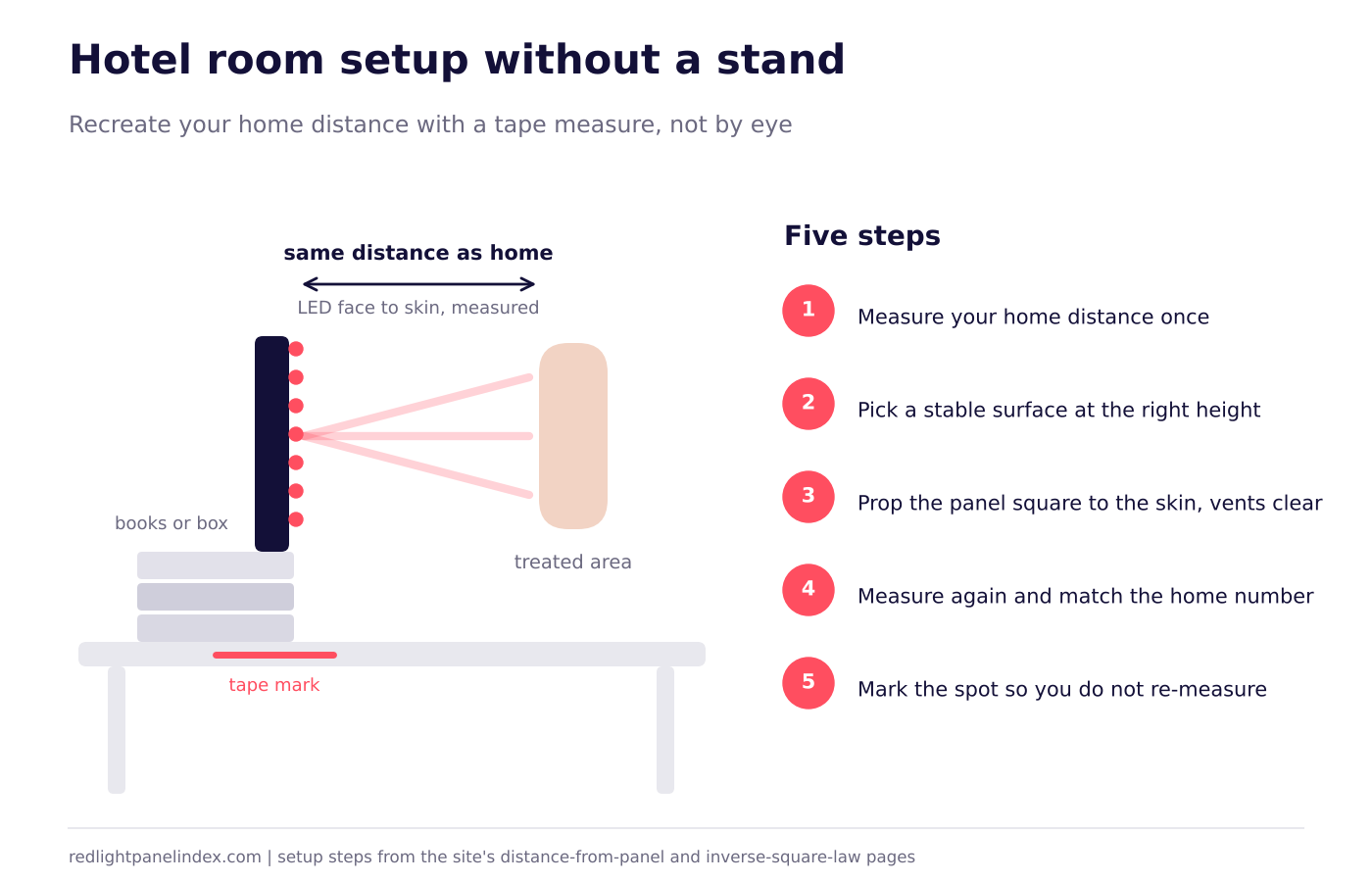
To travel with a red light panel, pack a small one in your carry-on with the LED face padded, check that its power supply accepts the local voltage before you plug it in, and recreate your home distance in the hotel room with a tape measure rather than by eye. The two things that most often go wrong on a trip are a cracked or scratched front face from a checked bag and a session run at the wrong distance because the panel was propped on whatever was nearby, so most of this guide is about those two.
Choosing a panel? Our ranking of the best red light therapy panels is computed from published, method-labeled specs across 188 devices. For travel, the spec that matters is footprint paired with an irradiance figure stated at a distance you can actually reproduce in a hotel room.
Which panel to take
A full-body panel is not a travel device. The practical options are the compact models compared in our portable and travel devices ranking, which range from about 18 square inches for the Rouge Nano to about 52 square inches for the BlockBlueLight PowerPanel Mini. The database does not record weight or whether a travel case is included for any of these models, so check both on the brand's product page before you rely on a panel for travel.
If you own a mid-size panel and a small one, take the small one and accept that it covers less area. A palm-sized device treats a palm-sized area, so a session that covers a knee at home with one pass may take two or three positions on the road. Our guide to targeted vs full panels works through how extra positions add to session time.
Carry-on or checked
Carry-on is the safer choice for the panel. The front face is the part that matters optically, and a scratched, cracked or hazed face can change how evenly the light leaves the device. Checked bags are handled roughly and can be crushed.
- Wrap the panel face in a microfiber cloth, then pad it with clothing on both sides. Do not let hard items such as chargers or shoes press against the LEDs.
- Pack the power supply and cable separately so the cable is not bent sharply at the point where it enters the panel.
- If the device has a built-in battery, airlines and airport security set their own rules for lithium batteries, and those rules are generally stricter for checked bags. Check your airline's current rules before you fly. Among the compact models we compared, the Vellgus Mini is the only one whose page states a battery or USB power option.
- Keep goggles with the panel. They are small and easy to leave behind, and you need them for any face session.
On arrival, look over the face and housing before the first session. Do not use a panel that has been cracked or damaged in transit, and contact the brand rather than taping or patching it. Our cleaning and maintenance guide covers how to wipe the face without hazing it and what counts as a warranty question.
Power and voltage abroad
Our database holds no voltage or plug data for any model, so the only reliable source is the label on your own power supply and the brand's manual. Read the input line on the power adapter or the panel's rating plate before you travel:
- If it lists an input range that includes the mains voltage where you are going, a plug adapter that changes only the plug shape is enough.
- If it lists a single voltage that does not match the destination, a plug adapter is not enough; you would need a voltage converter rated for the device, or a different device. If you are unsure, contact the brand before you plug in.
- Our electricity cost guide explains why the wattage in a model name is rarely the measured draw.
Do not use a power strip or adapter that gets hot, and keep vents clear.
Setting up in a hotel room without a stand
Distance is the variable that changes most when you travel. At home, a stand or a door mount fixes it; in a hotel room you tend to prop the panel on a desk, a chair or a stack of towels, and the distance drifts from one session to the next.
- Measure the distance you use at home once, with a tape measure, from the LED face to the skin. Write it down.
- In the room, find a stable surface at roughly the height of the area you treat: a desk for the face or forearm, a chair seat for the knee, the bed for a lower-leg session.
- Prop the panel so its face points squarely at the treated area. Books, a folded towel or the panel's own box can hold it upright. Make sure it cannot tip and its vents stay clear.
- Measure again, from the LED face to the skin, and adjust until it matches your home number.
- Mark the spot. A strip of tape on the desk or floor saves you from re-measuring every day.
The reason to bother: irradiance falls as you move back, and a spec sheet figure is only accurate at the one distance it was measured. Our guide to distance from the panel covers the usual 6 to 24 inch range, and the inverse square law explainer explains why the drop at close range is real but smaller than a factor of four when you double the distance. A panel propped 10 inches away instead of your usual 6 delivers noticeably less in the same minutes.
Keeping the dose the same
If you can reproduce your home distance, keep your home session length. If you cannot, recalculate rather than guessing: enter the irradiance you plan from and your session target into the dose calculator. Our session length guide explains how to work backward from a target dose, and recommends holding the same session length across a course rather than adjusting it session to session.
Two cautions apply on the road as at home. First, do not lengthen a session to make up for missed days; more light is not more benefit, and the session length guide treats the trial-tested dose as the target to hit, not a floor to build on. Second, frequency is a separate decision; our guide on how often to use red light therapy covers the weekly pattern, and a few missed days on a short trip simply pause it.
Exceptions and cautions
- Face sessions: wear the goggles, and never look into the LEDs at any distance. Our eye protection guide covers when goggles matter most.
- New medications or sun exposure: if you start a medication on the trip, check our list of photosensitizing medications before your next session.
- Shared rooms: the panel's light is bright. Point it away from anyone sleeping, and do not run it near a sleeping child.
- Heat: small panels still get warm. If a session feels hot at your usual distance, move back slightly and recalculate the time rather than pressing on.
- Short trips: for a trip of a few days, leaving the panel at home is a reasonable choice. Packing a device you cannot set up at a stable, measured distance adds risk to the panel without adding much to the course.
For choosing a compact device in the first place, the portable panels ranking compares footprint, power source, method-labeled irradiance and buyer terms; see how rankings work for the criteria behind every list on the site.