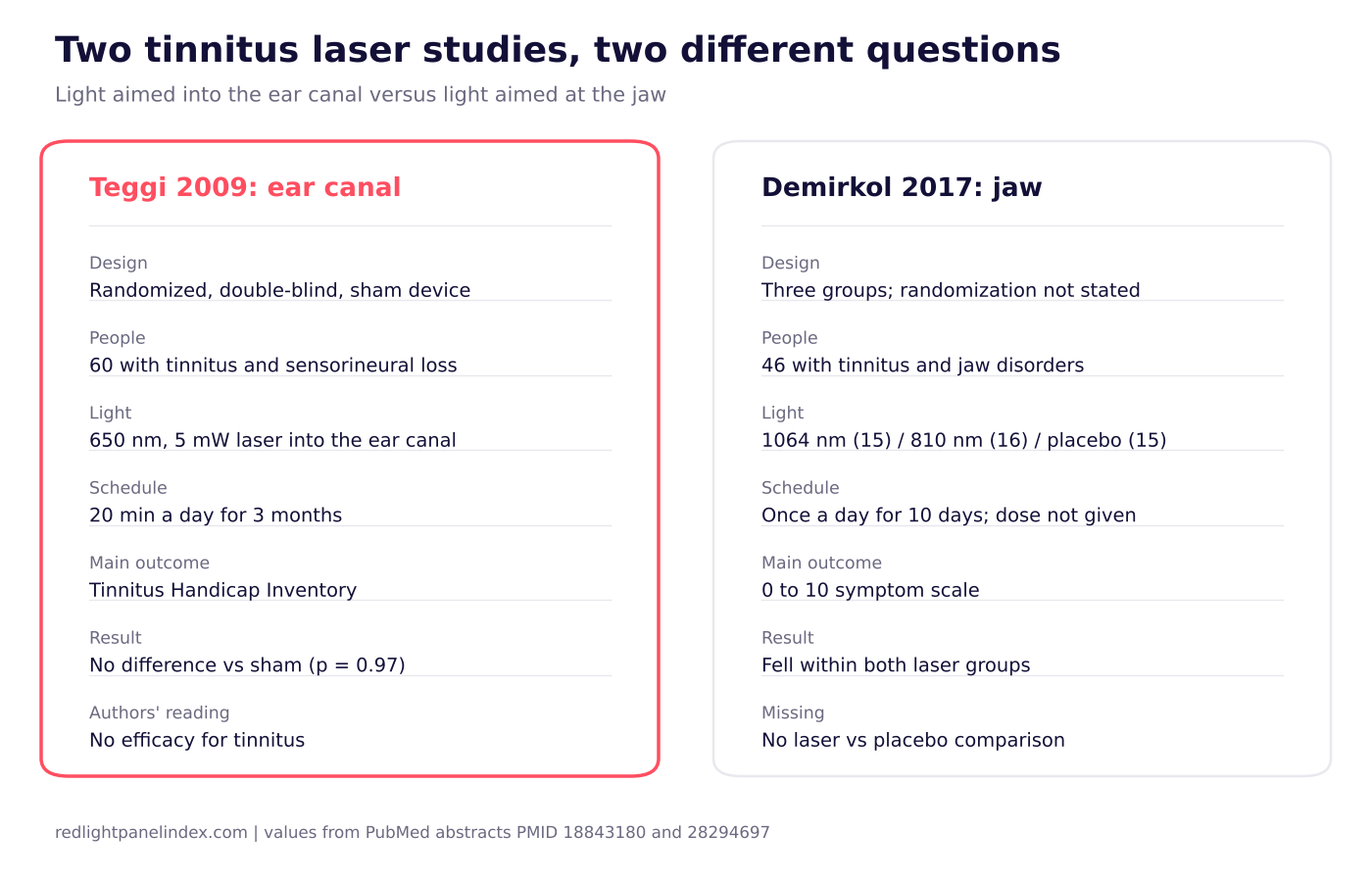
A 2009 randomized, double-blind trial that aimed a low-power laser into the ear canal every day for three months found no difference from a sham device on its main outcome, the Tinnitus Handicap Inventory, and the authors concluded that soft laser therapy showed no efficacy for tinnitus (PMID 18843180). A 2017 study of a different group, people whose tinnitus came with jaw joint disorders, reported that symptom scores fell with two lasers and did not fall significantly with placebo (PMID 28294697). The two papers answer different questions, and neither supports pointing a home panel at the ear.
Choosing a panel? Our ranking of the best red light therapy panels is computed from published, method-labeled specs across 188 devices. For tinnitus, the spec that matters is not one a panel can meet: both trials used lasers aimed at a small target, a delivery geometry no wall panel reproduces.
What the studies asked
The ear canal trial. Teggi and colleagues, writing in Audiology and Neurotology in 2009, asked whether low-level laser light delivered through the ear canal (transmeatal delivery) reduces chronic tinnitus in people whose tinnitus comes with damage to the inner ear (PMID 18843180). The idea is that light reaching the cochlea might change how it works. This is the trial that tests the "light into the ear" claim most directly.
The jaw trial. Demirkol and colleagues, writing in Photomedicine and Laser Surgery in 2017, asked a different question: whether low-level laser therapy reduces subjective tinnitus in people who also have temporomandibular disorders, the jaw joint and jaw muscle problems covered on our TMJ evidence page (PMID 28294697). Tinnitus in this group is thought to be linked to the jaw, so the treatment target was the jaw problem, not the ear itself.
Who was studied
Ear canal trial. Sixty outpatients with tinnitus and sensorineural hearing loss in the affected ear were randomly divided into two groups. The abstract reports dropouts in both arms: one person in each group left because of increased tinnitus loudness, and two more in each group for not following the protocol. It does not give final group sizes, ages or how long people had had tinnitus beyond calling it chronic.
Jaw trial. Forty-six patients referred to the authors' department with tinnitus in both ears and temporomandibular disorders were split into three groups: 15 received a 1064 nm Nd:YAG laser, 16 received an 810 nm diode laser, and 15 received placebo treatment. The abstract we read does not say the groups were randomized, does not give inclusion or exclusion criteria, and does not report age or sex.
Device and parameters as stated
Ear canal trial. The active group used a 650 nm, 5 mW soft laser for 20 minutes a day for three months. The control group used a dummy device that duplicated every aspect of the active treatment except that the laser beam never switched on. That is a properly built sham in the sense our guide to sham-controlled trials describes: participants could not tell from handling the device which arm they were in.
Jaw trial. Treatment was given once a day for 10 days. The abstract names the two wavelengths, 1064 nm and 810 nm, but gives no power, energy, dose per point or treated area for either laser, and does not say where on the jaw the light was applied or how the placebo was delivered. Without those figures, the dose cannot be compared with any home device or run through the dose calculator. What each band does in tissue is covered on our 810 nm page and 1064 nm page; neither page turns this trial into a dose.
Both studies used lasers, not LEDs. Our LED vs laser explainer covers why the wavelength appears to matter more than the light source, but also why a laser aimed at one spot delivers dose in a way that does not transfer to a panel without recalculating from that panel's own measured output. A 5 mW beam directed down the ear canal and a wide LED panel at a distance are very different deliveries even at a similar red wavelength; our 650 to 660 nm red band page covers that part of the spectrum.
What was measured and found
Ear canal trial. The main outcome was the Tinnitus Handicap Inventory, a questionnaire on how much tinnitus affects daily life. Its total score showed no difference between the laser group and the sham group (p = 0.97). A visual analog scale for self-rated tinnitus loudness also showed no difference (p = 0.69), and neither did the minimum masking level, the quietest sound that covers the tinnitus (p = 0.42). Two secondary measures favored the laser group: loudness expressed in sensation level was lower (p = 0.0127), and the rate of hyperacusis, an unusual sensitivity to everyday sounds, was lower (p = 0.02). No changes were detected in audiometric thresholds in either group. The authors' conclusion was plain: soft laser therapy demonstrated no efficacy as a therapeutic measure for tinnitus.
Jaw trial. Tinnitus severity was rated on a 0 to 10 visual analog scale before treatment, on the last day of treatment and one month later; the last-day and one-month scores were the same. Comparing before treatment with one month after, scores fell significantly in the Nd:YAG group (p = 0.001) and the 810 nm diode group (p = 0.005). The placebo group's change did not reach significance (p = 0.065). The authors concluded that both lasers were effective for tinnitus related to temporomandibular disorders.
Limitations
Ear canal trial. This is the stronger design of the two: randomized, double-blind and sham-controlled. Its weaknesses are a modest sample with dropouts in both arms, a single wavelength and power, and no follow-up after treatment reported in the abstract. The two positive secondary measures sit beside three null results, including the main outcome; when a trial tests several measures, a couple of them will sometimes cross the significance line by chance, which is why the primary outcome carries the most weight. The authors themselves read the result as negative.
Jaw trial. The reported p-values compare each group with its own starting point. The abstract gives no comparison between the laser groups and placebo, which is the test that would show the lasers did better than placebo rather than simply that people improved over time. The placebo group's p = 0.065 shows some movement there too. Randomization is not stated, the dose is not reported, and each arm had 15 or 16 people. Tinnitus is a self-reported symptom, and self-reported outcomes are especially open to expectation effects, the problem sham controls exist to address.
Seen through our evidence grades guide, these two papers cannot support a grade for tinnitus as a single condition. The better-controlled trial was negative on its primary measure, and the positive study was small, studied a narrower group and did not report the between-group comparison.
What it means for a home panel
- Pointing a panel at the ear is not supported. The trial that tested light aimed into the ear canal, with a proper sham, found no benefit on tinnitus handicap, self-rated loudness or masking level. A panel cannot aim light down the ear canal in the first place.
- The jaw result is about jaw-related tinnitus, not tinnitus in general. Tinnitus that comes with a jaw disorder is a specific subgroup. If that applies to you, the relevant reading is our TMJ evidence page, which grades clinic lasers on the jaw Moderate and home panels Insufficient.
- The doses do not transfer. The ear canal trial used a 5 mW laser at 650 nm, and the jaw trial reported no dose at all. There is no figure a panel user could match.
- Get a diagnosis first. Tinnitus has many causes, some of which need medical attention, especially if it is in one ear only, pulses with your heartbeat, or comes with sudden hearing loss or dizziness. A hearing assessment is the first step, not a light device.
For general cautions on home use, including eyes and skin, see the safety and side effects page.