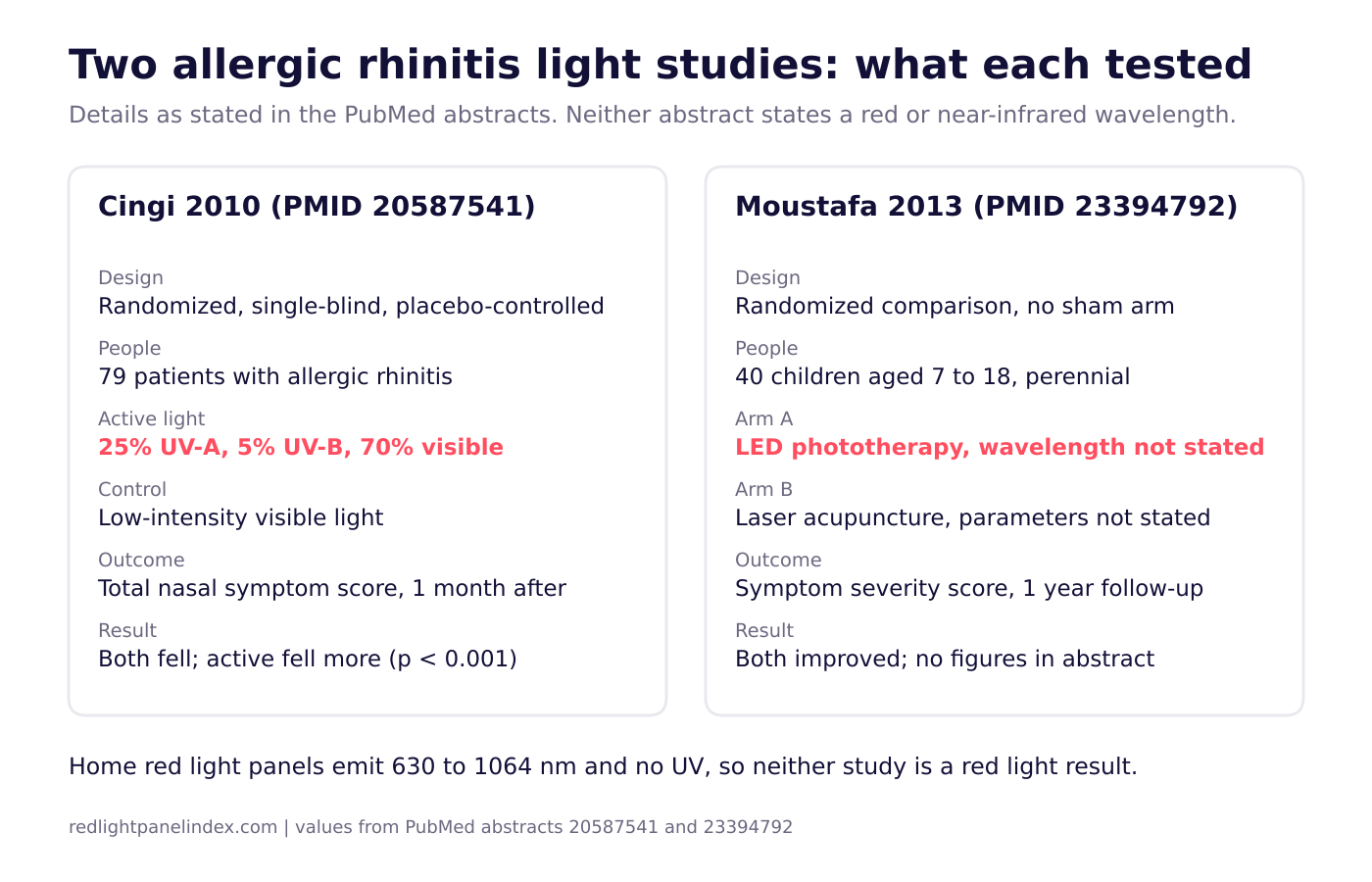
A 2010 randomized, single-blind, placebo-controlled trial in 79 people with allergic rhinitis found that nasal symptom scores fell further with a light mix of 25% UV-A, 5% UV-B and 70% visible light than with low-intensity visible light (PMID 20587541). A 2013 study in 40 children reported that symptoms improved with both LED phototherapy and laser acupuncture, with no sham group and no wavelength given in the abstract (PMID 23394792). Neither is a result for red light: the first light was nearly a third ultraviolet, and the second does not say what color its LEDs were.
Choosing a panel? Our ranking of the best red light therapy panels is computed from published, method-labeled specs across 188 devices. For allergic rhinitis, no panel spec matches these trials: one used ultraviolet light that no red or near-infrared panel emits, and the other did not publish a wavelength.
What the studies asked
Allergic rhinitis is the sneezing, itching, runny and blocked nose of hay fever and year-round allergies. Light therapy has been tried for it because ultraviolet phototherapy suppresses immune activity in skin, and dermatology already uses UV for inflammatory skin disease. The 2010 trial by Cingi and colleagues set out to test, in a randomized and placebo-controlled design, whether a mix of UV-A, UV-B and visible light could reduce nasal symptoms.
The 2013 study by Moustafa and colleagues asked a different question: how two light-based treatments compared with each other in children with perennial allergic rhinitis. It was a comparison of LED phototherapy with laser acupuncture, not a test of either against an inactive control.
Who was studied
Cingi 2010. Seventy-nine patients with allergic rhinitis were randomized. The abstract does not give the split between the two arms, and the indexing covers both seasonal and perennial rhinitis.
Moustafa 2013. Forty children and teenagers aged 7 to 18 with perennial allergic rhinitis were randomly divided into two groups. The abstract does not give the number in each group or how the diagnosis was made.
Device and parameters, as stated
Cingi 2010. The active light was a combination of UV-A (25%), UV-B (5%) and visible light (70%). The control group received low-intensity visible light, which the abstract also calls placebo. The abstract does not name a device, give wavelengths for the visible part, describe how the light reached the nose, or report a dose, number of sessions or schedule. Thirty percent of the active light was ultraviolet, and that alone puts this trial outside red light therapy: the panels in this site's database work at 630 to 1064 nm and emit no UV.
Moustafa 2013. One group received LED phototherapy and the other laser acupuncture. The abstract gives no wavelength or color for the LEDs, no laser wavelength or power, no acupuncture points, no session count and no schedule. The children were followed for one year.
Since neither abstract states a red or near-infrared wavelength, this review does not describe either study as a red light trial. Our explainer on red light vs UV phototherapy sets out why UV evidence cannot be borrowed to support a red or near-infrared panel.
What was measured and found
Cingi 2010. The outcome was the total nasal symptom score, assessed before treatment and one month after treatment ended. Scores fell in both groups. The fall in the active group was reported as highly significant compared with placebo (p < 0.001). The abstract gives no group means, no size for the difference and no adverse effects. The authors concluded that phototherapy may be an effective treatment for allergic rhinitis, especially when commonly used drugs are contraindicated or do not work well enough.
Moustafa 2013. The abstract reports a significant improvement in a severity score of symptoms in both groups during follow-up and at its end, with no figures, p-values or named scoring instrument. The authors concluded that both techniques were "equally safe, reliable, non invasive and successful."
Limitations
The light in the controlled trial was not red light. The Cingi result is a result for a UV-containing mix. It cannot show whether the UV fraction, the visible fraction or both produced the effect, and it says nothing about red or near-infrared bands alone.
The control arm improved too. Symptom scores fell with low-intensity visible light as well. That is what a sham-controlled design is for: a symptom score is a self-report, which is the kind of outcome most open to a placebo response, so the comparison that matters is between arms. The trial was single-blind, and the abstract does not say whether the person scoring symptoms was masked.
The size of the effect is unknown from the abstract. A p-value shows the difference was unlikely to be chance. It does not show whether the difference was large enough for a patient to notice.
The child study cannot separate light from expectation or time. With two active treatments and no sham or untreated group, improvement in both arms could reflect the treatments, the natural course of the allergy, seasonal change over a year, or the attention of being in a study. The PEDro database, which rates the methods of physical therapy trials, scores this study 3 out of 10, with no concealed allocation, no blinding of participants, therapists or assessors, and no between-group comparison credited. "Equally successful" here means neither treatment was shown to beat the other, not that either was shown to beat nothing.
Neither abstract reports a dose. Without wavelength, irradiance, session time and session count, there is no protocol to translate to any device, home or clinic. Both studies also used clinic equipment rather than a home LED panel, so even a stated dose would differ from what a panel delivers.
What it means for a home panel
Nothing in these two studies supports pointing a red light panel at your face for hay fever. The one placebo-controlled trial tested ultraviolet light mixed with visible light, which no red or near-infrared panel produces, and the other study tested an LED of unstated color against another active treatment. A home panel used for this purpose would be an untested extrapolation, not a version of either study.
The broader case for light calming inflammation is also thin in people. Our inflammation evidence page grades that question Limited: the mechanism work is extensive in cells and animals, but the only human trial in the site's sources that measured an inflammatory marker enrolled seven people and used a 904 nm laser. Our review of Hamblin's anti-inflammatory mechanisms paper covers the cell and animal side, and none of it was done in nasal tissue.
If you use a panel for another reason and wonder about the nose, three points apply:
- No dose exists for this. Neither study gives one, so the dose calculator can set a session for skin or recovery goals, not for rhinitis.
- Do not seek out UV. The controlled trial's light was 30% ultraviolet under research conditions. A tanning bed or an unlabeled UV lamp is not a substitute, and UV near the eyes and face carries real risks.
- Keep your eyes protected. Facing a bright panel puts light straight into the eyes; see the eye protection guide.
Allergic rhinitis has well-established treatments. Anyone whose symptoms are not controlled should see a clinician, and any light device used alongside treatment is an optional add-on, not a replacement for it.