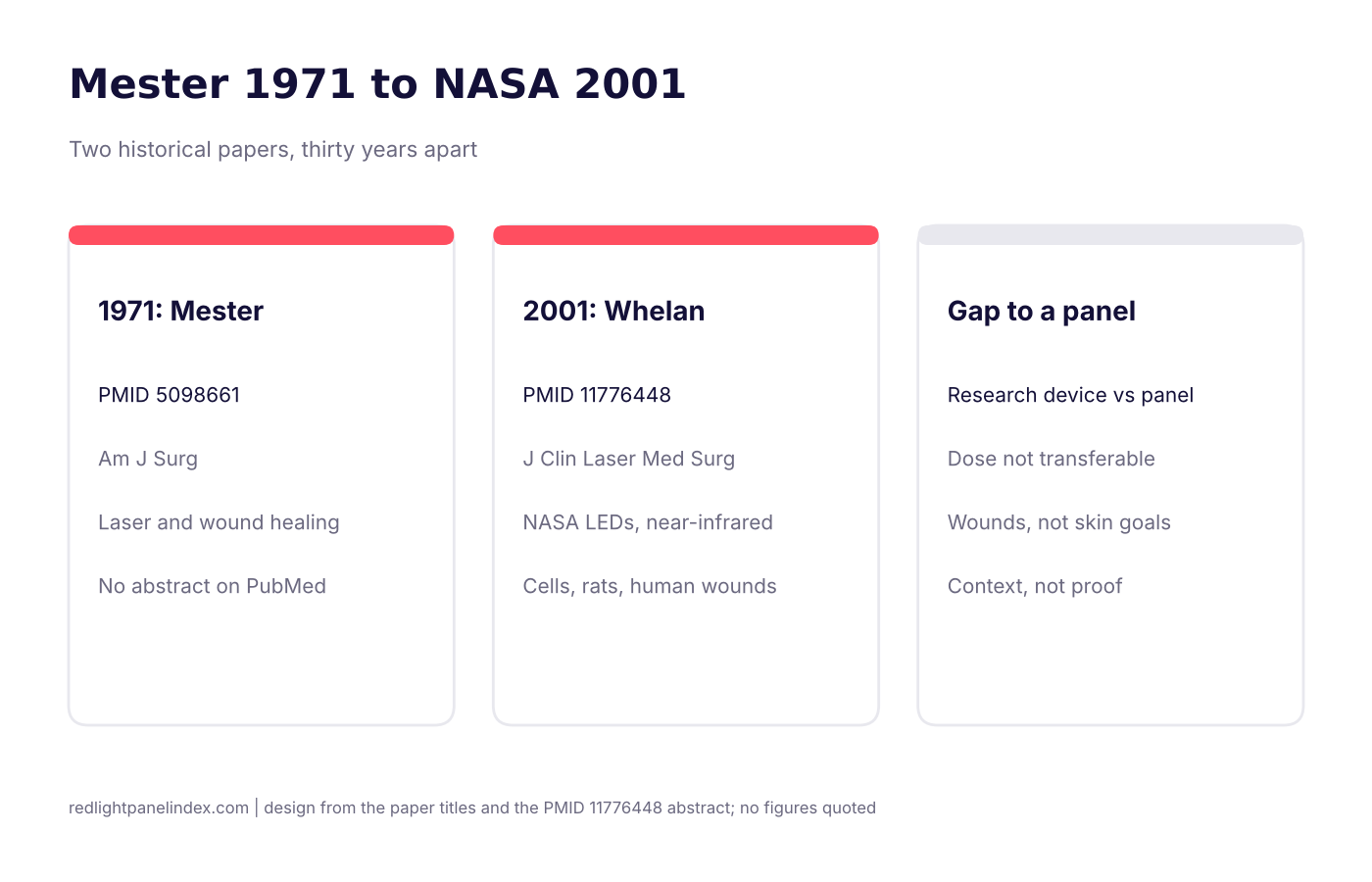
Two papers, thirty years apart, explain why red light therapy exists as a field: a 1971 report that laser light affected wound healing (PMID 5098661) and a 2001 paper from a NASA-linked group testing LEDs on cells, animals and people (PMID 11776448). Both are useful history. Neither is evidence that a home panel works, and this review explains why.
Choosing a panel? Our ranking of the best red light therapy panels is computed from published, method-labeled specs across 188 devices. For history-driven claims about LEDs, the spec that matters is a stated wavelength with a method-labeled irradiance, not a reference to NASA.
What the studies asked
Mester 1971. The paper, "Effect of laser rays on wound healing" by Mester and colleagues, appeared in the American Journal of Surgery (PMID 5098661). From its title and from how our photobiomodulation explainer describes it, the question was whether laser irradiation changes how wounds heal. The explainer notes that PubMed shows no abstract for this paper, so we do not quote any figures from it, and neither should anyone else without reading the full text.
Whelan 2001. The paper, "Effect of NASA light-emitting diode irradiation on wound healing," appeared in the Journal of Clinical Laser Medicine and Surgery (PMID 11776448). Its abstract states the objective as assessing the effects of hyperbaric oxygen and near-infrared light therapy on wound healing. The background explains that LEDs first developed for NASA plant growth experiments were being studied as a way to deliver light into body tissue.
Who or what was studied
The 1971 paper is described in our explainer as laboratory work on wound healing with a laser; we could not read the abstract, so we cannot state the animals, numbers or groups.
The 2001 paper is a mix by design. According to its abstract it reviews and presents new data on LED treatment in cultured cells, in ischemic and diabetic wounds in rat models, and in acute and chronic wounds in humans. That means no single population, and no single sample size, describes it. Each part answers a different question at a different level of evidence, from cell culture at the bottom to human wounds at the top.
Device and parameters
1971: a laser. The title names laser rays, and the explainer ties the work to laser irradiation. Wavelength, power and dose are not available to us from the abstract.
2001: LEDs, used alone or alongside hyperbaric oxygen. The abstract names near-infrared light and NASA-developed LEDs, but this review does not copy wavelength, irradiance or dose figures into the text, because we did not read them in the abstract. The site's explainer summarizes the wavelengths and results the group reported if you want the headline numbers; check them against the paper.
The device gap is the central caveat. A research LED array delivering light to a wound at a known distance is not the same as a consumer panel. Our LED versus laser page explains why laser doses should not be copied directly onto panel sessions: beam geometry, treated area and dose reporting all differ.
What was measured and found
The 1971 abstract is not available, so we do not describe results.
For 2001, the authors concluded that the NASA LEDs, alone or with hyperbaric oxygen, could enhance natural wound healing. That is the authors' own conclusion about their combined body of work, not an independent finding. We are not reporting percentages here because we did not read them in the abstract.
Limitations
- Missing abstract. For 1971 we cannot assess design, size or outcomes.
- Mixed designs in 2001. Cell, animal and human results are blended in one paper, and findings in rats or cultured cells do not transfer automatically to people.
- Combination treatment. Hyperbaric oxygen was part of the question, so a benefit cannot be credited to light alone.
- Age. Both papers predate the now-standard practice of detailed dose reporting and sham-controlled designs.
- Wounds, not skin goals. The subjects were wounds. Wrinkles, muscle soreness or joint pain are different questions with their own evidence pages.
- Authors' conclusions. The 2001 conclusion is the authors' own.
Why the history still matters
Reading these papers in order shows how the vocabulary changed. Early work used the word laser because lasers were the available tool, and the name low-level laser therapy stuck for decades. The NASA-linked work asked a practical question: could cheaper, more durable LED arrays do a similar job? Our photobiomodulation explainer describes how that line of research led to the broader name, which no longer implies that a laser is required.
It also shows how a field can rest on a few famous papers. Citing a 1971 or 2001 paper in a product page is not wrong, but the reader should ask what was actually measured, in what tissue, with what light. For the wound-focused studies that came later, see the wound healing evidence page, and for how coherence and beam shape differ between lasers and LEDs, see the LED versus laser comparison.
What this means for a home panel
The history matters because it answers "why LEDs?" and "why wavelengths in the red and near-infrared?" It does not tell you what a panel on your wall will do.
- Do not buy on the NASA label. A panel citing NASA is citing a research program, not a validated dose. Compare the wavelength and the method-labeled irradiance, as our irradiance explainer describes.
- Work out your own dose. Trial devices and panels differ, so use the dose calculator with your panel's stated figures instead of copying a research protocol.
- Know the wavelength you are buying. Our wavelength guide shows what red and near-infrared bands are used for.
- Do not treat an open wound at home based on a 25-year-old paper. Ask the clinician managing it first.
- For wound questions today, the wound healing evidence page is the better starting point.
Bottom line
Mester's 1971 report is the starting point of the field, and the 2001 NASA paper helped move it from lasers toward LEDs. Both are context. They set up a hypothesis, that red and near-infrared light can influence repair, without establishing a dose, a device or a result for a home panel.